This website uses cookies to enhance your browsing experience and ensure the functionality of our site. For more detailed information about the types of cookies we use and how we protect your privacy, please visit our Privacy Information page.
×
Cookie Settings
This website uses different types of cookies to enhance your experience. Please select your preferences below:
> Gobiiformes (Gobies) > Gobiidae (Gobies) > Gobiinae
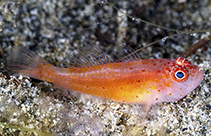
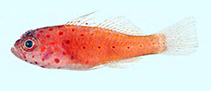
Etymology: Trimma:Greek, trimma, -atos = something crushed (Ref. 45335); halonevum:Name from 'halo nevus', a skin condition characterized by pale spots with a red centre, referring to the similar spots on the body of the new species (the name was given by Dr. Irving Klinghofer, a Toronto physician). More on author: Winterbottom.
Umwelt: Milieu / Klimazone / Tiefenbereich / Verbreitungsgebiet Ökologie
seewasser demersal; tiefenbereich 1 - 45 m (Ref. 118045). Tropical
Indo-Pacific: Maldives and Christmas Island; Indonesia, Philippines, Papua New Guinea, Solomon Islands, New Hebrides, and, apparently, Society Islands.
Größe / Gewicht / Alter
Geschlechtsreife: Lm? range ? - ? cm Max length : 3.0 cm SL Männchen/unbestimmt; (Ref. 48637)
Rückenflossenstacheln (insgesamt) : 6 - 7; Rückenflossenweichstrahlen (insgesamt) : 8 - 10; Afterflossenstacheln: 1; Afterflossenweichstrahlen: 8. Distinguished by the following characters: reddish orange to yellow orange with small pale edged red spots widely scattered on head and body; longitudinal scale series 23-25; predorsal scales 6-10; absence of scales on cheek; upper opercle with 2-3 cycloid scales; depth of body about 3.3 in SL (Ref. 90102). Body shape (shape guide): fusiform / normal; Cross section: oval.
Inhabits coastal reefs on mixed algae and coral to about 20 meters depth (Ref. 48637). Minimum depth from Ref. 58018.
Winterbottom, R., 2000. Four new species of Trimma (Gobiidae), from the Indian and western Pacific Oceans. aqua, J. Ichthyol. Aquat. Biol. 4(2):57-66. (Ref. 118045)
IUCN Rote Liste Status (Ref. 130435: Version 2025-2 (Global))
Bevorzugte Temperatur (Ref. 123201): 27.1 - 29, mean 28.1 °C (based on 396 cells).
Phylogenetischer Diversitätsindex (Ref. 82804): PD50 = 0.5000 [Uniqueness, from 0.5 = low to 2.0 = high].
Bayesian length-weight: a=0.01023 (0.00477 - 0.02194), b=3.01 (2.83 - 3.19), in cm total length, based on LWR estimates for this (Sub)family-body shape (Ref. 93245).
Widerstandsfähigkeit (Ref. 120179): hoch, Verdopplung der Population dauert weniger als 15 Monate. (Preliminary K or Fecundity.).
Anfälligkeit der Fischerei (Ref. 59153): Low vulnerability (10 of 100). 🛈