



Hochladen Photos und videos
Bilder | Google Bild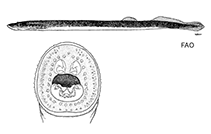 Mordacia praecox
Photo von FAO
Bilder | Google Bild
Photo von FAO
Klassifizierung / Names Namen | Synonyme | Catalog of Fishes(Gattung, Arten) | ITIS | CoL | WoRMS | Cloffa
> Petromyzontiformes (Lampreys) > Mordaciidae (Southern topeyed lampreys)
Etymology: Mordacia: Etymology not explained, likely derived from mordax (L.), biting, referring to specific name of M. mordax (See ETYFish); praecox: Latin for premature, referring to its “precocious nature of sexual development,” wherein newly metamorphosed ammocoetes become sexually mature without first reaching their adult parasitic phase (See ETYFish).
Etymology: Mordacia: Etymology not explained, likely derived from mordax (L.), biting, referring to specific name of M. mordax (See ETYFish); praecox: Latin for premature, referring to its “precocious nature of sexual development,” wherein newly metamorphosed ammocoetes become sexually mature without first reaching their adult parasitic phase (See ETYFish).
Taxonomic Remarks
No study has specifically described ammocoetes of this species. Based on the
general statement in Potter (1968) and Potter et al. (1968) that ammocoetes of M. mordax are indistinguishable from those of M. praecox, the reader is advised to refer to the description of ammocoetes of M. mordax (Ref. 89241).
Umwelt: Milieu / Klimazone / Tiefenbereich / Verbreitungsgebiet Ökologie
; süßwasser demersal; potamodrom (Ref. 51243). Temperate
Verbreitung Territorien | FAO Gebiete | Ökosysteme | Vorkommen | Punkt Karte | Einführungen | Faunafri
Oceania: known only from the Moruya and Tuross Rivers in southern New South Wales, Australia.
Größe / Gewicht / Alter
Geschlechtsreife: Lm ? range ? - ? cm
Max length : 50.0 cm SL Männchen/unbestimmt; (Ref. 44894); common length : 37.5 cm SL Männchen/unbestimmt; (Ref. 44894)
Max length : 50.0 cm SL Männchen/unbestimmt; (Ref. 44894); common length : 37.5 cm SL Männchen/unbestimmt; (Ref. 44894)
Kurzbeschreibung Bestimmungsschlüssel | Morphologie | Morphometrie
Adults: 10.2-172 mm TL; body proportions, as percentage of TL: 9.4-12.6 prebranchial length, 8.2-9.9 branchial length, 59.6-64.2 trunk length, 16.5-20.4 tail length, 1.3-1.5 eye length and 5.4-8.4 disc length; no gular pouch develops; urogenital papilla not prominent in mature adults; trunk myomeres, 85-93. Adult dentition: 2 triangular supraoral laminae each with 3 unicuspid teeth, 1 per apex (exceptionally, 4 unicuspid teeth per supraoral lamina); Infraoral lamina, 9-10 unicuspid teeth of various size (these teeth become greatly enlarged with sexual maturation); 5-6 endolaterals on each side; endolateral formula, typically 2-2-3-3-4-3 or 2-2-3-3-4-4 in immature individuals and 1-1-1-1-1 or 1-1-1-1-1-1 in mature individuals; 1 row of anterials; first row of anterials, 2 unicuspid teeth flanked on either side by one bicuspid tooth in immature individuals and 4 unicuspid teeth in mature individuals; 1-2 rows of exolaterals on each side; 1 row of posterials; first row of posterials, 16 posterial plates, the three lateralmost tricuspid and the internal ones bicuspid in immature individuals and 13 unicuspid teeth in mature individuals; transverse lingual lamina w-shaped with numerous unicuspid teeth of various size, the middle apex one being intermediate in size and the two bottom apex ones being largest, while the rest are small; longitudinal lingual laminae hook-shaped each with an undetermined number of unicuspid teeth. Body coloration (live) of mature adults with dark blue dorsal surface, occasionally with a green tinge, ventral surface of males mottled gray and ventral surface of females yellowish; extent of caudal fin pigmentation, 25% to <75%; caudal fin shape, spade-like; oral papillae, 33-48 (Ref. 89241).
Body shape (shape guide): eel-like.
Body shape (shape guide): eel-like.
Inhabits freshwater streams, a non-parasitic lamprey that spends its entire life cycle in freshwater. Ammocoetes burrow in soft substrates, phase lasts about 3 years; metamorphosis usually occurs between October and November. Presumed to migrate upstream around April, and spawns in late winter or spring (Ref. 44894). Fecundity, 326-675
eggs/female (Ref. 89241).
Lebenszyklus und Paarungsverhalten Geschlechtsreife | Fortpflanzung | Ablaichen | Eier | Fruchtbarkeit | Larven
Hauptreferenz
Laden Sie Ihre Referenzen hoch | Referenzen | Koordinator | Partner
Allen, G.R., 1989. Freshwater fishes of Australia. T.F.H. Publications, Inc., Neptune City, New Jersey. (Ref. 5259)
IUCN Rote Liste Status (Ref. 130435: Version 2025-2 (Global))
stark gefährdet (EN) (A2b; B2ab(v)); Date assessed: 04 February 2019
CITES
Not Evaluated
Bedrohung für Menschen
Harmless
Nutzung durch Menschen
Fischereien: nicht kommerziell
FAO - Publication: search | FishSource |
Mehr Information
Trophische Ökologie
Lebensmittel (Beutetiere)
Nahrungszusammensetzung
Nahrungsaufnahme
Lebensmittelrationen
Räuber
Lebensmittel (Beutetiere)
Nahrungszusammensetzung
Nahrungsaufnahme
Lebensmittelrationen
Räuber
Ökologie
Ökologie
Ökologie
Populationsdynamik
Wachstumsparameter
Max. Alter/Größen
Länge-Gewicht-Rel.
Länge-Länge-Verhältnis.
Längenhäufigkeiten
Massenkonvertierung
Rekrutierung
Dichte
Wachstumsparameter
Max. Alter/Größen
Länge-Gewicht-Rel.
Länge-Länge-Verhältnis.
Längenhäufigkeiten
Massenkonvertierung
Rekrutierung
Dichte
Lebenszyklus
Fortpflanzung
Geschlechtsreife
Reifung/Kiemen rel.
Fruchtbarkeit
Ablaichen
Laichaggregationen
Eier
Eientwicklung
Larven
Larven Pop.Dyn.
Fortpflanzung
Geschlechtsreife
Reifung/Kiemen rel.
Fruchtbarkeit
Ablaichen
Laichaggregationen
Eier
Eientwicklung
Larven
Larven Pop.Dyn.
Physiologie
Körperliche Zusammensetzung
Nährstoffe
Sauerstoffverbrauch
Schwimmart
Schwimmgeschwindigkeit
Visuelle Pigmente
Fischgeräusche
Krankheiten und Parasiten
Toxizität (LC50s)
Körperliche Zusammensetzung
Nährstoffe
Sauerstoffverbrauch
Schwimmart
Schwimmgeschwindigkeit
Visuelle Pigmente
Fischgeräusche
Krankheiten und Parasiten
Toxizität (LC50s)
Menschenbezogen
Aquakultur-Systeme
Aquakultur Profile
Zuchtlinien
Ciguatera-Fälle
Briefmarken, Münzen, Verschiedenes.
Aquakultur-Systeme
Aquakultur Profile
Zuchtlinien
Ciguatera-Fälle
Briefmarken, Münzen, Verschiedenes.
Tools
E-Book | Feldführer | Bestimmungsschlüssel | Längenhäufigkeits Tool | Lebensdaten Tool | Punkt Karte |
Catch-MSY |
Zusatzinformationen
Download XML
Zusammenfassung | Punktdaten | Namen | Photos
Internet Quellen
AFORO (otoliths) | Aquatic Commons | BHL | Cloffa | Websites from users | FishWatcher Einträge suchen | CISTI | Catalog of Fishes: Gattung, Arten | DiscoverLife | ECOTOX | FAO - Publication: search | Faunafri | Fishipedia | Fishtrace | GloBI | Google Books | Google Scholar | Google | IGFA World Record | OneZoom | Open Tree of Life | Otolith Atlas of Taiwan Fishes | PubMed | Reef Life Survey | Socotra Atlas | TreeBase | Tree of Life | Wikipedia: Gehe zu, Suchen | World Records Freshwater Fishing | Zoobank | Zoologischer Rekord
Schätzungen auf der Grundlage von Modellen
Phylogenetischer Diversitätsindex (Ref. 82804): PD50 = 0.7500 [Uniqueness, from 0.5 = low to 2.0 = high].
Bayesian length-weight: a=0.00102 (0.00046 - 0.00225), b=3.06 (2.88 - 3.24), in cm total length, based on all LWR estimates for this body shape (Ref. 93245).
Trophische Ebene (Ref. 69278): 4.4 ±0.8 se; based on size and trophs of closest relatives
Widerstandsfähigkeit (Ref. 120179): niedrig, Verdopplung der Population dauert 4,5 - 14 Jahre. (Semelparous species, assuming tm (= tmax) > 4).