



Enteromius venustus (Bailey, 1980)
Red Pangani barb
Carica il tuo foto e Video
Immagini | Google image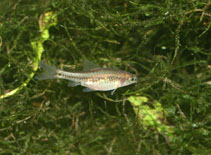 Enteromius venustus
Female Immagine di Grimm, M.
Immagini | Google image
Female Immagine di Grimm, M.
Classificazione / Nomi Nomi Comuni | Sinonimi | Catalog of Fishes(Genere, Specie) | ITIS | CoL | WoRMS | Cloffa
> Cypriniformes (Carps) > Cyprinidae (Minnows or carps) > Smiliogastrinae
Etymology: Enteromius: Greek, enteron = intestine + Greek, myo, mys = muscle (Ref. 45335); venustus: From the latin for pretty, and alludes to the attractive appearance of this small fish in life (Ref. 48244).
Etymology: Enteromius: Greek, enteron = intestine + Greek, myo, mys = muscle (Ref. 45335); venustus: From the latin for pretty, and alludes to the attractive appearance of this small fish in life (Ref. 48244).
Ambiente: milieu / zona climatica / distribuzione batimetrica / gamma di distribuzione Ecologia
; acqua dolce benthopelagico. Tropical
Distribuzione Territories | Aree FAO | Ecosistemi | Presenze | Mappa dei ritrovamenti | Introduzioni | Faunafri
Dimensione / Peso / Età
Breve descrizione Chiavi di identificazione | Morfologia | Morfometria
Body moderately compressed, its depth equal to or a little greater than the length of the head (Ref. 48244). Snout rounded, shorter than the eye diameter (Ref. 48244). Anterior barbel short, posterior barbel longer, extending as far as the vertical to the mid-point of the pupil of the eye (Ref. 48244). Teeth with recurved crowns; the teeth formula 2.3.5-5.3.2 (Ref. 48244). Well developed sunken pit-lines are present on the cheek and operculum and on the dorsal surface of the head; there may be as many as 12 lines between the preoperculum and the anterior orbital margin (Ref. 48244). Scales have radiate striae (Ref. 48244): 22-25 lateral line scales, 4½-5 scales between the dorsal fin origin and lateral line, 1½-2 scales between lateral line and pelvic insertion (Ref. 48244). Lateral line complete (Ref. 48244). Dorsal fin is on or slightly in advance of the perpendicular to the pelvic fin insertion; III/7 or III/8 rays, the third unbranched ray not ossified and flexible (Ref. 48244). Anal fin has III/5 rays (Ref. 48244). The pectoral fin does not reach the base of the pelvic fin (Ref. 48244). The caudal peduncle is relative slender, its depth 1.36 to 1.76 times in its length (Ref. 48244). The post Weberian vertebral count is 27 (Ref. 48244). The upper flanks, caudal peduncle and caudal fin are orange-red colored in life (Ref. 48244). A dark midlateral stripe of varying intensity runs from the tip of the snout to the base of the caudal fin; a small, rounded black spot is at the base of the caudal fin and patches of pigment about the origin of the dorsal and on the base of the anal fin (Ref. 48244).
Body shape (shape guide): fusiform / normal; Cross section: compressed.
Body shape (shape guide): fusiform / normal; Cross section: compressed.
Type specimens of Barbus venustus were caught in shallow water among open stands of the emergent grass Paspalidium geminatum in the Nyumba ya Mungu reservoir; it was taken in July and August at the onset of the dry season but with the lake level still close to its maximum (Ref. 48244). Gut content includes cladocerans, insect fragments, plant material and fine sand (Ref. 48244).
Ciclo vitale e comportamento di accoppiamento Maturità | Riproduzione | Deposizione | Uova | Fecondità | Larve
Riferimento principale
Caricare le referenze | Bibliografia | Coordinatore | Collaboratori
Bailey, R.G., 1980. A new species of small Barbus (Pisces, Cyprinidae) from Tanzania, East Africa. Bull. Br. Mus. nat. Hist. (Zool.) 38(3):141-144. (Ref. 48244)
Stato della Lista Rossa IUCN (Ref. 130435: Version 2025-2 (Global))
Data deficient (DD) ; Date assessed: 31 January 2006
CITES
Not Evaluated
Minaccia per l'uomo
Harmless
Usi umani
Pesca: di nessun interesse
FAO - Publication: search | FishSource |
Informazioni ulteriori
Ecologia trofica
Articoli alimentari (prede)
Alimentazione
Consumo di cibo
Razioni alimentari
Predatori
Articoli alimentari (prede)
Alimentazione
Consumo di cibo
Razioni alimentari
Predatori
Ecologia
Ecologia
Ecologia
Dinamica della popolazione
Parametri di crescita
Età massima / dimensioni massime
Rapporto lunghezza-peso.
Lunghezza-lunghezza rel.
Lunghezza-frequenze
Conversione di massa
Reclutamento
Abbondanza
Parametri di crescita
Età massima / dimensioni massime
Rapporto lunghezza-peso.
Lunghezza-lunghezza rel.
Lunghezza-frequenze
Conversione di massa
Reclutamento
Abbondanza
Ciclo di vita
Riproduzione
Maturità
Maturità/Gli occhielli sono relativi.
Fecondità
Deposizione
Aggregazioni riproduttive
Uova
Sviluppo delle uova
Larve
Dinamica popolazioni larvali
Riproduzione
Maturità
Maturità/Gli occhielli sono relativi.
Fecondità
Deposizione
Aggregazioni riproduttive
Uova
Sviluppo delle uova
Larve
Dinamica popolazioni larvali
Anatomia
Area branchiale
Cervello
Otolite
Area branchiale
Cervello
Otolite
Fisiologia
Composizione corporea
Nutrienti
Consumo di ossigeno
Tipo di nuoto
Velocità di nuoto
Pigmenti visivi
Suono del pesce
Malattie e parassiti
Tossicità (LC50)
Composizione corporea
Nutrienti
Consumo di ossigeno
Tipo di nuoto
Velocità di nuoto
Pigmenti visivi
Suono del pesce
Malattie e parassiti
Tossicità (LC50)
Genetica
Genome
Genetica
Eterozigosi
Ereditarietà
Diversità genetica
Genome
Genetica
Eterozigosi
Ereditarietà
Diversità genetica
Legato all'uomo
Sistemi di acquacoltura
Profili di acquacoltura
Varietà
Casi di Ciguatera
Francobolli, monete, materiale vario.
Sistemi di acquacoltura
Profili di acquacoltura
Varietà
Casi di Ciguatera
Francobolli, monete, materiale vario.
Strumenti
Libro elettronico | Giuda pratica | Generatore frequenze di lunghezza | Strumento Parametri Biologici | Mappa dei ritrovamenti |
Cattura-MSY |
Rapporti speciali
Controllo della manutenzione dell'acquario | Verificare la presenza di schede informative sulle specie | Verifica delle schede informative sull'acquacoltura
Scarica XML
Fonti Internet
AFORO (otoliths) | Aquatic Commons | BHL | Cloffa | Websites from users | Check FishWatcher | CISTI | Catalog of Fishes: Genere, Specie | DiscoverLife | ECOTOX | FAO - Publication: search | Faunafri | Fishipedia | Fishtrace | GloBI | Google Books | Google Scholar | Google | IGFA World Record | OneZoom | Open Tree of Life | Otolith Atlas of Taiwan Fishes | PubMed | Reef Life Survey | Socotra Atlas | TreeBase | Tree of Life | Wikipedia: Go, ricerca | World Records Freshwater Fishing | Record zoologico
Stime basate su modelli
Indice di diversità filogenetica (Fonte Biblio. 82804): PD50 = 0.5000 [Uniqueness, from 0.5 = low to 2.0 = high].
Bayesian length-weight: a=0.01122 (0.00521 - 0.02417), b=3.01 (2.84 - 3.18), in cm total length, based on LWR estimates for this Genus-body shape (Ref. 93245).
Livello trofico (Fonte Biblio. 69278): 3.0 ±0.3 se; based on size and trophs of closest relatives
Resilienza (Fonte Biblio. 120179): Alto, tempo minimo di raddoppiamento della popolazione meno di 15 mesi (tm<1).