



Hochladen Photos und videos
Google Bild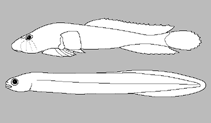 No image available for this species;
drawing shows typical species in Gobiesocidae.
Google Bild
drawing shows typical species in Gobiesocidae.
Klassifizierung / Names Namen | Synonyme | Catalog of Fishes(Gattung, Arten) | ITIS | CoL | WoRMS | Cloffa
> Gobiesociformes (Clingfishes) > Gobiesocidae (Clingfishes and singleslits) > Gobiesocinae
Etymology: Tomicodon: Greek, tomikos, -e, -on = that is useful for cutting (Ref. 45335); abuelorum: From the Spanish root abuel meaning grandparent and named in honor of Szelistowski's grandparents Irma Drescher and Martha and Telford Walker (Ref. 42103).
Eponymy: Abuelorum is a Latinized derivation from the Spanish word abuel, which means grandparent, and here refers to the author’s grandparents: Irma Drescher and Martha and Telford Walker. (Ref. 128868), visit book page.
Etymology: Tomicodon: Greek, tomikos, -e, -on = that is useful for cutting (Ref. 45335); abuelorum: From the Spanish root abuel meaning grandparent and named in honor of Szelistowski's grandparents Irma Drescher and Martha and Telford Walker (Ref. 42103).
Eponymy: Abuelorum is a Latinized derivation from the Spanish word abuel, which means grandparent, and here refers to the author’s grandparents: Irma Drescher and Martha and Telford Walker. (Ref. 128868), visit book page.
Umwelt: Milieu / Klimazone / Tiefenbereich / Verbreitungsgebiet Ökologie
seewasser; brackwasser demersal. Tropical; 26°C - 30°C (Ref. 42103)
Verbreitung Territorien | FAO Gebiete | Ökosysteme | Vorkommen | Punkt Karte | Einführungen | Faunafri
Eastern Central Pacific: Costa Rica.
Größe / Gewicht / Alter
Kurzbeschreibung Bestimmungsschlüssel | Morphologie | Morphometrie
Rückenflossenstacheln (insgesamt) : 0; Rückenflossenweichstrahlen (insgesamt) : 10 - 12; Afterflossenstacheln: 0; Afterflossenweichstrahlen: 8 - 10; Wirbelzahl: 29 - 31. 4 (4-5) pairs of trifid incisors in upper jaw, 4 pairs in lower jaw; anus markedly closer to anal fin origin than to rear of disc; dorsal-caudal distance forward passing tip of, usually extending to about middle of, pectoral fin; margin of anterior nostril without dermal flap (Ref. 42103). Nearly transparent, light olive; body markings quite variable in intensity, ranging from dark and distinct to light and indistinct, sometimes giving an overall mottled appearance (Ref. 42103).
Body shape (shape guide): elongated.
Body shape (shape guide): elongated.
Facultative air-breathing in the genus (Ref. 126274); Found in areas with mangrove prop roots, usually attached to, or moving about and feeding from, root surfaces at high tide (Ref. 42103). Stomach contents contained barnacle cirri and barnacle cyprid larvae, Sphaeroma peruvianum, small oysters and other bivalves, amphipods, and harpacticoid copepods (Ref. 42103).
Lebenszyklus und Paarungsverhalten Geschlechtsreife | Fortpflanzung | Ablaichen | Eier | Fruchtbarkeit | Larven
Hauptreferenz
Laden Sie Ihre Referenzen hoch | Referenzen | Koordinator : Williams, Jeffrey T. | Partner
Szelistowski, W.A., 1990. A new clingfish (Teleostei: Gobiesocidae) from the mangroves of Costa Rica, with notes on its ecology and early development. Copeia 1990(2):500-507. (Ref. 42103)
IUCN Rote Liste Status (Ref. 130435: Version 2025-2 (Global))
stark gefährdet (EN) (B1ab(i,iii)); Date assessed: 25 May 2007
CITES
Not Evaluated
Bedrohung für Menschen
Harmless
Nutzung durch Menschen
FAO - Publication: search | FishSource |
Mehr Information
Trophische Ökologie
Lebensmittel (Beutetiere)
Nahrungszusammensetzung
Nahrungsaufnahme
Lebensmittelrationen
Räuber
Lebensmittel (Beutetiere)
Nahrungszusammensetzung
Nahrungsaufnahme
Lebensmittelrationen
Räuber
Populationsdynamik
Wachstumsparameter
Max. Alter/Größen
Länge-Gewicht-Rel.
Länge-Länge-Verhältnis.
Längenhäufigkeiten
Massenkonvertierung
Rekrutierung
Dichte
Wachstumsparameter
Max. Alter/Größen
Länge-Gewicht-Rel.
Länge-Länge-Verhältnis.
Längenhäufigkeiten
Massenkonvertierung
Rekrutierung
Dichte
Lebenszyklus
Fortpflanzung
Geschlechtsreife
Reifung/Kiemen rel.
Fruchtbarkeit
Ablaichen
Laichaggregationen
Eier
Eientwicklung
Larven
Larven Pop.Dyn.
Fortpflanzung
Geschlechtsreife
Reifung/Kiemen rel.
Fruchtbarkeit
Ablaichen
Laichaggregationen
Eier
Eientwicklung
Larven
Larven Pop.Dyn.
Anatomie
Kiemenoberfläche
Gehirn
Otolith
Kiemenoberfläche
Gehirn
Otolith
Physiologie
Körperliche Zusammensetzung
Nährstoffe
Sauerstoffverbrauch
Schwimmart
Schwimmgeschwindigkeit
Visuelle Pigmente
Fischgeräusche
Krankheiten und Parasiten
Toxizität (LC50s)
Körperliche Zusammensetzung
Nährstoffe
Sauerstoffverbrauch
Schwimmart
Schwimmgeschwindigkeit
Visuelle Pigmente
Fischgeräusche
Krankheiten und Parasiten
Toxizität (LC50s)
Genetik
Genom
Genetik
Heterozygotie
Vererbbarkeit
Genetische Vielfalt
Genom
Genetik
Heterozygotie
Vererbbarkeit
Genetische Vielfalt
Menschenbezogen
Aquakultur-Systeme
Aquakultur Profile
Zuchtlinien
Ciguatera-Fälle
Briefmarken, Münzen, Verschiedenes.
Aquakultur-Systeme
Aquakultur Profile
Zuchtlinien
Ciguatera-Fälle
Briefmarken, Münzen, Verschiedenes.
Tools
Zusatzinformationen
Download XML
Zusammenfassung | Punktdaten | Namen | Photos
Internet Quellen
AFORO (otoliths) | Aquatic Commons | BHL | Cloffa | Websites from users | FishWatcher Einträge suchen | CISTI | Catalog of Fishes: Gattung, Arten | DiscoverLife | ECOTOX | FAO - Publication: search | Faunafri | Fishipedia | Fishtrace | GloBI | Google Books | Google Scholar | Google | IGFA World Record | OneZoom | Open Tree of Life | Otolith Atlas of Taiwan Fishes | PubMed | Reef Life Survey | Socotra Atlas | TreeBase | Tree of Life | Wikipedia: Gehe zu, Suchen | World Records Freshwater Fishing | Zoobank | Zoologischer Rekord
Schätzungen auf der Grundlage von Modellen
Phylogenetischer Diversitätsindex (Ref. 82804): PD50 = 0.5000 [Uniqueness, from 0.5 = low to 2.0 = high].
Bayesian length-weight: a=0.00617 (0.00249 - 0.01527), b=3.15 (2.93 - 3.37), in cm total length, based on LWR estimates for this (Sub)family-body shape (Ref. 93245).
Trophische Ebene (Ref. 69278): 3.3 ±0.42 se; based on food items.
Widerstandsfähigkeit (Ref. 120179): hoch, Verdopplung der Population dauert weniger als 15 Monate. (Preliminary K or Fecundity.).