This website uses cookies to enhance your browsing experience and ensure the functionality of our site. For more detailed information about the types of cookies we use and how we protect your privacy, please visit our Privacy Information page.
×
Cookie Settings
This website uses different types of cookies to enhance your experience. Please select your preferences below:
Indo-Pacific: Red Sea and East Africa to the Hawaiian, Marquesas and Ducie islands, north to southern Japan, south to Lord Howe Island (Ref. 1602); exxcluding Oman and Persian Gulf (Ref. 86689). Eastern Central Pacific: Galápagos Islands.
ขนาด / น้ำหนัก / อายุ
วัยเจริญพันธุ์: Lm? range ? - ? cm Max length : 60.0 cm TL เพศผู้/กระเทย; (Ref. 9808); อายุสูงสุดที่ได้รายงาน: 25 ปี (Ref. 52229)
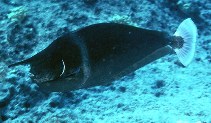
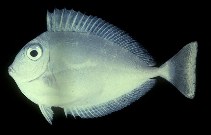
เงี่ยงครีบหลัง (รวม) : 6; ก้านครีบอ่อนที่หาง (รวม) : 27 - 29; เงี่ยงครีบก้น: 2; ก้านครีบอ่อนที่ก้น: 27 - 30. This species is distinguished by the following characters: body moderately deep and compressed, its depth 2.6 to 3 times in standard length (SL) (reported greatest depth of body in subadults at 2.3 in SL, Ref. 90102); dorsal profile of body uniformly convex; adults with a median, broad-based, tapering, horn-like projection extending directly anteriorly from snout at level of lower part of eye to more than 1/2 head length in front of mouth (first developing as a bump on forehead of young of about 10 cm SL; dorsal profile of snout from upper lip to base of horn very short, curved, and nearly vertical; mouth small; teeth small, spatulate, with denticulate edges, about 50 in each jaw; a continuous unnotched D VI,27-29; A II,27-30; pectoral-fin rays 15-17; pelvic fins I,3; caudal fin slightly rounded, without a filament from each corner; 2 bony plates on each side of caudal peduncle, developing moderate keels with age; colour of body olivaceous grey-brown to light grey, usually with vertical dark brown lines on body which break into small spots dorsally and ventrally; some individuals only with small dark spots; head with small dark brown spots or short irregular lines which become long and oblique on horn (dark markings on one pale phase may be faint or absent; in another phase the anterior third of the body may be distinctly paler than the rest); caudal fin whitish with a large diffuse dark blotch centrobasally in fin (Ref. 9808). Body shape (shape guide): fusiform / normal; Cross section: compressed.
Inhabit mid-waters along steep outer lagoon and seaward reef drop-offs. Also found along rocky shores (Ref. 30573, 48637). Benthopelagic (Ref. 58302). Usually in small groups but form large schools in oceanic locations or on reefs subject to strong currents (Ref. 48637). Juveniles and subadults feed on benthic algae; adults feed on zooplankton. Pair spawning has been observed. Caught with nets (Ref. 30573). Minimum depth reported taken from Ref. 128797.
อุณหภูมิที่ต้องการ (อ้างอิง 123201): 24.3 - 29, mean 27.8 °C (based on 1558 cells).
ดัชนีความหลากหลายทางวิวัฒนาการ (อ้างอิง 82804): PD50 = 0.5000 [Uniqueness, from 0.5 = low to 2.0 = high].
Bayesian length-weight: a=0.02089 (0.01324 - 0.03296), b=2.99 (2.86 - 3.12), in cm total length, based on LWR estimates for this species & Genus-body shape (Ref. 93245).
ระดับชั้นอาหาร (อ้างอิง 69278): 2.2 ±0.15 se; based on food items.
Generation time: 2.7 ( na - na) years. Estimated as median ln(3)/K based on 1 growth studies.