



Divandu albimarginatus Lamboj & Snoeks, 2000
Hochladen Photos und videos
Bilder | Google Bild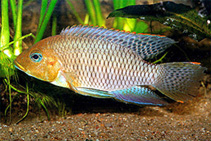 Divandu albimarginatus
Photo von AquaNet
Bilder | Google Bild
Photo von AquaNet
Klassifizierung / Names Namen | Synonyme | Catalog of Fishes(Gattung, Arten) | ITIS | CoL | WoRMS | Cloffa
> Cichliformes (Cichlids, convict blennies) > Cichlidae (Cichlids) > Incertae sedis
Etymology: Divandu: Vernacular name used in Mayombe, Congo; albimarginatus: From the white margin on the lower edge of the caudal fin in preserved specimens; an adjective.
Etymology: Divandu: Vernacular name used in Mayombe, Congo; albimarginatus: From the white margin on the lower edge of the caudal fin in preserved specimens; an adjective.
Umwelt: Milieu / Klimazone / Tiefenbereich / Verbreitungsgebiet Ökologie
; süßwasser pelagisch. Tropical
Verbreitung Territorien | FAO Gebiete | Ökosysteme | Vorkommen | Punkt Karte | Einführungen | Faunafri
Africa: Kouilou-Niari and Loeme-Loukene basins(Republic of Congo), Nyanga and upper Ngounie basins and the Ogowe River (Gabon) (Ref. 81260).
Größe / Gewicht / Alter
Kurzbeschreibung Bestimmungsschlüssel | Morphologie | Morphometrie
Rückenflossenstacheln (insgesamt) : 13 - 16; Rückenflossenweichstrahlen (insgesamt) : 9 - 12; Afterflossenstacheln: 3; Afterflossenweichstrahlen: 7 - 8; Wirbelzahl: 24 - 25. Diagnosis: relatively deep-bodied (Ref. 52307, 81260), particularly so in large specimens (depth 27.8-40.2% SL)(Ref. 8160). Head short (HL 31.9-37.2% SL); snout generally shorter than postorbital length; ascending process of premaxilla about one third longer than dentigerous arm; outer and inner row teeth in oral jaws unicuspid (Ref. 81260). Laterosensory system in the lachrymal bone with 5 openings (Ref. 45129, 52307, 81260). Infraorbital series complete (lachrymal bone and 4 other)(Ref. 45129, 81260). First pelvic fin ray longest in adults of both sexes (Ref. 45129), usually reaching anus or beyond (Ref. 81260). Pectoral fin somewhat shorter than pelvic; some dorsal and anal rays produced (branched dorsal rays 4-6, branched anal rays 4-5 longest), upper and lower caudal rays also produced in both sexes; caudal peduncle somewhat deeper than long (Ref. 81260). 2.3-3 scales between highest point of upper lateral line (about the 8-9th pored scale) and dorsal fin base; between the last 2-4 pored scale and the dorsal fin base 1 or 1 large and 1 very small scale (Ref. 45129). 12 circumpeduncular scales (Ref. 45129, 81260). Chest scales markedly smaller than flank scales (Ref. 81260). No sexual dimorphism in morphology or coloration (Ref. 45129).
Coloration: base body colour pale brown, cheeks and ventrum somewhat paler; usually 6-7 vertical bars on flanks; opercular spot well marked; reddish black maculae on caudal, soft dorsal and anal fins, often forming distinct bands proximally on the fins (Ref. 81260). Dorsal, anal and pelvic fins (Ref. 81260), and upper (Ref. 52307, 81260) and lower (Ref. 52307) edge of caudal fin, with narrow red margin (Ref. 52307, 81260), caudal fin also with thin white submargin (Ref. 52307). Lower edge of caudal with white margin; metallic (silvery) flush below red margin on soft dorsal fin (Ref. 81260).
Body shape (shape guide): short and / or deep; Cross section: compressed.
Body shape (shape guide): short and / or deep; Cross section: compressed.
Inhabits the middle and lower parts of the river basins; collection sites are in regions with primary or secondary forests. The water is clear with transparency of more than 100 cm, acidity approximately neutral (pH 7-7.5) with low conductivity (50 µS) and temperatures 21-22°C. The species lives syntopically with Chromidotilapia mamonekenei, which is more abundant than D. albimarginatus (Ref. 45129). Feeds on small particles (both animal- and plantbased), detritus and aufwuchs (Ref. 52307). Polygamous, ovophilic, female mouthbrooder (Ref. 81260). Possibly larvophilic (Ref. 52307).
Lebenszyklus und Paarungsverhalten Geschlechtsreife | Fortpflanzung | Ablaichen | Eier | Fruchtbarkeit | Larven
Hauptreferenz
Laden Sie Ihre Referenzen hoch | Referenzen | Koordinator : Kullander, Sven O. | Partner
Lamboj, A. and J. Snoeks, 2000. Divandu albimarginatus, a new genus and species of cichlid (Teleostei: Cichlidae) from Congo and Gabon, Central Africa. Ichthyol. Explor. Freshwat. 11(4):355-360. (Ref. 45129)
IUCN Rote Liste Status (Ref. 130435: Version 2025-2 (Global))
nicht bedroht (LC) ; Date assessed: 16 February 2009
CITES
Not Evaluated
Bedrohung für Menschen
Harmless
Nutzung durch Menschen
FAO - Publication: search | FishSource |
Mehr Information
Trophische Ökologie
Lebensmittel (Beutetiere)
Nahrungszusammensetzung
Nahrungsaufnahme
Lebensmittelrationen
Räuber
Lebensmittel (Beutetiere)
Nahrungszusammensetzung
Nahrungsaufnahme
Lebensmittelrationen
Räuber
Ökologie
Ökologie
Ökologie
Populationsdynamik
Wachstumsparameter
Max. Alter/Größen
Länge-Gewicht-Rel.
Länge-Länge-Verhältnis.
Längenhäufigkeiten
Massenkonvertierung
Rekrutierung
Dichte
Wachstumsparameter
Max. Alter/Größen
Länge-Gewicht-Rel.
Länge-Länge-Verhältnis.
Längenhäufigkeiten
Massenkonvertierung
Rekrutierung
Dichte
Lebenszyklus
Fortpflanzung
Geschlechtsreife
Reifung/Kiemen rel.
Fruchtbarkeit
Ablaichen
Laichaggregationen
Eier
Eientwicklung
Larven
Larven Pop.Dyn.
Fortpflanzung
Geschlechtsreife
Reifung/Kiemen rel.
Fruchtbarkeit
Ablaichen
Laichaggregationen
Eier
Eientwicklung
Larven
Larven Pop.Dyn.
Anatomie
Kiemenoberfläche
Gehirn
Otolith
Kiemenoberfläche
Gehirn
Otolith
Physiologie
Körperliche Zusammensetzung
Nährstoffe
Sauerstoffverbrauch
Schwimmart
Schwimmgeschwindigkeit
Visuelle Pigmente
Fischgeräusche
Krankheiten und Parasiten
Toxizität (LC50s)
Körperliche Zusammensetzung
Nährstoffe
Sauerstoffverbrauch
Schwimmart
Schwimmgeschwindigkeit
Visuelle Pigmente
Fischgeräusche
Krankheiten und Parasiten
Toxizität (LC50s)
Genetik
Genom
Genetik
Heterozygotie
Vererbbarkeit
Genetische Vielfalt
Genom
Genetik
Heterozygotie
Vererbbarkeit
Genetische Vielfalt
Menschenbezogen
Aquakultur-Systeme
Aquakultur Profile
Zuchtlinien
Ciguatera-Fälle
Briefmarken, Münzen, Verschiedenes.
Aquakultur-Systeme
Aquakultur Profile
Zuchtlinien
Ciguatera-Fälle
Briefmarken, Münzen, Verschiedenes.
Tools
Zusatzinformationen
Download XML
Zusammenfassung | Punktdaten | Namen | Photos
Internet Quellen
AFORO (otoliths) | Aquatic Commons | BHL | Cloffa | Websites from users | FishWatcher Einträge suchen | CISTI | Catalog of Fishes: Gattung, Arten | DiscoverLife | ECOTOX | FAO - Publication: search | Faunafri | Fishipedia | Fishtrace | GloBI | Google Books | Google Scholar | Google | IGFA World Record | OneZoom | Open Tree of Life | Otolith Atlas of Taiwan Fishes | PubMed | Reef Life Survey | Socotra Atlas | TreeBase | Tree of Life | Wikipedia: Gehe zu, Suchen | World Records Freshwater Fishing | Zoobank | Zoologischer Rekord
Schätzungen auf der Grundlage von Modellen
Phylogenetischer Diversitätsindex (Ref. 82804): PD50 = 1.0000 [Uniqueness, from 0.5 = low to 2.0 = high].
Bayesian length-weight: a=0.01995 (0.00906 - 0.04395), b=3.01 (2.83 - 3.19), in cm total length, based on all LWR estimates for this body shape (Ref. 93245).
Trophische Ebene (Ref. 69278): 3.3 ±0.3 se; based on size and trophs of closest relatives
Widerstandsfähigkeit (Ref. 120179): hoch, Verdopplung der Population dauert weniger als 15 Monate. (Preliminary K or Fecundity.).