



Waarneming toevoegen in Fish Watcher
| Native range | All suitable habitat | Point map | Year 2050 |

|
| This map was computer-generated and has not yet been reviewed. |
| Eustomias medusa AquaMaps Data sources: GBIF OBIS |
Uploaden van uw Foto's en video's
Google afbeelding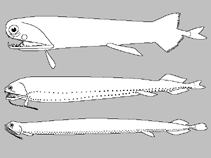 No image available for this species;
drawing shows typical species in Stomiidae.
Google afbeelding
drawing shows typical species in Stomiidae.
Classificatie / Namen Lokale namen | Synoniemen | Catalog of Fishes(Genus, Soort(en)) | ITIS | CoL | WoRMS | Cloffa
> Stomiiformes (Lightfishes and dragonfishes) > Stomiidae (Barbeled dragonfishes) > Melanostomiinae
Etymology: Eustomias: Greek, eu = good + Greek, stoma = mouth (Ref. 45335); medusa: Named for its numerous filaments arising from the distal bulb; noun in apposition.
Eponymy: In Greek mythology, Medusa was a Gorgon whose hair was made up of living snakes. The name is used fancifully for taxa with numerous filaments or barbels. (Ref. 128868), visit book page.
Etymology: Eustomias: Greek, eu = good + Greek, stoma = mouth (Ref. 45335); medusa: Named for its numerous filaments arising from the distal bulb; noun in apposition.
Eponymy: In Greek mythology, Medusa was a Gorgon whose hair was made up of living snakes. The name is used fancifully for taxa with numerous filaments or barbels. (Ref. 128868), visit book page.
Milieu: milieu / Klimaatzone / Diepte / verspreidingsgebied Ecologie
marien bathypelagisch; diepte 0 - 710 m (Ref. 11333). Deep-water
Verspreiding Gebieden | FAO regio's | Ecosystemen | Voorkomen | Verspreidingskaart | Introducties | Faunafri
North Pacific.
Grootte / Gewicht / Leeftijd
Maturiteit: Lm ? range ? - ? cm
Max length : 15.0 cm SL mannelijk / geslacht onbekend; (Ref. 11333); 15.2 cm SL (female)
Max length : 15.0 cm SL mannelijk / geslacht onbekend; (Ref. 11333); 15.2 cm SL (female)
Korte beschrijving Determinatiesleutels | Morfologie | Morfometrie
Dorsale zachte stralen (totaal) : 24; Anale zachte stralen: 38; Wervels: 68. Two terminal bulbs separated by an interspace, 1.4-3.6 times the length of distal bulb. Barbel length mostly 36-65% SL. Terminal filaments 7-10, arising together from distal bulb or from a short stem; all prominent bulblets of various sizes and with side branches distally; 1 filament a little thicker than others and usually forked. Pigment in filament axes variably present or absent. Distal bulb small, ovoid, usually with an abruptly narrowed distal end, 1.5- 3 times proximal-bulb length, which is very small. Axis of stem and between bulbs usually pigmented, variably light or dark, sometimes unpigmented. A black spot almost always present at proximal end of distal bulb; usually partially capping base of bulb. External chevron-shaped or roundish striated areas on stem pigmented or not. Middorsal paired spots between occiput and dorsal-fin origin 8, sometimes 7 (Ref. 11333).
Body shape (shape guide): elongated.
Body shape (shape guide): elongated.
Mesopelagic (Ref. 58302).
Levenscyclus en paargedrag Maturiteit | Voortplanting | Paaien | Eieren | Fecunditeit | Larven
Hoofdreferentie
Upload uw referenties | Referenties | Coördinator | Medewerkers
Gibbs, R.H. Jr., T.A. Clarke and J.R. Gomon, 1983. Taxonomy and distribution of the stomioid fish genus Eustomias (Melanostomiidae), I: subgenus Nominostomias. Smithson. Contrib. Zool. 380:139 p. (Ref. 11333)
Status op de Rode Lijst van het IUCN (Ref. 130435: Version 2025-2 (Global))
Onvoldoende gegevens (DD) ; Date assessed: 12 October 2018
CITES
Not Evaluated
Gevaar voor de mens
Harmless
Gebruik door de mens
Visserij: van geen belang
FAO - Publication: search | FishSource |
Meer informatie
Trofische ecologie
Voedsel (prooien)
Dieetsamenstelling
Voedselconsumptie
Voedselrantsoenen
Predatoren
Voedsel (prooien)
Dieetsamenstelling
Voedselconsumptie
Voedselrantsoenen
Predatoren
Ecologie
Ecologie
Ecologie
Populatiedynamica
Groeiparameters
Max. leeftijden / maten
Lengte-gewicht rel.
Lengte-lengte rel.
Lengtefrequenties
Massaconversie
Rekrutering
Abundantie
Groeiparameters
Max. leeftijden / maten
Lengte-gewicht rel.
Lengte-lengte rel.
Lengtefrequenties
Massaconversie
Rekrutering
Abundantie
Levenscyclus
Voortplanting
Maturiteit
Rijpheid/kieuwen rel.
Fecunditeit
Paaien
Paaibestanden
Eieren
Ontwikkeling van de eieren
Larven
Larvale populatiedynamiek
Voortplanting
Maturiteit
Rijpheid/kieuwen rel.
Fecunditeit
Paaien
Paaibestanden
Eieren
Ontwikkeling van de eieren
Larven
Larvale populatiedynamiek
Anatomie
Kieuwoppervlak
Hersenen
Otoliet
Kieuwoppervlak
Hersenen
Otoliet
Fysiologie
Lichaamssamenstelling
Voedingsstoffen
Zuurstofverbruik
Type zwemmen
Zwemsnelheid
Visuele pigmenten
Vis geluid
Ziekten en parasieten
Toxiciteit (LC50)
Lichaamssamenstelling
Voedingsstoffen
Zuurstofverbruik
Type zwemmen
Zwemsnelheid
Visuele pigmenten
Vis geluid
Ziekten en parasieten
Toxiciteit (LC50)
Genetica
genoom
Genetica
Heterozygositeit
Erfelijkheid
Genetische diversiteit
genoom
Genetica
Heterozygositeit
Erfelijkheid
Genetische diversiteit
Menselijk gerelateerd
Aquacultuursystemen
Aquacultuurprofielen
Kweeklijnen
Ciguatera gevallen
Postzegels, munten, diversen.
Aquacultuursystemen
Aquacultuurprofielen
Kweeklijnen
Ciguatera gevallen
Postzegels, munten, diversen.
Tools
E-boek | Veldgids | Determinatiesleutels | Lengtefrequentie Tool | Levenscyclus tool | Verspreidingskaart |
Vangst-MSY |
Speciale rapporten
Bekijk gegevens voor het houden in een aquarium | Bekijk Fact Sheets voor de soort | Bekijk Aquacultuur Fact Sheets
Download XML
Internetbronnen
AFORO (otoliths) | Aquatic Commons | BHL | Cloffa | Websites from users | Bekijk FishWatcher | CISTI | Catalog of Fishes: Genus, Soort(en) | DiscoverLife | ECOTOX | FAO - Publication: search | Faunafri | Fishipedia | Fishtrace | GloBI | Google Books | Google Scholar | Google | IGFA World Record | OneZoom | Open Tree of Life | Otolith Atlas of Taiwan Fishes | PubMed | Reef Life Survey | Socotra Atlas | TreeBase | Tree of Life | Wikipedia: ga naar, zoek | World Records Freshwater Fishing | Zoobank | Zoological Record
Schattingen op basis van modellen
Gewenste temperatuur (Ref. 123201): 5.8 - 15.2, mean 8.9 °C (based on 6 cells).
Fylogenetische diversiteitsindex (Ref. 82804): PD50 = 0.5000 [Uniqueness, from 0.5 = low to 2.0 = high].
Bayesian length-weight: a=0.00302 (0.00115 - 0.00790), b=3.11 (2.88 - 3.34), in cm total length, based on LWR estimates for this (Sub)family-body shape (Ref. 93245).
Trofisch niveau (Ref. 69278): 4.3 ±0.8 se; based on size and trophs of closest relatives
Weerstandsvermogen (Ref. 120179): Gemiddeld, minimale populatieverdubbelingstijd 1,4-4,4 jaar (Assuming tmax>3).