



Scylliogaleus quecketti Boulenger, 1902
Flapnose houndshark
Uploaden van uw Foto's en video's
Afbeeldingen | Google afbeelding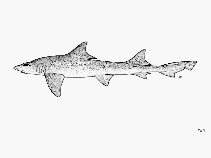 Scylliogaleus quecketti
Afbeelding van FAO
Afbeeldingen | Google afbeelding
Afbeelding van FAO
Classificatie / Namen Lokale namen | Synoniemen | Catalog of Fishes(Genus, Soort(en)) | ITIS | CoL | WoRMS | Cloffa
Elasmobranchii (haaien en roggen) (sharks and rays) > Carcharhiniformes (Ground sharks) > Triakidae (Houndsharks) > Triakinae
Etymology: Scylliogaleus: Etymology not explained, presumably a combination of Scyllium and galeus, i.e., a “galeid” shark with “nostrils as in Scyllium” (=Scyliorhinus, Scyliorhinidae) (See ETYFish); quecketti: In honor of London-born conchologist John Frederick Whitlie Quekett (1849-1913), Curator, Durban Museum (South Africa), who provided holotype [Boulenger consistently misspelled Quekett’s name as “Queckett”] (See ETYFish).
Eponymy: John Frederick Whitlie Quekett (1849–1913) was born in London, but emigrated to Natal (1871) and was appointed to organise the collection of the Natal Society (1886). [...] (Ref. 128868), visit book page.
More on author: Boulenger.
Etymology: Scylliogaleus: Etymology not explained, presumably a combination of Scyllium and galeus, i.e., a “galeid” shark with “nostrils as in Scyllium” (=Scyliorhinus, Scyliorhinidae) (See ETYFish); quecketti: In honor of London-born conchologist John Frederick Whitlie Quekett (1849-1913), Curator, Durban Museum (South Africa), who provided holotype [Boulenger consistently misspelled Quekett’s name as “Queckett”] (See ETYFish).
Eponymy: John Frederick Whitlie Quekett (1849–1913) was born in London, but emigrated to Natal (1871) and was appointed to organise the collection of the Natal Society (1886). [...] (Ref. 128868), visit book page.
More on author: Boulenger.
Milieu: milieu / Klimaatzone / Diepte / verspreidingsgebied Ecologie
marien demersaal. Subtropical; 27°S - 33°S
Verspreiding Gebieden | FAO regio's | Ecosystemen | Voorkomen | Verspreidingskaart | Introducties | Faunafri
Western Indian Ocean: Natal and northeastern Cape in South Africa.
Grootte / Gewicht / Leeftijd
Maturiteit: Lm ? range ? - ? cm
Max length : 89.0 cm TL mannelijk / geslacht onbekend; (Ref. 244); 102.0 cm TL (female)
Max length : 89.0 cm TL mannelijk / geslacht onbekend; (Ref. 244); 102.0 cm TL (female)
Korte beschrijving Determinatiesleutels | Morfologie | Morfometrie
Dorsale stekels (totaal) : 0; Anale stekels: 0. A blunt-nosed houndshark with large, fused nasal flaps, and small, blunt, pebble-like teeth; 2nd dorsal fin as large as 1st (Ref. 5578). Grey above, cream below; newborn with white rear edges on dorsal, anal and caudal fins (Ref. 5578).
Body shape (shape guide): elongated.
Body shape (shape guide): elongated.
Occurs from the surf line to close offshore (Ref. 5578). Feeds mainly on crustaceans (including lobsters), also squid (Ref. 244). Viviparous (Ref. 50449). Caught by rock and surf anglers (Ref. 5578).
Levenscyclus en paargedrag Maturiteit | Voortplanting | Paaien | Eieren | Fecunditeit | Larven
Viviparous, placental (Ref. 50449). With 2 to 4 young in a litter (Ref. 244, 5578). Size at birth about 34 cm (Ref. 244). Gestation period is 9 to 10 months (Ref. 244). Distinct pairing with embrace (Ref. 205).
Hoofdreferentie
Upload uw referenties | Referenties | Coördinator : Compagno, Leonard J.V. | Medewerkers
Compagno, L.J.V., 1984. FAO Species Catalogue. Vol. 4. Sharks of the world. An annotated and illustrated catalogue of shark species known to date. Part 2 - Carcharhiniformes. FAO Fish. Synop. 125(4/2):251-655. Rome: FAO. (Ref. 244)
Status op de Rode Lijst van het IUCN (Ref. 130435: Version 2025-2 (Global))
Kwetsbaar (VU) (B1ab(iii,v)); Date assessed: 25 April 2018
CITES
Not Evaluated
Gevaar voor de mens
Harmless
Gebruik door de mens
Visserij: visserij voor eigen gebruik; sportvis: ja
FAO - Publication: search | FishSource |
Meer informatie
Trofische ecologie
Voedsel (prooien)
Dieetsamenstelling
Voedselconsumptie
Voedselrantsoenen
Predatoren
Voedsel (prooien)
Dieetsamenstelling
Voedselconsumptie
Voedselrantsoenen
Predatoren
Populatiedynamica
Groeiparameters
Max. leeftijden / maten
Lengte-gewicht rel.
Lengte-lengte rel.
Lengtefrequenties
Massaconversie
Rekrutering
Abundantie
Groeiparameters
Max. leeftijden / maten
Lengte-gewicht rel.
Lengte-lengte rel.
Lengtefrequenties
Massaconversie
Rekrutering
Abundantie
Levenscyclus
Voortplanting
Maturiteit
Rijpheid/kieuwen rel.
Fecunditeit
Paaien
Paaibestanden
Eieren
Ontwikkeling van de eieren
Larven
Larvale populatiedynamiek
Voortplanting
Maturiteit
Rijpheid/kieuwen rel.
Fecunditeit
Paaien
Paaibestanden
Eieren
Ontwikkeling van de eieren
Larven
Larvale populatiedynamiek
Anatomie
Kieuwoppervlak
Hersenen
Otoliet
Kieuwoppervlak
Hersenen
Otoliet
Fysiologie
Lichaamssamenstelling
Voedingsstoffen
Zuurstofverbruik
Type zwemmen
Zwemsnelheid
Visuele pigmenten
Vis geluid
Ziekten en parasieten
Toxiciteit (LC50)
Lichaamssamenstelling
Voedingsstoffen
Zuurstofverbruik
Type zwemmen
Zwemsnelheid
Visuele pigmenten
Vis geluid
Ziekten en parasieten
Toxiciteit (LC50)
Genetica
genoom
Genetica
Heterozygositeit
Erfelijkheid
Genetische diversiteit
genoom
Genetica
Heterozygositeit
Erfelijkheid
Genetische diversiteit
Menselijk gerelateerd
Aquacultuursystemen
Aquacultuurprofielen
Kweeklijnen
Ciguatera gevallen
Postzegels, munten, diversen.
Aquacultuursystemen
Aquacultuurprofielen
Kweeklijnen
Ciguatera gevallen
Postzegels, munten, diversen.
Tools
Speciale rapporten
Bekijk gegevens voor het houden in een aquarium | Bekijk Fact Sheets voor de soort | Bekijk Aquacultuur Fact Sheets
Download XML
Internetbronnen
AFORO (otoliths) | Aquatic Commons | BHL | Cloffa | Websites from users | Bekijk FishWatcher | CISTI | Catalog of Fishes: Genus, Soort(en) | DiscoverLife | ECOTOX | FAO - Publication: search | Faunafri | Fishipedia | Fishtrace | GloBI | Google Books | Google Scholar | Google | IGFA World Record | OneZoom | Open Tree of Life | Otolith Atlas of Taiwan Fishes | PubMed | Reef Life Survey | Socotra Atlas | TreeBase | Tree of Life | Wikipedia: ga naar, zoek | World Records Freshwater Fishing | Zoobank | Zoological Record
Schattingen op basis van modellen
Fylogenetische diversiteitsindex (Ref. 82804): PD50 = 1.0000 [Uniqueness, from 0.5 = low to 2.0 = high].
Bayesian length-weight: a=0.00245 (0.00117 - 0.00517), b=3.14 (2.96 - 3.32), in cm total length, based on LWR estimates for this (Sub)family-body shape (Ref. 93245).
Trofisch niveau (Ref. 69278): 3.6 ±0.5 se; based on diet studies.
Weerstandsvermogen (Ref. 120179): Zeer laag, minimale populatieverdubbelingstijd meer dan 14 jaar (Fec=2).