This website uses cookies to enhance your browsing experience and ensure the functionality of our site. For more detailed information about the types of cookies we use and how we protect your privacy, please visit our Privacy Information page.
×
Cookie Settings
This website uses different types of cookies to enhance your experience. Please select your preferences below:
> Perciformes/Scorpaenoidei (Scorpionfishes) > Scorpaenidae (Scorpionfishes or rockfishes) > Pteroinae
Etymology: Ebosia:Ebosia, Ebusus = an island in the Tarraconense province of Roman empire (Spain); falcata:From the elongated parietal crests of mature males; species with the sickle-shaped helmet or headdress.
Ambiente: milieu / zona climatica / distribuzione batimetrica / gamma di distribuzione Ecologia
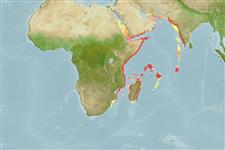
Indian Ocean: off Somalia, Pakistan and the west coast of India and off the Andaman Sea coast of Thailand.
Dimensione / Peso / Età
Maturità: Lm? range ? - ? cm Max length : 11.6 cm TL maschio/sesso non determinato; (Ref. 121532); peso massimo pubblicato: 15.00 g (Ref. 121532)
Breve descrizione Chiavi di identificazione | Morfologia | Morfometria
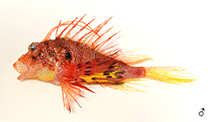
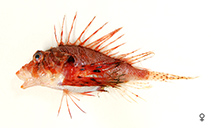
Spine dorsali (totale) : 12 - 13; Raggi dorsali molli (totale) : 10; Spine anali: 3; Raggi anali molli: 8 - 10; Vertebre: 24. Parietal crest of adult males very elongate; low in females. Dorsal fin rays 4.5-10.5; spines very long, longest at middle of the fin, 12th shortest; membranes deeply incised between spines; soft rays branched distally in largest specimens. Anal fin rays 7.5-9.5, usually 8.5; 1st spine shortest, increasing in length to 3rd; soft rays branched in larger specimens. Pectoral fin almost reaching caudal fin base, a little beyond in small individuals, short of caudal base in larger ones. Caudal fin very long , middle rays longest and branched; procurrent rays spinous. Vertical ctenoid scale rows about 40; cheek and area behind eyes scaled. Supraocular tentacle present. Preopercle with 3 spines; supplemental spine absent. Suborbital ridge spiny, irregular, with more than 10 spinous points of variable shape. Ocular ridges with spines, but poorly defined by location. Sphenotic and pterotic spines multiple. No spines on interorbital space, occiput, snout; no upper and lower post temporal, cleithral and supracleithral spines (Ref. 41422). Body shape (shape guide): fusiform / normal.
Ciclo vitale e comportamento di accoppiamento Maturità | Riproduzione | Deposizione | Uova | Fecondità | Larve
Eschmeyer, W.N. and K.V. Rama-Rao, 1977. A new scorpionfish, Ebosia falcata (Scorpaenidae, Pteroinae), from the western Indian Ocean, with comments on the genus. Matsya 3:64-71. (Ref. 41422)
Stato della Lista Rossa IUCN (Ref. 130435: Version 2025-2 (Global))
Dinamica della popolazione Parametri di crescita Età massima / dimensioni massime Rapporto lunghezza-peso. Lunghezza-lunghezza rel. Lunghezza-frequenze Conversione di massa Reclutamento Abbondanza
Ciclo di vita Riproduzione Maturità Maturità/Gli occhielli sono relativi. Fecondità Deposizione Aggregazioni riproduttive Uova Sviluppo delle uova Larve Dinamica popolazioni larvali
Fisiologia Composizione corporea Nutrienti Consumo di ossigeno Tipo di nuoto Velocità di nuoto Pigmenti visivi Suono del pesce Malattie e parassiti Tossicità (LC50)
Temperatura preferita (Fonte Biblio. 123201): 18.7 - 24.8, mean 23.4 °C (based on 53 cells).
Indice di diversità filogenetica (Fonte Biblio. 82804): PD50 = 0.5625 [Uniqueness, from 0.5 = low to 2.0 = high].
Bayesian length-weight: a=0.00871 (0.00431 - 0.01761), b=2.97 (2.80 - 3.14), in cm total length, based on LWR estimates for this species & (Sub)family-body (Ref. 93245).
Livello trofico (Fonte Biblio. 69278): 3.7 ±0.6 se; based on size and trophs of closest relatives
Resilienza (Fonte Biblio. 120179): Alto, tempo minimo di raddoppiamento della popolazione meno di 15 mesi (Preliminary K or Fecundity.).
Vulnerabilità della pesca (Ref. 59153): Low vulnerability (10 of 100). 🛈