



Megachasma pelagios Taylor, Compagno & Struhsaker, 1983
Megamouth shark
Beobachtung melden im Fish Watcher
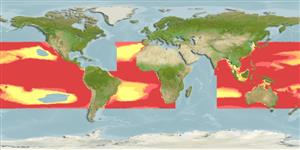
| Native range | All suitable habitat | Point map | Year 2050 |
|
| This map was computer-generated and has not yet been reviewed. |
| Megachasma pelagios AquaMaps Data sources: GBIF OBIS |
Hochladen Photos und videos
Bilder | Google Bild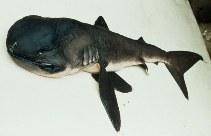 Megachasma pelagios
Male Photo von Carvalho Filho, A.
Bilder | Google Bild
Male Photo von Carvalho Filho, A.
Klassifizierung / Names Namen | Synonyme | Catalog of Fishes(Gattung, Arten) | ITIS | CoL | WoRMS | Cloffa
Elasmobranchii (Haie und Rochen) (sharks and rays) > Lamniformes (Mackerel sharks) > Megachasmidae (Megamouth sharks)
Etymology: Megachasma: megas (Gr.), large; chasma (Gr.), yawning hole or open mouth, referring to its unusually large oral cavity (See ETYFish); pelagios: Greek for “of the sea,” referring to its oceanic, epipelagic habitat (See ETYFish).
Etymology: Megachasma: megas (Gr.), large; chasma (Gr.), yawning hole or open mouth, referring to its unusually large oral cavity (See ETYFish); pelagios: Greek for “of the sea,” referring to its oceanic, epipelagic habitat (See ETYFish).
Umwelt: Milieu / Klimazone / Tiefenbereich / Verbreitungsgebiet Ökologie
seewasser pelagic-oceanic; ozeanodrom (Ref. 51243); tiefenbereich 5 - 600 m (Ref. 58302), usually 120 - 166 m (Ref. 48844). Deep-water; 40°N - 40°S, 180°W - 180°E
Verbreitung Territorien | FAO Gebiete | Ökosysteme | Vorkommen | Punkt Karte | Einführungen | Faunafri
Pacific Ocean: Japan, Indonesia, Philippines, Hawaii and California, USA. Atlantic Ocean: Brazil and Senegal.
Länge bei der ersten Reifung / Größe / Gewicht / Alter
Geschlechtsreife: Lm ?, range 540 - ? cm
Max length : 549 cm TL Männchen/unbestimmt; (Ref. 85838); 709.0 cm TL (female)
Max length : 549 cm TL Männchen/unbestimmt; (Ref. 85838); 709.0 cm TL (female)
Kurzbeschreibung Bestimmungsschlüssel | Morphologie | Morphometrie
Rückenflossenstacheln (insgesamt) : 0; Wirbelzahl: 125. Body stout, tapering posteriorly (Ref. 6871), tadpole-like with larger head and tapering trunk and tail (Ref. 47786). Snout extremely short but broadly rounded (Ref 43278, 47786). Head huge, blubbery (Ref. 6871). Mouth very broad and terminal on head, with corner extending behind the eyes (Ref. 6871, 43278). Jaws huge, protrusible anteriorly but not greatly distensible laterally (Ref. 43278, 47786), lower jaw extending to snout tip (Ref. 6871). Teeth very small, numerous, hooked (Ref. 43278, 6871, 47787). Gill slits moderately long, not reaching dorsal surface of head (Ref. 6871; 43278), internal gill slits lined with dense rows of papillose gill rakers (Ref. 43278). Eyes semicircular (Ref. 47786), with no nictitating membrane (Ref. 43278, 6871, 47786). Two dorsal fins, relatively low and angular; small anal fin; long, narrow pectoral fins; moderate-sized pelvic fin; caudal fin asymmetrical, non-lunate, with a short and strong ventral lobe; upper pre-caudal pit only; caudal peduncle without keels or ridges (Ref, 6871, 43278).
Body shape (shape guide): elongated.
Body shape (shape guide): elongated.
Oceanic, possibly occurring in depths between 150 and 1,000 m (Ref. 6871). Epi- and mesopelagic (Ref. 58302). Feeds on planktivorous prey such as euphausiid shrimps, copepods and jellyfish (Ref. 6871). May also eat small midwater fishes. Ovoviviparous (Ref. 50449). Possibly less active than the basking and whale sharks (Ref. 6871). Its feeding habits and habitat suggest that it may be a rare catch in the future. Ovoviviparous, embryos feeding on yolk sac and other ova produced by the mother (Ref. 50449). Males mature by 400 cm (Ref. 6871). A bright white band on the snout just above the upper jaw may play a role in feeding behavior or with recognition of individuals (Ref. 47761). Preyed on by the semi-parasitic cookiecutter shark, Isistius brasiliensis.
Lebenszyklus und Paarungsverhalten Geschlechtsreife | Fortpflanzung | Ablaichen | Eier | Fruchtbarkeit | Larven
Exhibit ovoviparity (aplacental viviparity), with embryos feeding on other ova produced by the mother (oophagy) after the yolk sac is absorbed (Ref. 50449). Distinct pairing with embrace (Ref. 205). Size at birth <177 cm (Ref. 85838).
Hauptreferenz
Laden Sie Ihre Referenzen hoch | Referenzen | Koordinator | Partner
Compagno, L.J.V., 1984. FAO Species Catalogue. Vol. 4. Sharks of the world. An annotated and illustrated catalogue of shark species known to date. Part 1 - Hexanchiformes to Lamniformes. FAO Fish. Synop. 125(4/1):1-249. Rome, FAO. (Ref. 247)
IUCN Rote Liste Status (Ref. 130435: Version 2025-2 (Global))
nicht bedroht (LC) ; Date assessed: 09 November 2018
CITES
Not Evaluated
Bedrohung für Menschen
Harmless
Nutzung durch Menschen
Fischereien: nicht kommerziell
FAO - Fischereien: Artbeschreibung; Publication: search | FishSource |
Mehr Information
Trophische Ökologie
Lebensmittel (Beutetiere)
Nahrungszusammensetzung
Nahrungsaufnahme
Lebensmittelrationen
Räuber
Lebensmittel (Beutetiere)
Nahrungszusammensetzung
Nahrungsaufnahme
Lebensmittelrationen
Räuber
Populationsdynamik
Wachstumsparameter
Max. Alter/Größen
Länge-Gewicht-Rel.
Länge-Länge-Verhältnis.
Längenhäufigkeiten
Massenkonvertierung
Rekrutierung
Dichte
Wachstumsparameter
Max. Alter/Größen
Länge-Gewicht-Rel.
Länge-Länge-Verhältnis.
Längenhäufigkeiten
Massenkonvertierung
Rekrutierung
Dichte
Lebenszyklus
Fortpflanzung
Geschlechtsreife
Reifung/Kiemen rel.
Fruchtbarkeit
Ablaichen
Laichaggregationen
Eier
Eientwicklung
Larven
Larven Pop.Dyn.
Fortpflanzung
Geschlechtsreife
Reifung/Kiemen rel.
Fruchtbarkeit
Ablaichen
Laichaggregationen
Eier
Eientwicklung
Larven
Larven Pop.Dyn.
Physiologie
Körperliche Zusammensetzung
Nährstoffe
Sauerstoffverbrauch
Schwimmart
Schwimmgeschwindigkeit
Visuelle Pigmente
Fischgeräusche
Krankheiten und Parasiten
Toxizität (LC50s)
Körperliche Zusammensetzung
Nährstoffe
Sauerstoffverbrauch
Schwimmart
Schwimmgeschwindigkeit
Visuelle Pigmente
Fischgeräusche
Krankheiten und Parasiten
Toxizität (LC50s)
Menschenbezogen
Aquakultur-Systeme
Aquakultur Profile
Zuchtlinien
Ciguatera-Fälle
Briefmarken, Münzen, Verschiedenes.
Aquakultur-Systeme
Aquakultur Profile
Zuchtlinien
Ciguatera-Fälle
Briefmarken, Münzen, Verschiedenes.
Tools
Zusatzinformationen
Download XML
Zusammenfassung | Punktdaten | Namen | Photos
Internet Quellen
AFORO (otoliths) | Aquatic Commons | BHL | Cloffa | Websites from users | FishWatcher Einträge suchen | CISTI | Catalog of Fishes: Gattung, Arten | DiscoverLife | ECOTOX | FAO - Fischereien: Artbeschreibung; Publication: search | Faunafri | Fishipedia | Fishtrace | GloBI | Google Books | Google Scholar | Google | IGFA World Record | OneZoom | Open Tree of Life | Otolith Atlas of Taiwan Fishes | PubMed | Reef Life Survey | Socotra Atlas | TreeBase | Tree of Life | Wikipedia: Gehe zu, Suchen | | Zoobank | Zoologischer Rekord
Schätzungen auf der Grundlage von Modellen
|
Phylogenetischer Diversitätsindex (Ref. 82804) |
PD50 = 1.5000 [Uniqueness, from 0.5 = low to 2.0 = high]. |
| Bayesian length-weight | a=0.00389 (0.00180 - 0.00842), b=3.12 (2.94 - 3.30), in cm total length, based on all LWR estimates for this body shape (Ref. 93245). |
|
Trophische Ebene (Ref. 69278) |
3.4 ±0.2 se; based on diet studies. |
|
Widerstandsfähigkeit (Ref. 120179) |
sehr niedrig, Verdopplung der Population dauert mehr als 14 Jahre. (Fec assumed to be <10). |
|
Anfälligkeit der Fischerei (Ref. 59153) |
Very high vulnerability (89 of 100). 🛈 |