



Hymenocephalus nascens Gilbert & Hubbs, 1920
Nascent membranehead
Waarneming toevoegen in Fish Watcher
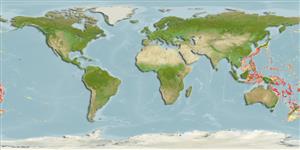
| Native range | All suitable habitat | Point map | Year 2050 |
|
| This map was computer-generated and has not yet been reviewed. |
| Hymenocephalus nascens AquaMaps Data sources: GBIF OBIS |
Uploaden van uw Foto's en video's
Afbeeldingen | Google afbeelding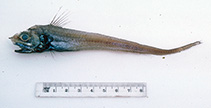 Hymenocephalus nascens
Afbeelding van Graham, K.
Afbeeldingen | Google afbeelding
Afbeelding van Graham, K.
Classificatie / Namen Lokale namen | Synoniemen | Catalog of Fishes(Genus, Soort(en)) | ITIS | CoL | WoRMS | Cloffa
> Gadiformes (Cods) > Macrouridae (Grenadiers or rattails)
Etymology: Hymenocephalus: Named for its transparent membrane-like head covering (‘‘hymen head’’) and fragile nature of head bones (Ref. 100825).
More on authors: Gilbert & Hubbs.
Etymology: Hymenocephalus: Named for its transparent membrane-like head covering (‘‘hymen head’’) and fragile nature of head bones (Ref. 100825).
More on authors: Gilbert & Hubbs.
Milieu: milieu / Klimaatzone / Diepte / verspreidingsgebied Ecologie
marien benthopelagisch; diepte 366 - 1000 m (Ref. 35908). Deep-water
Verspreiding Gebieden | FAO regio's | Ecosystemen | Voorkomen | Verspreidingskaart | Introducties | Faunafri
Western Central Pacific: South China Sea off Hong Kong, through Philippines and Indonesia, off northern Australia, to New Caledonia and New Zealand.
Grootte / Gewicht / Leeftijd
Korte beschrijving Determinatiesleutels | Morfologie | Morfometrie
Dorsale stekels (totaal) : 2. This species is distinguished by the following characters: pelvic rays usually 12-14 (elsewhere 11-13); total gill-rakers first arch (outer/inner) 17-22/23-28, second arch 22-28/22-26; no chin barbel; snout length 22-31% HL; orbit diameter 29-40% HL; suborbital width 10-14%HL, interorbital width 24-29%HL; most of the orbit, upper surface of snout, sides of head and trunk silvery or pale, ventral aspects of heed and trunk black; a prominent midlateral stripe of silvery (when fresh) or brownish (preserved) pigment running along trunk and tail (Ref. 97189). Additional distinguishing characteristics: pectoral fin rays 13-16; projecting snout, 20-26% HL; infraorbital width 11-16% HL; moderately long preopercular supporter, with obtuse angle at rear margin, 4-9% HL; ventral striae reaching to ½ distance from pelvic fin bases to periproct; otolith has moderately high predorsal lobe, with colliculi separated, closely placed across collum with a tendency to joining in large individuals, terminating at some distance from anterior and posterior rims of otolith; otolith length to height (OL:OH), 1.1-1.2; total colliculum length to pseudocolliculum length (TCL:PCL), 1.8-2.4 (Ref. 98298).
Body shape (shape guide): elongated.
Body shape (shape guide): elongated.
Levenscyclus en paargedrag Maturiteit | Voortplanting | Paaien | Eieren | Fecunditeit | Larven
Hoofdreferentie
Upload uw referenties | Referenties | Coördinator : Iwamoto, Tomio | Medewerkers
Iwamoto, T. and N.R. Merrett, 1997. Pisces Gadiformes: Taxonomy of grenadiers of the New Caledonian region, southwest Pacific. Mem. Mus. Natl. Hist. Nat. (176):473-570. (Ref. 35908)
CITES
Not Evaluated
Gevaar voor de mens
Harmless
Gebruik door de mens
FAO - Publication: search | FishSource |
Meer informatie
Trofische ecologie
Voedsel (prooien)
Dieetsamenstelling
Voedselconsumptie
Voedselrantsoenen
Predatoren
Voedsel (prooien)
Dieetsamenstelling
Voedselconsumptie
Voedselrantsoenen
Predatoren
Ecologie
Ecologie
Ecologie
Populatiedynamica
Groeiparameters
Max. leeftijden / maten
Lengte-gewicht rel.
Lengte-lengte rel.
Lengtefrequenties
Massaconversie
Rekrutering
Abundantie
Groeiparameters
Max. leeftijden / maten
Lengte-gewicht rel.
Lengte-lengte rel.
Lengtefrequenties
Massaconversie
Rekrutering
Abundantie
Levenscyclus
Voortplanting
Maturiteit
Rijpheid/kieuwen rel.
Fecunditeit
Paaien
Paaibestanden
Eieren
Ontwikkeling van de eieren
Larven
Larvale populatiedynamiek
Voortplanting
Maturiteit
Rijpheid/kieuwen rel.
Fecunditeit
Paaien
Paaibestanden
Eieren
Ontwikkeling van de eieren
Larven
Larvale populatiedynamiek
Anatomie
Kieuwoppervlak
Hersenen
Otoliet
Kieuwoppervlak
Hersenen
Otoliet
Fysiologie
Lichaamssamenstelling
Voedingsstoffen
Zuurstofverbruik
Type zwemmen
Zwemsnelheid
Visuele pigmenten
Vis geluid
Ziekten en parasieten
Toxiciteit (LC50)
Lichaamssamenstelling
Voedingsstoffen
Zuurstofverbruik
Type zwemmen
Zwemsnelheid
Visuele pigmenten
Vis geluid
Ziekten en parasieten
Toxiciteit (LC50)
Genetica
genoom
Genetica
Heterozygositeit
Erfelijkheid
Genetische diversiteit
genoom
Genetica
Heterozygositeit
Erfelijkheid
Genetische diversiteit
Menselijk gerelateerd
Aquacultuursystemen
Aquacultuurprofielen
Kweeklijnen
Ciguatera gevallen
Postzegels, munten, diversen.
Aquacultuursystemen
Aquacultuurprofielen
Kweeklijnen
Ciguatera gevallen
Postzegels, munten, diversen.
Tools
E-boek | Veldgids | Determinatiesleutels | Lengtefrequentie Tool | Levenscyclus tool | Verspreidingskaart |
Vangst-MSY |
Speciale rapporten
Bekijk gegevens voor het houden in een aquarium | Bekijk Fact Sheets voor de soort | Bekijk Aquacultuur Fact Sheets
Download XML
Internetbronnen
AFORO (otoliths) | Aquatic Commons | BHL | Cloffa | Websites from users | Bekijk FishWatcher | CISTI | Catalog of Fishes: Genus, Soort(en) | DiscoverLife | ECOTOX | FAO - Publication: search | Faunafri | Fishipedia | Fishtrace | GloBI | Google Books | Google Scholar | Google | IGFA World Record | OneZoom | Open Tree of Life | Otolith Atlas of Taiwan Fishes | PubMed | Reef Life Survey | Socotra Atlas | TreeBase | Tree of Life | Wikipedia: ga naar, zoek | World Records Freshwater Fishing | Zoobank | Zoological Record
Schattingen op basis van modellen
Gewenste temperatuur (Ref. 123201): 6.4 - 11.4, mean 8.2 °C (based on 237 cells).
Fylogenetische diversiteitsindex (Ref. 82804): PD50 = 0.5000 [Uniqueness, from 0.5 = low to 2.0 = high].
Bayesian length-weight: a=0.00219 (0.00111 - 0.00432), b=3.20 (3.03 - 3.37), in cm total length, based on LWR estimates for this (Sub)family-body shape (Ref. 93245).
Trofisch niveau (Ref. 69278): 3.3 ±0.4 se; based on size and trophs of closest relatives
Weerstandsvermogen (Ref. 120179): Gemiddeld, minimale populatieverdubbelingstijd 1,4-4,4 jaar (Preliminary K or Fecundity.).