



Brachaelurus waddi (Bloch & Schneider, 1801)
Blind shark
Beobachtung melden im Fish Watcher
| Native range | All suitable habitat | Point map | Year 2050 |

|
| This map was computer-generated and has not yet been reviewed. |
| Brachaelurus waddi AquaMaps Data sources: GBIF OBIS |
Hochladen Photos und videos
Bilder | Google Bild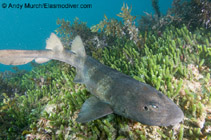 Brachaelurus waddi
Photo von Murch, A.
Bilder | Google Bild
Photo von Murch, A.
Klassifizierung / Names Namen | Synonyme | Catalog of Fishes(Gattung, Arten) | ITIS | CoL | WoRMS | Cloffa
Elasmobranchii (Haie und Rochen) (sharks and rays) > Orectolobiformes (Carpet sharks) > Brachaeluridae (Blind sharks)
Etymology: Brachaelurus: brachys (Gr.), short, referring to short and stout body; aelurus, from ailouros (Gr.), cat, i.e., a short catshark (See ETYFish); waddi: Name given on a painting (now lost) by British ornithologist John Latham (1740-1837), from which it was described; meaning unknown, possibly based on waddi or waddy, an Australian aboriginal name for a war club and a species of tree (Acacia peuce) endemic to central Australia (See ETYFish).
Eponymy: The original description does not explain the binomial. [...] (Ref. 128868), visit book page.
More on authors: Bloch & Schneider.
Etymology: Brachaelurus: brachys (Gr.), short, referring to short and stout body; aelurus, from ailouros (Gr.), cat, i.e., a short catshark (See ETYFish); waddi: Name given on a painting (now lost) by British ornithologist John Latham (1740-1837), from which it was described; meaning unknown, possibly based on waddi or waddy, an Australian aboriginal name for a war club and a species of tree (Acacia peuce) endemic to central Australia (See ETYFish).
Eponymy: The original description does not explain the binomial. [...] (Ref. 128868), visit book page.
More on authors: Bloch & Schneider.
Umwelt: Milieu / Klimazone / Tiefenbereich / Verbreitungsgebiet Ökologie
seewasser riff-verbunden; tiefenbereich 0 - 140 m (Ref. 6871). Tropical; 11°S - 36°S, 112°E - 143°E (Ref. 54288)
Verbreitung Territorien | FAO Gebiete | Ökosysteme | Vorkommen | Punkt Karte | Einführungen | Faunafri
Southwest Pacific: confined to Australia, southern Queensland and New South Wales. Records from Western Australia and northern Territory need confirmation.
Größe / Gewicht / Alter
Geschlechtsreife: Lm ? range ? - ? cm
Max length : 122 cm TL Männchen/unbestimmt; (Ref. 247); common length : 62.0 cm TL Männchen/unbestimmt; (Ref. 247); common length :66 cm TL (female)
Max length : 122 cm TL Männchen/unbestimmt; (Ref. 247); common length : 62.0 cm TL Männchen/unbestimmt; (Ref. 247); common length :66 cm TL (female)
Kurzbeschreibung Bestimmungsschlüssel | Morphologie | Morphometrie
Rückenflossenstacheln (insgesamt) : 0; Afterflossenstacheln: 0. Mostly with white spots on body (Ref. 13576). Caudal fin with its upper lobe at a low angle above body axis, with a strong terminal lobe and subterminal notch but no ventral lobe (Ref. 13576).
Body shape (shape guide): elongated.
Body shape (shape guide): elongated.
Usually found close inshore in tide pools (barely deep enough to keep it covered) and at the surf line, but sometimes deeper (Ref. 247). Prefers rocky shoreline areas and coral reefs (Ref. 247, 43278). Feeds on small reef invertebrates (Ref. 247), including crabs, shrimps, cuttlefish, squid and sea anemones (Ref. 43278), and small fishes (Ref. 247). Ovoviviparous (Ref. 43278, 50449). Thrives in an aquaria and capable of living out of water for a long time (Ref. 247).
Lebenszyklus und Paarungsverhalten Geschlechtsreife | Fortpflanzung | Ablaichen | Eier | Fruchtbarkeit | Larven
Ovoviviparous, embryos feed solely on yolk (Ref. 50449). With 7 or 8 young in a litter (Ref. 247). Distinct pairing with embrace (Ref. 205).
Hauptreferenz
Laden Sie Ihre Referenzen hoch | Referenzen | Koordinator | Partner
Compagno, L.J.V., 1984. FAO Species Catalogue. Vol. 4. Sharks of the world. An annotated and illustrated catalogue of shark species known to date. Part 1 - Hexanchiformes to Lamniformes. FAO Fish. Synop. 125(4/1):1-249. Rome, FAO. (Ref. 247)
IUCN Rote Liste Status (Ref. 130435: Version 2025-2 (Global))
nicht bedroht (LC) ; Date assessed: 24 April 2025
CITES
Not Evaluated
Bedrohung für Menschen
Harmless (Ref. 247)
Nutzung durch Menschen
Fischereien: bycatch; Sportfisch: ja
FAO - Fischereien: Artbeschreibung; Publication: search | FishSource |
Mehr Information
Trophische Ökologie
Lebensmittel (Beutetiere)
Nahrungszusammensetzung
Nahrungsaufnahme
Lebensmittelrationen
Räuber
Lebensmittel (Beutetiere)
Nahrungszusammensetzung
Nahrungsaufnahme
Lebensmittelrationen
Räuber
Populationsdynamik
Wachstumsparameter
Max. Alter/Größen
Länge-Gewicht-Rel.
Länge-Länge-Verhältnis.
Längenhäufigkeiten
Massenkonvertierung
Rekrutierung
Dichte
Wachstumsparameter
Max. Alter/Größen
Länge-Gewicht-Rel.
Länge-Länge-Verhältnis.
Längenhäufigkeiten
Massenkonvertierung
Rekrutierung
Dichte
Lebenszyklus
Fortpflanzung
Geschlechtsreife
Reifung/Kiemen rel.
Fruchtbarkeit
Ablaichen
Laichaggregationen
Eier
Eientwicklung
Larven
Larven Pop.Dyn.
Fortpflanzung
Geschlechtsreife
Reifung/Kiemen rel.
Fruchtbarkeit
Ablaichen
Laichaggregationen
Eier
Eientwicklung
Larven
Larven Pop.Dyn.
Physiologie
Körperliche Zusammensetzung
Nährstoffe
Sauerstoffverbrauch
Schwimmart
Schwimmgeschwindigkeit
Visuelle Pigmente
Fischgeräusche
Krankheiten und Parasiten
Toxizität (LC50s)
Körperliche Zusammensetzung
Nährstoffe
Sauerstoffverbrauch
Schwimmart
Schwimmgeschwindigkeit
Visuelle Pigmente
Fischgeräusche
Krankheiten und Parasiten
Toxizität (LC50s)
Genetik
Genom
Genetik
Heterozygotie
Vererbbarkeit
Genetische Vielfalt
Genom
Genetik
Heterozygotie
Vererbbarkeit
Genetische Vielfalt
Menschenbezogen
Aquakultur-Systeme
Aquakultur Profile
Zuchtlinien
Ciguatera-Fälle
Briefmarken, Münzen, Verschiedenes.
Aquakultur-Systeme
Aquakultur Profile
Zuchtlinien
Ciguatera-Fälle
Briefmarken, Münzen, Verschiedenes.
Tools
E-Book | Feldführer | Bestimmungsschlüssel | Längenhäufigkeits Tool | Lebensdaten Tool | Punkt Karte |
Catch-MSY |
Zusatzinformationen
Download XML
Zusammenfassung | Punktdaten | Namen | Photos
Internet Quellen
AFORO (otoliths) | Aquatic Commons | BHL | Cloffa | Websites from users | FishWatcher Einträge suchen | CISTI | Catalog of Fishes: Gattung, Arten | DiscoverLife | ECOTOX | FAO - Fischereien: Artbeschreibung; Publication: search | Faunafri | Fishipedia | Fishtrace | GloBI | Google Books | Google Scholar | Google | IGFA World Record | OneZoom | Open Tree of Life | Otolith Atlas of Taiwan Fishes | PubMed | Reef Life Survey | Socotra Atlas | TreeBase | Tree of Life | Wikipedia: Gehe zu, Suchen | World Records Freshwater Fishing | Zoologischer Rekord
Schätzungen auf der Grundlage von Modellen
Bevorzugte Temperatur (Ref. 123201): 19.3 - 26.1, mean 24.2 °C (based on 140 cells).
Phylogenetischer Diversitätsindex (Ref. 82804): PD50 = 1.0000 [Uniqueness, from 0.5 = low to 2.0 = high].
Bayesian length-weight: a=0.00389 (0.00180 - 0.00842), b=3.12 (2.94 - 3.30), in cm total length, based on all LWR estimates for this body shape (Ref. 93245).
Trophische Ebene (Ref. 69278): 3.9 ±0.62 se; based on food items.
Widerstandsfähigkeit (Ref. 120179): sehr niedrig, Verdopplung der Population dauert mehr als 14 Jahre. (Fec=7).
Nährstoffe (Ref. 124155): Calcium = 11.8 [2.5, 44.6] mg/100g; Iron = 0.368 [0.089, 1.012] mg/100g; Protein = 19.5 [17.3, 21.5] %; Omega3 = 0.0912 [, ] g/100g; Selenium = 38.2 [11.8, 102.1] μg/100g; VitaminA = 42.8 [16.4, 113.8] μg/100g; Zinc = 0.772 [0.380, 1.593] mg/100g (wet weight);