



Beobachtung melden im Fish Watcher
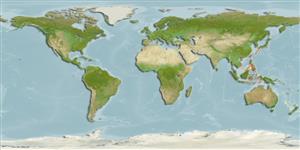
| Native range | All suitable habitat | Point map | Year 2050 |
|
| This map was computer-generated and has not yet been reviewed. |
| Rouleina euryops AquaMaps Data sources: GBIF OBIS |
Hochladen Photos und videos
Google Bild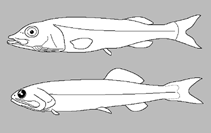 No image available for this species;
drawing shows typical species in Alepocephalidae.
Google Bild
drawing shows typical species in Alepocephalidae.
Klassifizierung / Names Namen | Synonyme | Catalog of Fishes(Gattung, Arten) | ITIS | CoL | WoRMS | Cloffa
> Alepocephaliformes (Slickheads and tubeshoulders) > Alepocephalidae (Slickheads)
Etymology: euryops: From the big eyes of the species.
Etymology: euryops: From the big eyes of the species.
Umwelt: Milieu / Klimazone / Tiefenbereich / Verbreitungsgebiet Ökologie
seewasser bathypelagisch; tiefenbereich 622 - 1412 m (Ref. 36330). Deep-water
Verbreitung Territorien | FAO Gebiete | Ökosysteme | Vorkommen | Punkt Karte | Einführungen | Faunafri
Western Central Pacific: Sulu Sea.
Größe / Gewicht / Alter
Kurzbeschreibung Bestimmungsschlüssel | Morphologie | Morphometrie
Rückenflossenweichstrahlen (insgesamt) : 17 - 21; Afterflossenweichstrahlen: 14 - 18. Body shallow, maximum depth reaching 20%SL. Caudal peduncle relatively long (usually >18%SL). Vertical fin bases against each other. Head not very deep, moderately wide (postorbital width 11-12.5%SL). Snout very short but not blunt; its length 1.5-2.3 times smaller than orbit diameter; olfactory bulbs relatively large; ethymoid in olfactory bulb region relatively narrow. Eyes very large; orbit > 30% HL; no aggregations of light connective tissue in the orbit area around the eyeball; interorbital gap very narrow and < half the orbit diameter. Lacrimal not deep, significantly smaller than lens diameter, slightly overlapping maxillare. Seismosensory canals on head not extended, their pores not enlarged. No separate suprapreoperculum at the upper end of the praeoperculum; preopercular canal connects to the postorbital canal by means of a skin tube. Upper edge of upper jaw overlaps with the vertical of the rear edge of the lens, it may reach the vertical of the back edge of the orbit in large specimens. Supramaxilla 2; front one relatively long; its length equal or shorter than upper outgrowth of the posterior one. Photophores present on the head: a row of 4-5 infraorbitalias; 1 behind back edge of the orbit at its middle level; 5 on both sides along the lower jaw seismosensory canals; 2-4 along the upper 3 rays of the gill membrane; 1 each on the operculum, interoperculum, and between orbit and olfactory capsule. Photophores on body, situated above and below the lateral line, the size increases in the vertical direction that the largest ones cover the lower profile of the body; in front of the vertical fins; 3 rows in the caudal region; several irregular rows of small ones on the gill membranes. Pyloric caeca < 10 (Ref. 36330).
Lebenszyklus und Paarungsverhalten Geschlechtsreife | Fortpflanzung | Ablaichen | Eier | Fruchtbarkeit | Larven
Hauptreferenz
Laden Sie Ihre Referenzen hoch | Referenzen | Koordinator | Partner
Sazonov, Y.I., 1999. A new species of the genus Rouleina (Argentiniformes, Alepocephalidae) from the Philippine Archipelago Seas and a redescription of R. livida and R. nuda. J. Ichthyol. 39(7):479-487. (Ref. 36330)
IUCN Rote Liste Status (Ref. 130435: Version 2025-2 (Global))
nicht bedroht (LC) ; Date assessed: 01 March 2017
CITES
Not Evaluated
Bedrohung für Menschen
Harmless
Nutzung durch Menschen
FAO - Publication: search | FishSource |
Mehr Information
Trophische Ökologie
Lebensmittel (Beutetiere)
Nahrungszusammensetzung
Nahrungsaufnahme
Lebensmittelrationen
Räuber
Lebensmittel (Beutetiere)
Nahrungszusammensetzung
Nahrungsaufnahme
Lebensmittelrationen
Räuber
Ökologie
Ökologie
Ökologie
Populationsdynamik
Wachstumsparameter
Max. Alter/Größen
Länge-Gewicht-Rel.
Länge-Länge-Verhältnis.
Längenhäufigkeiten
Massenkonvertierung
Rekrutierung
Dichte
Wachstumsparameter
Max. Alter/Größen
Länge-Gewicht-Rel.
Länge-Länge-Verhältnis.
Längenhäufigkeiten
Massenkonvertierung
Rekrutierung
Dichte
Lebenszyklus
Fortpflanzung
Geschlechtsreife
Reifung/Kiemen rel.
Fruchtbarkeit
Ablaichen
Laichaggregationen
Eier
Eientwicklung
Larven
Larven Pop.Dyn.
Fortpflanzung
Geschlechtsreife
Reifung/Kiemen rel.
Fruchtbarkeit
Ablaichen
Laichaggregationen
Eier
Eientwicklung
Larven
Larven Pop.Dyn.
Anatomie
Kiemenoberfläche
Gehirn
Otolith
Kiemenoberfläche
Gehirn
Otolith
Physiologie
Körperliche Zusammensetzung
Nährstoffe
Sauerstoffverbrauch
Schwimmart
Schwimmgeschwindigkeit
Visuelle Pigmente
Fischgeräusche
Krankheiten und Parasiten
Toxizität (LC50s)
Körperliche Zusammensetzung
Nährstoffe
Sauerstoffverbrauch
Schwimmart
Schwimmgeschwindigkeit
Visuelle Pigmente
Fischgeräusche
Krankheiten und Parasiten
Toxizität (LC50s)
Genetik
Genom
Genetik
Heterozygotie
Vererbbarkeit
Genetische Vielfalt
Genom
Genetik
Heterozygotie
Vererbbarkeit
Genetische Vielfalt
Menschenbezogen
Aquakultur-Systeme
Aquakultur Profile
Zuchtlinien
Ciguatera-Fälle
Briefmarken, Münzen, Verschiedenes.
Aquakultur-Systeme
Aquakultur Profile
Zuchtlinien
Ciguatera-Fälle
Briefmarken, Münzen, Verschiedenes.
Tools
Zusatzinformationen
Download XML
Zusammenfassung | Punktdaten | Namen | Photos
Internet Quellen
AFORO (otoliths) | Aquatic Commons | BHL | Cloffa | Websites from users | FishWatcher Einträge suchen | CISTI | Catalog of Fishes: Gattung, Arten | DiscoverLife | ECOTOX | FAO - Publication: search | Faunafri | Fishipedia | Fishtrace | GloBI | Google Books | Google Scholar | Google | IGFA World Record | OneZoom | Open Tree of Life | Otolith Atlas of Taiwan Fishes | PubMed | Reef Life Survey | Socotra Atlas | TreeBase | Tree of Life | Wikipedia: Gehe zu, Suchen | | Zoobank | Zoologischer Rekord
Schätzungen auf der Grundlage von Modellen
|
Phylogenetischer Diversitätsindex (Ref. 82804) |
PD50 = 0.5010 [Uniqueness, from 0.5 = low to 2.0 = high]. |
| Bayesian length-weight | a=0.00339 (0.00162 - 0.00707), b=3.19 (3.00 - 3.38), in cm total length, based on LWR estimates for this (Sub)family-body shape (Ref. 93245). |
|
Trophische Ebene (Ref. 69278) |
3.5 ±0.5 se; based on size and trophs of closest relatives |
|
Widerstandsfähigkeit (Ref. 120179) |
mittel, Verdopplung der Population dauert 1,4 - 4,4 Jahre. (Preliminary K or Fecundity.). |
|
Anfälligkeit der Fischerei (Ref. 59153) |
Moderate vulnerability (37 of 100). 🛈 |