



Coelorinchus lasti Iwamoto & Williams, 1999
Roughsnout whiptail
Envoyez vos Photos et vidéos
Images Google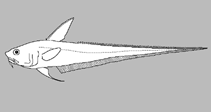 No image available for this species;
drawing shows typical species in Macrouridae.
Images Google
drawing shows typical species in Macrouridae.
Classification / Noms Noms communs | Synonymes | Catalog of Fishes(Genre, Espèce) | ITIS | CoL | WoRMS | Cloffa
> Gadiformes (Cods) > Macrouridae (Grenadiers or rattails)
Etymology: Coelorinchus: Greek, koilos = a hollow + Greek, rhyngchos = jaw (Ref. 45335); lasti: Named after Peter Last (CSIRO) in tribute to his contributions to Australian ichthyology.
Eponymy: Dr Peter Robert Last is an eminent Australian ichthyologist who is the senior taxonomist and Senior Principal Research Scientist at CSIRO Marine and Atmospheric Research Hobart. [...] (Ref. 128868), visit book page.
More on authors: Iwamoto & Williams.
Etymology: Coelorinchus: Greek, koilos = a hollow + Greek, rhyngchos = jaw (Ref. 45335); lasti: Named after Peter Last (CSIRO) in tribute to his contributions to Australian ichthyology.
Eponymy: Dr Peter Robert Last is an eminent Australian ichthyologist who is the senior taxonomist and Senior Principal Research Scientist at CSIRO Marine and Atmospheric Research Hobart. [...] (Ref. 128868), visit book page.
More on authors: Iwamoto & Williams.
Environnement : milieu / zone climatique / profondeur / gamme de distribution Écologie
marin benthopélagique; profondeur ? - 1140 m (Ref. 35909). Deep-water; 33°S - 43°S
Distribution Territoires | Zones FAO | Écosystèmes | Occurrences | Carte par point | Introductions | Faunafri
Eastern Indian Ocean: known only from the holotype and paratype taken off Western Australia and off the west coast of Tasmania.
Taille / Poids / Âge
Description synthétique Clés d'identification | Morphologie | Morphométrie
Épines dorsales (Total) : 2. Snout moderately pointed, 1.4-1.6 times orbit diameter; anterolateral margin incompletely supported by bone; upper jaw slightly less than 1/3 HL; orbit 1.5-1.8 into postorbital length; subopercle produced into slender point ventrally, the tip protruding slightly beyond angle of preopercle. Color overall dark chocolate brown. Nasal fossa with small scales on anteroventral corner but otherwise naked. Spinules on body scales below dorsal interspace imbricate, broadly trihedral, with wide lateral buttresses, in 3-5 saw-toothed, divergent rows. Anus immediately anterior to anal fin; no external sign of light organ.
Body shape (shape guide): elongated.
Body shape (shape guide): elongated.
A benthic species found on the continental slope (Ref. 75154).
Cycle de vie et comportement reproducteur Maturité | Reproduction | Frai | Œufs | Fécondité | Larves
Référence principale
Téléchargez vos références | Références | Coordinateur : Iwamoto, Tomio | Collaborateurs
Iwamoto, T. and A. Williams, 1999. Grenadiers (Pisces, Gadiformes) from the continental slope of western and northwestern Australia. Proc. Calif. Acad. Sci. 51(3):105-243. (Ref. 35909)
CITES
Not Evaluated
Menace pour l'homme
Harmless
Utilisations par l'homme
FAO - Publication: search | FishSource |
Plus d'informations
Écologie trophique
Aliments (proies)
Composition du régime alimentaire
Consommation alimentaire
Rations alimentaires
Prédateurs
Aliments (proies)
Composition du régime alimentaire
Consommation alimentaire
Rations alimentaires
Prédateurs
Écologie
Écologie
Écologie
Dynamique des populations
Paramètres de croissance
Âges / tailles maximales
Longueur-poids rel.
Rel. longueur-longueur.
Fréquences de longueurs
Conversion de masse
Recrutement
Abondance
Paramètres de croissance
Âges / tailles maximales
Longueur-poids rel.
Rel. longueur-longueur.
Fréquences de longueurs
Conversion de masse
Recrutement
Abondance
Cycle de vie
Reproduction
Maturité
Maturité/épines rel.
Fécondité
Frai
Agrégats de frai
Œufs
Développement de l'œuf
Larves
Dynamique des populations larvaires
Reproduction
Maturité
Maturité/épines rel.
Fécondité
Frai
Agrégats de frai
Œufs
Développement de l'œuf
Larves
Dynamique des populations larvaires
Anatomie
Surface branchiale
Cerveau
Otolithe
Surface branchiale
Cerveau
Otolithe
Physiologie
Composition corporelle
Nutriments
Consommation d'oxygène
Type de natation
Vitesse de nage
Pigments visuels
Son de poisson
Maladies et parasites
Toxicité (CL50)
Composition corporelle
Nutriments
Consommation d'oxygène
Type de natation
Vitesse de nage
Pigments visuels
Son de poisson
Maladies et parasites
Toxicité (CL50)
Génétique
génôme
Génétique
Hétérozygotie
Héritabilité
Diversité génétique
génôme
Génétique
Hétérozygotie
Héritabilité
Diversité génétique
Liées à l'homme
Systèmes d'aquaculture
Profils d'aquaculture
Souches
Cas de ciguatera
Timbres, pièces de monnaie, divers
Systèmes d'aquaculture
Profils d'aquaculture
Souches
Cas de ciguatera
Timbres, pièces de monnaie, divers
Outils
E-book | Guide de terrain | Clés d'identification | Générateur de fréquences de longueur | Outil de dynamique de population | Carte par point |
Capture-MSY |
Articles particuliers
Télécharger en XML
Sources Internet
AFORO (otoliths) | Aquatic Commons | BHL | Cloffa | Websites from users | FishWatcher | CISTI | Catalog of Fishes: Genre, Espèce | DiscoverLife | ECOTOX | FAO - Publication: search | Faunafri | Fishipedia | Fishtrace | GloBI | Google Books | Google Scholar | Google | IGFA World Record | OneZoom | Open Tree of Life | Otolith Atlas of Taiwan Fishes | PubMed | Reef Life Survey | Socotra Atlas | TreeBase | Arbre de Vie | Wikipedia: aller à, chercher | World Records Freshwater Fishing | Zoological Record
Estimations basées sur des modèles
Indice de diversité phylogénétique (Réf. 82804): PD50 = 0.5000 [Uniqueness, from 0.5 = low to 2.0 = high].
Bayesian length-weight: a=0.00257 (0.00132 - 0.00501), b=3.19 (3.02 - 3.36), in cm total length, based on LWR estimates for this Genus-body shape (Ref. 93245).
Niveau trophique (Réf. 69278): 3.6 ±0.5 se; based on size and trophs of closest relatives
Résilience (Réf. 120179): Très faible, temps minimum de doublement de population supérieur à 14 ans (Preliminary K or Fecundity.).