This website uses cookies to enhance your browsing experience and ensure the functionality of our site. For more detailed information about the types of cookies we use and how we protect your privacy, please visit our Privacy Information page.
×
Cookie Settings
This website uses different types of cookies to enhance your experience. Please select your preferences below:
> Eupercaria/misc (Various families in series Eupercaria) > Nemipteridae (Threadfin breams, Whiptail breams)
Etymology: Scolopsis:Name from the Greek masculine noun 'skolos' meaning 'thorn' and suffix '-opsis' (from Greek feminine n. 'opsis' meaning 'aspect', 'appearance') meaning ‘thorny appearance’ presumably referring to 'les dentelures de la préopercule, en ont aussi, et même d'épineuses, aux sous-orbitaires' mentioned by Cuvier (1814) in his designation of the genus. Name ending in -'opsis' are treated as feminine according to ICZN 1999: Article 30.1.2 (Ref. 130620). More on author: Cuvier.
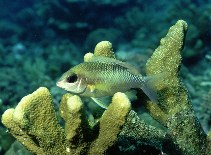
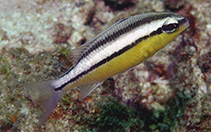
เงี่ยงครีบหลัง (รวม) : 10; ก้านครีบอ่อนที่หาง (รวม) : 9; เงี่ยงครีบก้น: 3; ก้านครีบอ่อนที่ก้น: 7. Head scales reaching to or almost to posterior nostrils. Lower limb of preopercle scaly. Antrorse (forward-directed) suborbital spine absent. Pelvic fins long, reaching almost to or beyond level of origin of anal fin. Color: Upper body olive, white below. 2 pearly white stripes on snout in front of eyes. Lower lobe of caudal fin reddish. Juveniles white, with a narrow black stripe along back (only on some specimens) and black midlateral stripe. Some with a yellowish ventral surface. Presence of a black spot between first four dorsal spines. Some color variation between Indian and Pacific populations: juveniles lack yellow stripe in the Indian Ocean population and adults show a contrasting dark back compared to Pacific form (Ref. 48635). Body shape (shape guide): fusiform / normal; Cross section: oval.
Found on sand bottoms close to reefs. Feed on crustaceans, polychaete worms, mollusks and small fishes (Ref. 3810, 9785). Juveniles may be Batesian mimics of poison-fang blennies, Meiacanthus spp. (M. geminatus and M. vittatus) (Ref. 37816, 90102). It is parasitised by the monogenean Anoplodiscus hutsonae on the pectoral fins and body surface (Ref. 124057).
Russell, B.C., 1990. FAO Species Catalogue. Vol. 12. Nemipterid fishes of the world. (Threadfin breams, whiptail breams, monocle breams, dwarf monocle breams, and coral breams). Family Nemipteridae. An annotated and illustrated catalogue of nemipterid species known to date. FAO Fish. Synop. 125(12):149p. Rome: FAO. (Ref. 3810)
สถานะบัญชีแดงของ IUCN (Ref. 130435: Version 2025-2 (Global))
อุณหภูมิที่ต้องการ (อ้างอิง 123201): 26.7 - 29.3, mean 28.7 °C (based on 1950 cells).
ดัชนีความหลากหลายทางวิวัฒนาการ (อ้างอิง 82804): PD50 = 0.5000 [Uniqueness, from 0.5 = low to 2.0 = high].
Bayesian length-weight: a=0.01622 (0.00961 - 0.02738), b=2.99 (2.85 - 3.13), in cm total length, based on LWR estimates for this species & Genus-body shape (Ref. 93245).
ระดับชั้นอาหาร (อ้างอิง 69278): 3.6 ±0.52 se; based on food items.
ความสามารถในการกลับคืนสู่ปกติ (อ้างอิง 120179): ความสูง, เวลาต่ำสุดที่จะทำให้ประชากรเพิ่มขึ้นเป็น 2 เท่าใช้เวลาน้อยกว่า 15 เดือน (Preliminary K or Fecundity.).
ความเสี่ยงต่อการตกปลา (Ref. 59153): Low vulnerability (18 of 100). 🛈