



Paretroplus nourissati (Allgayer, 1998)
Blood-finned Madagascar cichlid
Hochladen Photos und videos
Bilder | Google Bild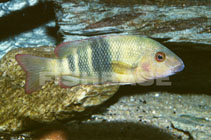 Paretroplus nourissati
Male Photo von Artigas Azas, J.M.
Bilder | Google Bild
Male Photo von Artigas Azas, J.M.
Klassifizierung / Names Namen | Synonyme | Catalog of Fishes(Gattung, Arten) | ITIS | CoL | WoRMS | Cloffa
> Cichliformes (Cichlids, convict blennies) > Cichlidae (Cichlids) > Etroplinae
Etymology: Paretroplus: Name from the Greek 'para' meaning 'on the side of'; in taxonomy it is commonly used in generic names to express similarity or relatedness; in the present case it would mean 'next to Etroplus' (S.Kullander, pers.comm. 3/11).
Eponymy: Jean Claude Nourissat (1942–2003) was a French cichlid aquarist and collector who risked his life looking for new species in Madagascar, including the Paretroplus (he died from malaria three days after returning from his last trip there). [...] (Ref. 128868), visit book page.
Etymology: Paretroplus: Name from the Greek 'para' meaning 'on the side of'; in taxonomy it is commonly used in generic names to express similarity or relatedness; in the present case it would mean 'next to Etroplus' (S.Kullander, pers.comm. 3/11).
Eponymy: Jean Claude Nourissat (1942–2003) was a French cichlid aquarist and collector who risked his life looking for new species in Madagascar, including the Paretroplus (he died from malaria three days after returning from his last trip there). [...] (Ref. 128868), visit book page.
Umwelt: Milieu / Klimazone / Tiefenbereich / Verbreitungsgebiet Ökologie
; süßwasser benthopelagisch. Tropical
Verbreitung Territorien | FAO Gebiete | Ökosysteme | Vorkommen | Punkt Karte | Einführungen | Faunafri
Africa: Sofia River basin in Madagascar (Ref. 78623).
Größe / Gewicht / Alter
Kurzbeschreibung Bestimmungsschlüssel | Morphologie | Morphometrie
Rückenflossenstacheln (insgesamt) : 14 - 16; Rückenflossenweichstrahlen (insgesamt) : 12 - 15; Afterflossenstacheln: 7 - 8; Afterflossenweichstrahlen: 10 - 13. Diagnosis: A shallow-bodied, elongate Paretroplus diagnosed from all congeners except P. lamenabe and P. tsimoly by the presence of two wide and convergent, below the lateral midline, dark brown to black midlateral bands, representing the second and third or third and four bars in series; Paretroplus nourissati is diagnosed in life by a pigmentation pattern of broad vertical black bars on the flanks over bright orange to reddish-orange ground colouration (Ref. 78623). It is further distinguished from both P. lamenabe and P. tsimoly, in life and preservative, by the absence of bluish-gray to bluish-black lips, lower jaw, lower cheek, gular region, and belly; Paretroplus nourissati is further distinguished from P. lamenabe by a shallower body, 38.1-43.5% of standard length vs. 47.0-54.3%; pelvic fins that do not extend to origin of the anal fin when adducted, and by a smaller adult size, up to 160 mm standard length vs. regularly exceeding 180 mm standard length in P. lamenabe; it is further distinguished from P. tsimoly by the absence of enlarged, lobed lips; only P. lamenabe and P. nourissati exhibit a lateral pigmentation pattern in which the central two bars, which converge below the lateral midline, are by far the most prominent; by contrast, in life and preservation, P. tsimoly exhibits a pigmentation pattern in which the posteriormost five or four, as the bar on the caudal peduncle is sometimes pale, bars on the flanks are about equally prominent (Ref. 78623).
Body shape (shape guide): fusiform / normal.
Body shape (shape guide): fusiform / normal.
Lebenszyklus und Paarungsverhalten Geschlechtsreife | Fortpflanzung | Ablaichen | Eier | Fruchtbarkeit | Larven
Hauptreferenz
Laden Sie Ihre Referenzen hoch | Referenzen | Koordinator : Kullander, Sven O. | Partner
Sparks, J.S., 2008. Phylogeny of the cichlid subfamily Etroplinae and taxonomic revision of the Malagasy cichlid genus Paretroplus (Teleostei: Cichlidae). Bull. Am. Mus. Nat. Hist. 314:1-151. (Ref. 78623)
IUCN Rote Liste Status (Ref. 130435: Version 2025-2 (Global))
stark gefährdet (EN) (B1ab(iii,v)); Date assessed: 26 June 2016
CITES
Not Evaluated
Bedrohung für Menschen
Harmless
Nutzung durch Menschen
FAO - Publication: search | FishSource |
Mehr Information
Trophische Ökologie
Lebensmittel (Beutetiere)
Nahrungszusammensetzung
Nahrungsaufnahme
Lebensmittelrationen
Räuber
Lebensmittel (Beutetiere)
Nahrungszusammensetzung
Nahrungsaufnahme
Lebensmittelrationen
Räuber
Ökologie
Ökologie
Ökologie
Populationsdynamik
Wachstumsparameter
Max. Alter/Größen
Länge-Gewicht-Rel.
Länge-Länge-Verhältnis.
Längenhäufigkeiten
Massenkonvertierung
Rekrutierung
Dichte
Wachstumsparameter
Max. Alter/Größen
Länge-Gewicht-Rel.
Länge-Länge-Verhältnis.
Längenhäufigkeiten
Massenkonvertierung
Rekrutierung
Dichte
Lebenszyklus
Fortpflanzung
Geschlechtsreife
Reifung/Kiemen rel.
Fruchtbarkeit
Ablaichen
Laichaggregationen
Eier
Eientwicklung
Larven
Larven Pop.Dyn.
Fortpflanzung
Geschlechtsreife
Reifung/Kiemen rel.
Fruchtbarkeit
Ablaichen
Laichaggregationen
Eier
Eientwicklung
Larven
Larven Pop.Dyn.
Anatomie
Kiemenoberfläche
Gehirn
Otolith
Kiemenoberfläche
Gehirn
Otolith
Physiologie
Körperliche Zusammensetzung
Nährstoffe
Sauerstoffverbrauch
Schwimmart
Schwimmgeschwindigkeit
Visuelle Pigmente
Fischgeräusche
Krankheiten und Parasiten
Toxizität (LC50s)
Körperliche Zusammensetzung
Nährstoffe
Sauerstoffverbrauch
Schwimmart
Schwimmgeschwindigkeit
Visuelle Pigmente
Fischgeräusche
Krankheiten und Parasiten
Toxizität (LC50s)
Genetik
Genom
Genetik
Heterozygotie
Vererbbarkeit
Genetische Vielfalt
Genom
Genetik
Heterozygotie
Vererbbarkeit
Genetische Vielfalt
Menschenbezogen
Aquakultur-Systeme
Aquakultur Profile
Zuchtlinien
Ciguatera-Fälle
Briefmarken, Münzen, Verschiedenes.
Aquakultur-Systeme
Aquakultur Profile
Zuchtlinien
Ciguatera-Fälle
Briefmarken, Münzen, Verschiedenes.
Tools
Zusatzinformationen
Download XML
Zusammenfassung | Punktdaten | Namen | Photos
Internet Quellen
AFORO (otoliths) | Aquatic Commons | BHL | Cloffa | Websites from users | FishWatcher Einträge suchen | CISTI | Catalog of Fishes: Gattung, Arten | DiscoverLife | ECOTOX | FAO - Publication: search | Faunafri | Fishipedia | Fishtrace | GloBI | Google Books | Google Scholar | Google | IGFA World Record | OneZoom | Open Tree of Life | Otolith Atlas of Taiwan Fishes | PubMed | Reef Life Survey | Socotra Atlas | TreeBase | Tree of Life | Wikipedia: Gehe zu, Suchen | | Zoologischer Rekord
Schätzungen auf der Grundlage von Modellen
|
Phylogenetischer Diversitätsindex (Ref. 82804) |
PD50 = 0.5001 [Uniqueness, from 0.5 = low to 2.0 = high]. |
| Bayesian length-weight | a=0.01660 (0.00655 - 0.04205), b=2.95 (2.74 - 3.16), in cm total length, based on LWR estimates for this (Sub)family-body shape (Ref. 93245). |
|
Trophische Ebene (Ref. 69278) |
2.8 ±0.3 se; based on size and trophs of closest relatives |
|
Widerstandsfähigkeit (Ref. 120179) |
hoch, Verdopplung der Population dauert weniger als 15 Monate. (Preliminary K or Fecundity.). |
|
Anfälligkeit der Fischerei (Ref. 59153) |
Low vulnerability (23 of 100). 🛈 |