



Rhinecanthus rectangulus (Bloch & Schneider, 1801)
Wedgetail triggerfish
Aggiungete la vostra osservazione in Fish Watcher
| Native range | All suitable habitat | Point map | Year 2050 |

|
| This map was computer-generated and has not yet been reviewed. |
| Rhinecanthus rectangulus AquaMaps Data sources: GBIF OBIS |
Carica il tuo foto e Video
Immagini | Video | Google image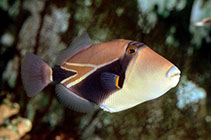 Rhinecanthus rectangulus
Immagine di Muséum-Aquarium de Nancy/D. Terver
Immagini | Video | Google image
Immagine di Muséum-Aquarium de Nancy/D. Terver
Classificazione / Nomi Nomi Comuni | Sinonimi | Catalog of Fishes(Genere, Specie) | ITIS | CoL | WoRMS | Cloffa
> Tetraodontiformes (Puffers and filefishes) > Balistidae (Triggerfishes)
Etymology: Rhinecanthus: Greek, rhinos = nose + Greek, akantha = thorn (Ref. 45335).
Eponymy: Pablo Ruiz Picasso (1881–1973) was a Spanish painter and sculptor. The vivid patterns and colours of Rhinecanthus triggerfish have led to them being popularly known as picassofish. (Ref. 128868), visit book page.
More on authors: Bloch & Schneider.
Etymology: Rhinecanthus: Greek, rhinos = nose + Greek, akantha = thorn (Ref. 45335).
Eponymy: Pablo Ruiz Picasso (1881–1973) was a Spanish painter and sculptor. The vivid patterns and colours of Rhinecanthus triggerfish have led to them being popularly known as picassofish. (Ref. 128868), visit book page.
More on authors: Bloch & Schneider.
Ambiente: milieu / zona climatica / distribuzione batimetrica / gamma di distribuzione Ecologia
marino associati a barriera corallina; distribuzione batimetrica 0 - 20 m (Ref. 9770). Tropical; 30°N - 32°S
Distribuzione Territories | Aree FAO | Ecosistemi | Presenze | Mappa dei ritrovamenti | Introduzioni | Faunafri
Indo-Pacific: Red Sea south to East Africa through Indonesia and northern Australia up to Hawaii and Pitcairn islands; north to southern Japan.
Dimensione / Peso / Età
Breve descrizione Chiavi di identificazione | Morfologia | Morfometria
Spine dorsali (totale) : 3; Raggi dorsali molli (totale) : 22 - 25; Spine anali: 0; Raggi anali molli: 20 - 22. Body orange-brown above; head and belly white; soft dorsal, anal and pectoral fins pale; caudal fin dusky (Ref. 4420).
Body shape (shape guide): short and / or deep.
Body shape (shape guide): short and / or deep.
Occur in shallow outer reefs subject to surge (Ref. 9770, 48637). Commonly found over barren rock or the spur-and-groove zone where there is a mixture of bare rock, rubble, and coral. Juveniles on algae reef (Ref. 48637). Benthopelagic (Ref. 58302). Feed on algae, detritus, mollusks, crustaceans, worms, echinoderms, fishes, sponges, foraminiferans, and eggs. Territorial. Oviparous (Ref. 205). Also taken by drive-in nets (Ref. 9770). Minimum depth reported taken from Ref. 128797.
Ciclo vitale e comportamento di accoppiamento Maturità | Riproduzione | Deposizione | Uova | Fecondità | Larve
Distinct pairing (Ref. 205).
Riferimento principale
Caricare le referenze | Bibliografia | Coordinatore : Matsuura, Keiichi | Collaboratori
Matsuura, K., 2001. Balistidae. Triggerfishes. p. 3911-3928. In K.E. Carpenter and V. Niem (eds.) FAO species identification guide for fishery purposes. The living marine resources of the Western Central Pacific. Vol. 6. Bony fishes part 4 (Labridae to Latimeriidae), estuarine crocodiles. FAO, Rome. (Ref. 9770)
Stato della Lista Rossa IUCN (Ref. 130435: Version 2025-2 (Global))
Least Concern (LC) ; Date assessed: 14 January 2022
CITES
Not Evaluated
Minaccia per l'uomo
Harmless
Usi umani
Pesca: scarso interesse commerciale; Acquario: Commerciale
FAO - Publication: search | FishSource | Sea Around Us
Informazioni ulteriori
Ecologia trofica
Articoli alimentari (prede)
Alimentazione
Consumo di cibo
Razioni alimentari
Predatori
Articoli alimentari (prede)
Alimentazione
Consumo di cibo
Razioni alimentari
Predatori
Dinamica della popolazione
Parametri di crescita
Età massima / dimensioni massime
Rapporto lunghezza-peso.
Lunghezza-lunghezza rel.
Lunghezza-frequenze
Conversione di massa
Reclutamento
Abbondanza
Parametri di crescita
Età massima / dimensioni massime
Rapporto lunghezza-peso.
Lunghezza-lunghezza rel.
Lunghezza-frequenze
Conversione di massa
Reclutamento
Abbondanza
Ciclo di vita
Riproduzione
Maturità
Maturità/Gli occhielli sono relativi.
Fecondità
Deposizione
Aggregazioni riproduttive
Uova
Sviluppo delle uova
Larve
Dinamica popolazioni larvali
Riproduzione
Maturità
Maturità/Gli occhielli sono relativi.
Fecondità
Deposizione
Aggregazioni riproduttive
Uova
Sviluppo delle uova
Larve
Dinamica popolazioni larvali
Fisiologia
Composizione corporea
Nutrienti
Consumo di ossigeno
Tipo di nuoto
Velocità di nuoto
Pigmenti visivi
Suono del pesce
Malattie e parassiti
Tossicità (LC50)
Composizione corporea
Nutrienti
Consumo di ossigeno
Tipo di nuoto
Velocità di nuoto
Pigmenti visivi
Suono del pesce
Malattie e parassiti
Tossicità (LC50)
Legato all'uomo
Sistemi di acquacoltura
Profili di acquacoltura
Varietà
Casi di Ciguatera
Francobolli, monete, materiale vario.
Sistemi di acquacoltura
Profili di acquacoltura
Varietà
Casi di Ciguatera
Francobolli, monete, materiale vario.
Strumenti
Libro elettronico | Giuda pratica | Chiavi di identificazione | Generatore frequenze di lunghezza | Strumento Parametri Biologici | Mappa dei ritrovamenti |
Cattura-MSY |
Rapporti speciali
Controllo della manutenzione dell'acquario | Verificare la presenza di schede informative sulle specie | Verifica delle schede informative sull'acquacoltura
Scarica XML
Fonti Internet
AFORO (otoliths) | Aquatic Commons | BHL | Cloffa | Websites from users | Check FishWatcher | CISTI | Catalog of Fishes: Genere, Specie | DiscoverLife | ECOTOX | FAO - Publication: search | Faunafri | Fishipedia | Fishtrace | GloBI | Google Books | Google Scholar | Google | IGFA World Record | Database Nazionali | OneZoom | Open Tree of Life | Otolith Atlas of Taiwan Fishes | Acquari pubblici | PubMed | Reef Life Survey | Socotra Atlas | TreeBase | Tree of Life | Wikipedia: Go, ricerca | World Records Freshwater Fishing | Record zoologico
Stime basate su modelli
Temperatura preferita (Fonte Biblio. 123201): 24.8 - 29.3, mean 28.3 °C (based on 2985 cells).
Indice di diversità filogenetica (Fonte Biblio. 82804): PD50 = 0.5078 [Uniqueness, from 0.5 = low to 2.0 = high].
Bayesian length-weight: a=0.02692 (0.01559 - 0.04647), b=2.90 (2.75 - 3.05), in cm total length, based on LWR estimates for this species & (Sub)family-body (Ref. 93245).
Livello trofico (Fonte Biblio. 69278): 3.5 ±0.3 se; based on diet studies.
Resilienza (Fonte Biblio. 120179): Medio, tempo minimo di raddoppiamento della popolazione 1.4 - 4.4 anni (Preliminary K or Fecundity.).
Nutrienti (Ref. 124155): Calcium = 47.6 [19.7, 119.4] mg/100g; Iron = 0.614 [0.304, 1.369] mg/100g; Protein = 18.5 [16.4, 20.7] %; Omega3 = 0.109 [0.055, 0.214] g/100g; Selenium = 28.2 [14.6, 59.2] μg/100g; VitaminA = 59 [17, 203] μg/100g; Zinc = 1.08 [0.73, 1.62] mg/100g (wet weight);