This website uses cookies to enhance your browsing experience and ensure the functionality of our site. For more detailed information about the types of cookies we use and how we protect your privacy, please visit our Privacy Information page.
×
Cookie Settings
This website uses different types of cookies to enhance your experience. Please select your preferences below:
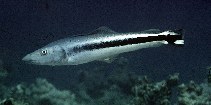
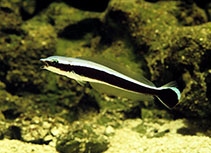
Malacanthus latovittatus, Blue blanquillo : fisheries, aquarium
> Eupercaria/misc (Various families in series Eupercaria) > Malacanthidae (Tilefishes)
Etymology: Malacanthus:Greek, mala = a lot + Greek, akantha = thorn (Ref. 45335). More on author: Lacepède.
Environnement : milieu / zone climatique / profondeur / gamme de distribution Écologie
marin récifal; non migrateur (Ref. 52884); profondeur 5 - 65 m (Ref. 90102), usually 20 - 65 m (Ref. 27115). Tropical; 22°C - 28°C (Ref. 27115); 35°N - 25°S
Indo-Pacific: Red Sea and Kenya east to Hawaiian Islands, Fanning Islands and Samoa; northward to Japan south to Australia. Apparently not found off New Zealand (Ref. 8991).
Taille / Poids / Âge
Maturité: Lm? range ? - ? cm Max length : 45.0 cm SL mâle / non sexé; (Ref. 8991); common length : 35.0 cm SL mâle / non sexé; (Ref. 9645)
Found on outer reef slopes, hovering above the bottom. They swim often high above the substrate to pick prey from the substrate with their excellent eyesight (Ref. 48635). They tend to swim away from its pursuer rather than enter its burrow (Ref. 1602). Solitary or in pairs (Ref. 9710), Monogamous and always in home-ranging pairs, that is they do not defend an exclusive territory (Refs. 52884, 37816). Maximum depth from Ref. 027115.
Cycle de vie et comportement reproducteur Maturité | Reproduction | Frai | Œufs | Fécondité | Larves
Monogamous mating is observed as both obligate and genetic (Ref. 52884).
Dooley, J.K., 1978. Systematics and biology of the tilefishes (Perciformes: Branchiostegidae and Malacanthidae) with descriptions of two new species. NOAA Tech. Rep. NMFS Circ. No. 411:1-78. (Ref. 8991)
Statut dans la liste rouge de l'IUCN (Ref. 130435: Version 2025-2 (Global))
Cycle de vie Reproduction Maturité Maturité/épines rel. Fécondité Frai Agrégats de frai Œufs Développement de l'œuf Larves Dynamique des populations larvaires
Physiologie Composition corporelle Nutriments Consommation d'oxygène Type de natation Vitesse de nage Pigments visuels Son de poisson Maladies et parasites Toxicité (CL50)
Température préférée (Réf. 123201): 24.6 - 29, mean 27.9 °C (based on 1578 cells).
Indice de diversité phylogénétique (Réf. 82804): PD50 = 0.6250 [Uniqueness, from 0.5 = low to 2.0 = high].
Bayesian length-weight: a=0.00537 (0.00239 - 0.01205), b=3.03 (2.82 - 3.24), in cm total length, based on LWR estimates for this (Sub)family-body shape (Ref. 93245).
Niveau trophique (Réf. 69278): 3.5 ±0.50 se; based on food items.
Vulnérabilité de la pêche (Ref. 59153): Moderate vulnerability (42 of 100). 🛈