



Envoyez vos Photos et vidéos
Images Google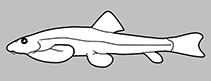 No image available for this species;
drawing shows typical species in Gastromyzontidae.
Images Google
drawing shows typical species in Gastromyzontidae.
Classification / Noms Noms communs | Synonymes | Catalog of Fishes(Genre, Espèce) | ITIS | CoL | WoRMS | Cloffa
> Cypriniformes (Carps) > Gastromyzontidae (Hillstream loaches)
Etymology: serrilineata: From the Latin serra (saw) and lineatus (striped) a reference to the saw-toothed midlateral stripe.
Eponymy: Mari Albert Johan Van Manen (1877–1943) was a Dutch ethnographer, theosophist and orientalist who made a specialty of the study of Tibet and its texts. [...] (Ref. 128868), visit book page.
More on author: Kottelat.
Etymology: serrilineata: From the Latin serra (saw) and lineatus (striped) a reference to the saw-toothed midlateral stripe.
Eponymy: Mari Albert Johan Van Manen (1877–1943) was a Dutch ethnographer, theosophist and orientalist who made a specialty of the study of Tibet and its texts. [...] (Ref. 128868), visit book page.
More on author: Kottelat.
Environnement : milieu / zone climatique / profondeur / gamme de distribution Écologie
; eau douce démersal; pH range: 8.1 - ?. Tropical; 16°C - ? (Ref. 95066)
Distribution Territoires | Zones FAO | Écosystèmes | Occurrences | Carte par point | Introductions | Faunafri
Asia: Mekong at Nam Ou and Nam Tha basins in northern Laos and Nanlahe River, Mekong Basin in Yunnan, China.
Taille / Poids / Âge
Description synthétique Clés d'identification | Morphologie | Morphométrie
Caudal peduncle 1.2-1.4 times longer than deep, depth 8.6-9.7 %SL; anus closer to posterior extremity of pelvic-fin base than caudal-fin origin; 18-30 dark brown bars on body, their width conspicuously smaller than eye diameter, very irregularly shaped and spaced, more or less connected along lateral line to form a saw-toothed stripe; juveniles with 5-6 broad black bars on body and a large black blotch on anterior half of caudal fin; 5 large saddles on back; pelvic and pectoral fins yellow in life, with a series of dark brown marks; 2-3 irregular row of brown spots on dorsal fin, 2 irregular black bars or rows of spots on caudal fin; 15-16 branched pectoral-fin rays; 8 branched pelvic-fin rays (Ref. 36949).
Body shape (shape guide): elongated; Cross section: compressed.
Body shape (shape guide): elongated; Cross section: compressed.
Collected in swift creeks under forest cover (Ref. 36949). Also recorded from a stream with clear water ((16 °C; pH 8.1; 250 μs/cm; measured on 1 January 2011 at 11:00 am) that flowed over boulders and rocks with moderate to fast current. Found syntopic with nemacheilids Schistura macrocephalus and Pteronemacheilus meridionalis, the snakehead Channa gachua, and cyprinids such as Barilius pulchellus, Devario chrysotaeniatus, Poropuntius huangchuchieni, and Scaphiodonichthys acanthopterus (Ref. 95066).
Cycle de vie et comportement reproducteur Maturité | Reproduction | Frai | Œufs | Fécondité | Larves
Référence principale
Téléchargez vos références | Références | Coordinateur | Collaborateurs
Kottelat, M., 2000. Diagnosis of a new genus and 64 new species of fishes from Laos (Teleostei: Cyprinidae, Balitoridae, Bagridae, Syngnathidae, Chaudhuriidae and Tetraodontidae). J. South Asian Nat. Hist. 5(1):37-82. (Ref. 36949)
Statut dans la liste rouge de l'IUCN (Ref. 130435: Version 2025-2 (Global))
Données manquantes (DD) ; Date assessed: 09 February 2011
CITES
Not Evaluated
Menace pour l'homme
Harmless
Utilisations par l'homme
FAO - Publication: search | FishSource |
Plus d'informations
Écologie trophique
Aliments (proies)
Composition du régime alimentaire
Consommation alimentaire
Rations alimentaires
Prédateurs
Aliments (proies)
Composition du régime alimentaire
Consommation alimentaire
Rations alimentaires
Prédateurs
Écologie
Écologie
Écologie
Dynamique des populations
Paramètres de croissance
Âges / tailles maximales
Longueur-poids rel.
Rel. longueur-longueur.
Fréquences de longueurs
Conversion de masse
Recrutement
Abondance
Paramètres de croissance
Âges / tailles maximales
Longueur-poids rel.
Rel. longueur-longueur.
Fréquences de longueurs
Conversion de masse
Recrutement
Abondance
Cycle de vie
Reproduction
Maturité
Maturité/épines rel.
Fécondité
Frai
Agrégats de frai
Œufs
Développement de l'œuf
Larves
Dynamique des populations larvaires
Reproduction
Maturité
Maturité/épines rel.
Fécondité
Frai
Agrégats de frai
Œufs
Développement de l'œuf
Larves
Dynamique des populations larvaires
Anatomie
Surface branchiale
Cerveau
Otolithe
Surface branchiale
Cerveau
Otolithe
Physiologie
Composition corporelle
Nutriments
Consommation d'oxygène
Type de natation
Vitesse de nage
Pigments visuels
Son de poisson
Maladies et parasites
Toxicité (CL50)
Composition corporelle
Nutriments
Consommation d'oxygène
Type de natation
Vitesse de nage
Pigments visuels
Son de poisson
Maladies et parasites
Toxicité (CL50)
Génétique
génôme
Génétique
Hétérozygotie
Héritabilité
Diversité génétique
génôme
Génétique
Hétérozygotie
Héritabilité
Diversité génétique
Liées à l'homme
Systèmes d'aquaculture
Profils d'aquaculture
Souches
Cas de ciguatera
Timbres, pièces de monnaie, divers
Systèmes d'aquaculture
Profils d'aquaculture
Souches
Cas de ciguatera
Timbres, pièces de monnaie, divers
Outils
E-book | Guide de terrain | Générateur de fréquences de longueur | Outil de dynamique de population | Carte par point |
Capture-MSY |
Articles particuliers
Télécharger en XML
Sources Internet
AFORO (otoliths) | Aquatic Commons | BHL | Cloffa | Websites from users | FishWatcher | CISTI | Catalog of Fishes: Genre, Espèce | DiscoverLife | ECOTOX | FAO - Publication: search | Faunafri | Fishipedia | Fishtrace | GloBI | Google Books | Google Scholar | Google | IGFA World Record | OneZoom | Open Tree of Life | Otolith Atlas of Taiwan Fishes | PubMed | Reef Life Survey | Socotra Atlas | TreeBase | Arbre de Vie | Wikipedia: aller à, chercher | World Records Freshwater Fishing | Zoobank | Zoological Record
Estimations basées sur des modèles
Indice de diversité phylogénétique (Réf. 82804): PD50 = 0.5000 [Uniqueness, from 0.5 = low to 2.0 = high].
Bayesian length-weight: a=0.00646 (0.00285 - 0.01461), b=3.11 (2.91 - 3.31), in cm total length, based on LWR estimates for this (Sub)family-body shape (Ref. 93245).
Niveau trophique (Réf. 69278): 2.7 ±0.2 se; based on size and trophs of closest relatives