This website uses cookies to enhance your browsing experience and ensure the functionality of our site. For more detailed information about the types of cookies we use and how we protect your privacy, please visit our Privacy Information page.
×
Cookie Settings
This website uses different types of cookies to enhance your experience. Please select your preferences below:
Indo-West Pacific: Red Sea and East Africa to Papua New Guinea, north to the Ryukyu Islands, south to Australia. Recorded in Bay of Islands, New Zealand (Ref. 35942). Also reported from Persian Gulf (Ref. 68964).
Größe / Gewicht / Alter
Geschlechtsreife: Lm? range ? - ? cm Max length : 70.0 cm TL Männchen/unbestimmt; (Ref. 11441)
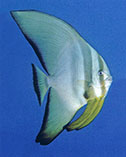
Rückenflossenstacheln (insgesamt) : 5 - 6; Rückenflossenweichstrahlen (insgesamt) : 28 - 37; Afterflossenstacheln: 3; Afterflossenweichstrahlen: 22 - 28. Ocular band of adult specimens uniformly dark (Ref. 5327). Yellowish silvery or dusky, with a black (or dusky) bar through eye and another dark bar from dorsal-fin origin across rear edge of operculum and pectoral-fin base to belly, where it usually encloses a black blotch, with another smaller black vertical streak often present at origin of anal fin. Median fins dusky yellow, with black margins posteriorly. Pelvic fins yellow, dusky yellow or blackish. Body orbicular and strongly compressed, its depth more than twice length of head and 0.9 to 1.2 times SL. Head length 2.7 to 3.5 times in SL. Large adults (above 35 cm standard length) with bony hump from top of head to interorbital region, the front head profile almost vertical. Interorbital width 42 to 50% head length. Jaws with bands of slender, flattened, tricuspid teeth, the middle cusp slightly longer than lateral cusps. Vomer with a few teeth, but none on palatines. Five pores on each side of lower jaw. Preopercle smooth. Opercle without spines (Ref 43039). Body shape (shape guide): short and / or deep; Cross section: compressed.
Large adults live in sheltered bays as well as deep offshore. Commonly found around shipwrecks in small groups and occasionally forms large schools. Small juveniles with floating debris and form aggregations as they find each other. They can be pelagic to large sizes and form schools under large Sargassum rafts that usually form after the wet season (Ref. 48637). Juveniles inhabit shallow protected inner reefs while adults occur in lagoon and seaward reefs to a depth of 20 m or more. Edible but not esteemed (Ref. 12484). Not an important game fish (Ref. 12484).
Bevorzugte Temperatur (Ref. 123201): 24.6 - 28.9, mean 28.2 °C (based on 2481 cells).
Phylogenetischer Diversitätsindex (Ref. 82804): PD50 = 0.5313 [Uniqueness, from 0.5 = low to 2.0 = high].
Bayesian length-weight: a=0.02818 (0.01180 - 0.06734), b=2.94 (2.74 - 3.14), in cm total length, based on LWR estimates for this (Sub)family-body shape (Ref. 93245).
Trophische Ebene (Ref. 69278): 4.0 ±0.64 se; based on food items.
Widerstandsfähigkeit (Ref. 120179): niedrig, Verdopplung der Population dauert 4,5 - 14 Jahre. (Preliminary K or Fecundity.).
Anfälligkeit der Fischerei (Ref. 59153): Moderate to high vulnerability (48 of 100). 🛈