



Stolephorus insularis Hardenberg, 1933
Hardenberg's anchovy
Beobachtung melden im Fish Watcher
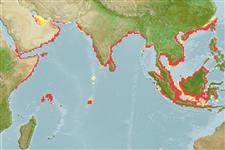
| Native range | All suitable habitat | Point map | Year 2050 |
|
| This map was computer-generated and has not yet been reviewed. |
| Stolephorus insularis AquaMaps Data sources: GBIF OBIS |
Hochladen Photos und videos
Bilder | Google Bild Stolephorus insularis
Photo von Shao, K.T.
Bilder | Google Bild
Photo von Shao, K.T.
Klassifizierung / Names Namen | Synonyme | Catalog of Fishes(Gattung, Arten) | ITIS | CoL | WoRMS | Cloffa
> Clupeiformes (Herrings) > Engraulidae (Anchovies) > Engraulinae
Etymology: Stolephorus: Greek, stole, -es = garment + Greek, pherein = to carry (Ref. 45335).
Etymology: Stolephorus: Greek, stole, -es = garment + Greek, pherein = to carry (Ref. 45335).
Taxonomic Remarks
Junior synonym Stolephorus baweanensis Hardenberg, 1933 is considered valid in CofF ver. 06 June 2023 following Hata et al., 2019 (Ref. 128121:11).
Umwelt: Milieu / Klimazone / Tiefenbereich / Verbreitungsgebiet Ökologie
seewasser; brackwasser pelagic-neritic; ozeanodrom (Ref. 51243); tiefenbereich 0 - 50 m (Ref. 189). Tropical; 28°N - 9°S, 42°E - 123°E (Ref. 189)
Verbreitung Territorien | FAO Gebiete | Ökosysteme | Vorkommen | Punkt Karte | Einführungen | Faunafri
Indo-Pacific: northern part of the Indian Ocean (Gulf of Aden, not Red Sea or the Persian Gulf, eastward to Burma) and western Pacific (Gulf of Thailand, Java Sea, also Hong Kong, Fujian and Taiwan Island; if correctly identified, then reaches to Fiji and Samoa) (Ref. 189). Mediterranean: Tel Aviv, Israel (Ref. 96660).
Länge bei der ersten Reifung / Größe / Gewicht / Alter
Kurzbeschreibung Bestimmungsschlüssel | Morphologie | Morphometrie
Afterflossenstacheln: 0; Afterflossenweichstrahlen: 17 - 20. Diagnosis: Body somewhat compressed, belly with 4-8 small needle-like pre-pelvic scutes; a small pre-dorsal spine in some specimens; maxilla tip pointed, reaching to or beyond hind border of pre-operculum, the latter concave, indented near maxilla tip; lower gillrakers 21 to 28; fine teeth on upper edge of hyoid bones; anal fin short, usually with 3 unbranched and 14-17 branched finrays, its origin below about middle of dorsal fin base; a double pigment line on back behind dorsal fin; tail deep yellow, at least in Indian specimens (Ref. 189). Of species with an indented pre-operculum, Stolephorus andhraensis has fewer gillrakers, 20-21, and S. ronquilloi has more gillrakers, 28-30; other species with a pre-dorsal spine also have a spine on the pelvic scute, like in S. dubiosus, S. baganensis and S. tri; hyoid tooth patches are present in S. commersonnii, but pre-operculum rounded, scutes usually 1-4, and in S. carpenteriae, but no pigment lines on back, anal origin under anterior part of dorsal fin base (Ref. 189).
Body shape (shape guide): elongated; Cross section: compressed.
Body shape (shape guide): elongated; Cross section: compressed.
Coastal pelagic (Ref. 68964). A schooling species occurring in coastal waters. More data needed based on correct identifications. The record from the Godavari estuary implies tolerance of lowered salinities, but the identity of the material is uncertain (perhaps S. waitei). Appears to be fairly common throughout its range. Used as bait in the tuna fishery in the South Pacific, although rather fragile.
Lebenszyklus und Paarungsverhalten Geschlechtsreife | Fortpflanzung | Ablaichen | Eier | Fruchtbarkeit | Larven
Hauptreferenz
Laden Sie Ihre Referenzen hoch | Referenzen | Koordinator | Partner
Whitehead, P.J.P., G.J. Nelson and T. Wongratana, 1988. FAO Species Catalogue. Vol. 7. Clupeoid fishes of the world (Suborder Clupeoidei). An annotated and illustrated catalogue of the herrings, sardines, pilchards, sprats, shads, anchovies and wolf-herrings. FAO Fish. Synop. 125(7/2):305-579. Rome: FAO. (Ref. 189)
IUCN Rote Liste Status (Ref. 130435: Version 2025-2 (Global))
Daten mangelhaft (DD) ; Date assessed: 10 March 2020
CITES
Not Evaluated
Bedrohung für Menschen
Harmless
Nutzung durch Menschen
Fischereien: kommerziell; Köder: usually
FAO - Publication: search | FishSource | Das Meer um uns herum
Mehr Information
Trophische Ökologie
Lebensmittel (Beutetiere)
Nahrungszusammensetzung
Nahrungsaufnahme
Lebensmittelrationen
Räuber
Lebensmittel (Beutetiere)
Nahrungszusammensetzung
Nahrungsaufnahme
Lebensmittelrationen
Räuber
Ökologie
Ökologie
Ökologie
Populationsdynamik
Wachstumsparameter
Max. Alter/Größen
Länge-Gewicht-Rel.
Länge-Länge-Verhältnis.
Längenhäufigkeiten
Massenkonvertierung
Rekrutierung
Dichte
Wachstumsparameter
Max. Alter/Größen
Länge-Gewicht-Rel.
Länge-Länge-Verhältnis.
Längenhäufigkeiten
Massenkonvertierung
Rekrutierung
Dichte
Lebenszyklus
Fortpflanzung
Geschlechtsreife
Reifung/Kiemen rel.
Fruchtbarkeit
Ablaichen
Laichaggregationen
Eier
Eientwicklung
Larven
Larven Pop.Dyn.
Fortpflanzung
Geschlechtsreife
Reifung/Kiemen rel.
Fruchtbarkeit
Ablaichen
Laichaggregationen
Eier
Eientwicklung
Larven
Larven Pop.Dyn.
Anatomie
Kiemenoberfläche
Gehirn
Otolith
Kiemenoberfläche
Gehirn
Otolith
Physiologie
Körperliche Zusammensetzung
Nährstoffe
Sauerstoffverbrauch
Schwimmart
Schwimmgeschwindigkeit
Visuelle Pigmente
Fischgeräusche
Krankheiten und Parasiten
Toxizität (LC50s)
Körperliche Zusammensetzung
Nährstoffe
Sauerstoffverbrauch
Schwimmart
Schwimmgeschwindigkeit
Visuelle Pigmente
Fischgeräusche
Krankheiten und Parasiten
Toxizität (LC50s)
Genetik
Genom
Genetik
Heterozygotie
Vererbbarkeit
Genetische Vielfalt
Genom
Genetik
Heterozygotie
Vererbbarkeit
Genetische Vielfalt
Menschenbezogen
Aquakultur-Systeme
Aquakultur Profile
Zuchtlinien
Ciguatera-Fälle
Briefmarken, Münzen, Verschiedenes.
Aquakultur-Systeme
Aquakultur Profile
Zuchtlinien
Ciguatera-Fälle
Briefmarken, Münzen, Verschiedenes.
Tools
E-Book | Feldführer | Bestimmungsschlüssel | Längenhäufigkeits Tool | Lebensdaten Tool | Punkt Karte |
Catch-MSY |
Zusatzinformationen
Download XML
Zusammenfassung | Punktdaten | Namen | Photos
Internet Quellen
AFORO (otoliths) | Aquatic Commons | BHL | Cloffa | Websites from users | FishWatcher Einträge suchen | CISTI | Catalog of Fishes: Gattung, Arten | DiscoverLife | ECOTOX | FAO - Publication: search | Faunafri | Fishipedia | Fishtrace | GloBI | Google Books | Google Scholar | Google | IGFA World Record | Nationale Datenbanken | OneZoom | Open Tree of Life | Otolith Atlas of Taiwan Fishes | PubMed | Reef Life Survey | Socotra Atlas | TreeBase | Tree of Life | Wikipedia: Gehe zu, Suchen | World Records Freshwater Fishing | Zoobank | Zoologischer Rekord
Schätzungen auf der Grundlage von Modellen
Bevorzugte Temperatur (Ref. 123201): 25 - 29.2, mean 28.5 °C (based on 816 cells).
Phylogenetischer Diversitätsindex (Ref. 82804): PD50 = 0.5000 [Uniqueness, from 0.5 = low to 2.0 = high].
Bayesian length-weight: a=0.00417 (0.00229 - 0.00760), b=3.13 (2.98 - 3.28), in cm total length, based on LWR estimates for this species & Genus-body shape (Ref. 93245).
Trophische Ebene (Ref. 69278): 3.3 ±0.4 se; based on size and trophs of closest relatives
Generation time: 0.7 ( na - na) years. Estimated as median ln(3)/K based on 2 growth studies.
Widerstandsfähigkeit (Ref. 120179): hoch, Verdopplung der Population dauert weniger als 15 Monate. (K=1.61-20.8).
Nährstoffe (Ref. 124155): Calcium = 322 [83, 1,677] mg/100g; Iron = 2.35 [0.80, 5.89] mg/100g; Protein = 19.9 [17.5, 22.3] %; Omega3 = 0.248 [0.061, 1.094] g/100g; Selenium = 103 [22, 527] μg/100g; VitaminA = 17.9 [1.8, 166.4] μg/100g; Zinc = 5.43 [2.32, 10.65] mg/100g (wet weight);