This website uses cookies to enhance your browsing experience and ensure the functionality of our site. For more detailed information about the types of cookies we use and how we protect your privacy, please visit our Privacy Information page.
×
Cookie Settings
This website uses different types of cookies to enhance your experience. Please select your preferences below:
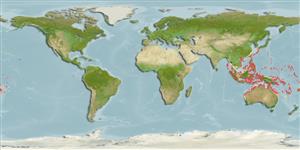
Indo-West Pacific: eastern edge of the Indian Ocean and Western Australia to New Guinea, New Britain, Solomon Islands, Marianas and Caroline Islands, Indonesia, Philippines, Taiwan and Ryukyu Islands. Also known from Vanuatu and New Caledonia; Palau and Yap in Micronesia (Ref. 1602); Samoa (Ref. 4537).
Größe / Gewicht / Alter
Geschlechtsreife: Lm? range ? - ? cm Max length : 8.5 cm TL Männchen/unbestimmt; (Ref. 48636)
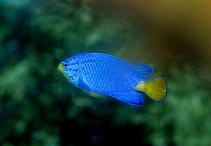
Adults are found amongst rubble and coral of clear sheltered lagoons and subtidal reef flats (Ref. 9710, 48636). They occur in groups of a male and several females or juveniles (Ref. 1602). Feed on algae, pelagic tunicates and copepods. Oviparous, distinct pairing during breeding (Ref. 205). Eggs are demersal and adhere to the substrate (Ref. 205). Males guard and aerate the eggs (Ref. 205). Diurnal species (Ref. 113699).
Oviparous, distinct pairing during breeding (Ref. 205). Eggs are demersal and adhere to the substrate (Ref. 205). Males guard and aerate the eggs (Ref. 205).
Bevorzugte Temperatur (Ref. 123201): 25.9 - 29.3, mean 28.6 °C (based on 2106 cells).
Phylogenetischer Diversitätsindex (Ref. 82804): PD50 = 0.5000 [Uniqueness, from 0.5 = low to 2.0 = high].
Bayesian length-weight: a=0.01445 (0.00624 - 0.03346), b=3.00 (2.81 - 3.19), in cm total length, based on LWR estimates for this (Sub)family-body shape (Ref. 93245).
Trophische Ebene (Ref. 69278): 2.5 ±0.1 se; based on diet studies.
Widerstandsfähigkeit (Ref. 120179): hoch, Verdopplung der Population dauert weniger als 15 Monate. (Preliminary K or Fecundity.).
Anfälligkeit der Fischerei (Ref. 59153): Low vulnerability (10 of 100). 🛈