



Uploaden van uw Foto's en video's
Afbeeldingen | Google afbeelding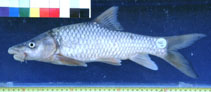 Labeobarbus nedgia
Afbeelding van Nagelkerke, L.
Afbeeldingen | Google afbeelding
Afbeelding van Nagelkerke, L.
Classificatie / Namen Lokale namen | Synoniemen | Catalog of Fishes(Genus, Soort(en)) | ITIS | CoL | WoRMS | Cloffa
Taxonomic Remarks
The species Barbus degeni Boulenger, 1902 is considered a synonym of Labeobarbus intermedius (Rüppell, 1835) in Eschmeyer (CofF ver. May 2011: Ref. 86870). It is treated here a synonym of Labeobarbus nedgia Rüppell, 1835 according to Nagelkerke & Sibbing (1997: Ref. 35835).
Milieu: milieu / Klimaatzone / Diepte / verspreidingsgebied Ecologie
; zoet water benthopelagisch; diepte 1 - 6 m (Ref. 35835). Tropical
Verspreiding Gebieden | FAO regio's | Ecosystemen | Voorkomen | Verspreidingskaart | Introducties | Faunafri
Africa: Lake Tana and its tributaries, Ethiopia (Ref. 35835, 96382, 128753); also known from another lake and several rivers in the Ethiopian region (Ref. 35835, 96382).
Grootte / Gewicht / Leeftijd
Korte beschrijving Determinatiesleutels | Morfologie | Morfometrie
Dorsale stekels (totaal) : 0; Dorsale zachte stralen (totaal) : 11 - 13; Anale stekels: 0; Anale zachte stralen: 8. Lower lip forming a distinct median lobe; upper lip well developed, often with a median fleshy lobe; if lobes are absent, often a fleshy 'nose' is present; operculum depth about as large as ventral cheek length; head length less than 1.2 times in body depth.
Body shape (shape guide): fusiform / normal.
Body shape (shape guide): fusiform / normal.
Occurs especially over rocky substrates in water of no more than 6 m depth. Is a macro-benthivore: specimens smaller than 15 cm FL mainly eat insect larvae, but switch to a more diverse diet when their size increases: adult insects, mollusks and detritus become more important; large specimens are the only barbs in Lake Tana that eat freshwater crabs of the genus Potamonautes; and also eat some fish (Ref. 35835).
Levenscyclus en paargedrag Maturiteit | Voortplanting | Paaien | Eieren | Fecunditeit | Larven
Hoofdreferentie
Upload uw referenties | Referenties | Coördinator | Medewerkers
Nagelkerke, L.A.J. and F.A. Sibbing, 1997. A revision of the large barbs (Barbus spp., Cyprinidae, Teleostei) of Lake Tana, Ethiopia, with a description of seven new species. p. 105-170. In L.A.J. Nagelkerke (ed.) The barbs of Lake Tana, Ethiopia: morphological diversity and its implications for taxonomy, trophic resource partititioning and fisheries. Wageningen University, The Netherlands. (Ref. 35835)
Status op de Rode Lijst van het IUCN (Ref. 130435: Version 2025-2 (Global))
Niet bedreigd (LC) ; Date assessed: 01 May 2009
CITES
Not Evaluated
Gevaar voor de mens
Harmless
Gebruik door de mens
Visserij: van geen belang
FAO - Publication: search | FishSource |
Meer informatie
Trofische ecologie
Voedsel (prooien)
Dieetsamenstelling
Voedselconsumptie
Voedselrantsoenen
Predatoren
Voedsel (prooien)
Dieetsamenstelling
Voedselconsumptie
Voedselrantsoenen
Predatoren
Populatiedynamica
Groeiparameters
Max. leeftijden / maten
Lengte-gewicht rel.
Lengte-lengte rel.
Lengtefrequenties
Massaconversie
Rekrutering
Abundantie
Groeiparameters
Max. leeftijden / maten
Lengte-gewicht rel.
Lengte-lengte rel.
Lengtefrequenties
Massaconversie
Rekrutering
Abundantie
Levenscyclus
Voortplanting
Maturiteit
Rijpheid/kieuwen rel.
Fecunditeit
Paaien
Paaibestanden
Eieren
Ontwikkeling van de eieren
Larven
Larvale populatiedynamiek
Voortplanting
Maturiteit
Rijpheid/kieuwen rel.
Fecunditeit
Paaien
Paaibestanden
Eieren
Ontwikkeling van de eieren
Larven
Larvale populatiedynamiek
Anatomie
Kieuwoppervlak
Hersenen
Otoliet
Kieuwoppervlak
Hersenen
Otoliet
Fysiologie
Lichaamssamenstelling
Voedingsstoffen
Zuurstofverbruik
Type zwemmen
Zwemsnelheid
Visuele pigmenten
Vis geluid
Ziekten en parasieten
Toxiciteit (LC50)
Lichaamssamenstelling
Voedingsstoffen
Zuurstofverbruik
Type zwemmen
Zwemsnelheid
Visuele pigmenten
Vis geluid
Ziekten en parasieten
Toxiciteit (LC50)
Genetica
genoom
Genetica
Heterozygositeit
Erfelijkheid
Genetische diversiteit
genoom
Genetica
Heterozygositeit
Erfelijkheid
Genetische diversiteit
Menselijk gerelateerd
Aquacultuursystemen
Aquacultuurprofielen
Kweeklijnen
Ciguatera gevallen
Postzegels, munten, diversen.
Aquacultuursystemen
Aquacultuurprofielen
Kweeklijnen
Ciguatera gevallen
Postzegels, munten, diversen.
Tools
Speciale rapporten
Bekijk gegevens voor het houden in een aquarium | Bekijk Fact Sheets voor de soort | Bekijk Aquacultuur Fact Sheets
Download XML
Internetbronnen
AFORO (otoliths) | Aquatic Commons | BHL | Cloffa | Websites from users | Bekijk FishWatcher | CISTI | Catalog of Fishes: Genus, Soort(en) | DiscoverLife | ECOTOX | FAO - Publication: search | Faunafri | Fishipedia | Fishtrace | GloBI | Google Books | Google Scholar | Google | IGFA World Record | OneZoom | Open Tree of Life | Otolith Atlas of Taiwan Fishes | PubMed | Reef Life Survey | Socotra Atlas | TreeBase | Tree of Life | Wikipedia: ga naar, zoek | World Records Freshwater Fishing | Zoobank | Zoological Record
Schattingen op basis van modellen
Fylogenetische diversiteitsindex (Ref. 82804): PD50 = 0.5000 [Uniqueness, from 0.5 = low to 2.0 = high].
Bayesian length-weight: a=0.00955 (0.00430 - 0.02123), b=3.02 (2.83 - 3.21), in cm total length, based on LWR estimates for this (Sub)family-body shape (Ref. 93245).
Trofisch niveau (Ref. 69278): 3.3 ±0.50 se; based on food items.
Weerstandsvermogen (Ref. 120179): laag, minimale populatieverdubbelingstijd 4,5-14 jaar (Preliminary K or Fecundity.).