This website uses cookies to enhance your browsing experience and ensure the functionality of our site. For more detailed information about the types of cookies we use and how we protect your privacy, please visit our Privacy Information page.
×
Cookie Settings
This website uses different types of cookies to enhance your experience. Please select your preferences below:
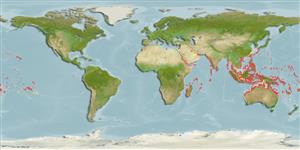
Indo-Pacific: Red Sea south to Inhaca Island, Mozambique (Ref. 4392) and east to the Hawaiian (1 specimen) and Tuamoto islands, north to southern Japan, south to the southern Great Barrier Reef and Austral Islands.
Längd vid första mognad / Storlek / Vikt / Ålder
Könsmognad: Lm7.0 range ? - ? cm Max length : 18.0 cm TL hane/ej könsbestämd; (Ref. 4392)
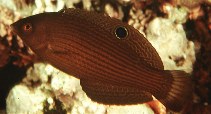
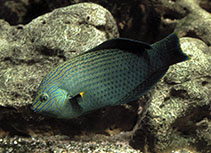
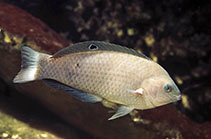
Taggstrålar i ryggfenan (totalt) : 9; Mjukstrålar i ryggfenan (totalt) : 13 - 14; Taggstrålar i analfenan: 3; Mjukstrålar i analfenan: 12 - 13. Juveniles are black with numerous longitudinal white streaks (Ref. 1602). Body shape (shape guide): fusiform / normal; Cross section: compressed.
Inhabit lagoon and seaward reefs, along the upper edges of coral-rich areas (Ref. 9710, 58534). Benthopelagic (Ref. 58302). May be solitary or found in small group (Ref. 90102). Juveniles are encountered in exposed outer reef flats (Ref. 1602). Feed on a wide variety of small invertebrates as well as fish eggs.
Pelagic spawner. Females migrate to spawning sites, larger females travel long distances to downcurrent areas than smaller ones to protect the eggs from becoming prey to larger reef fishes (Ref. 32198). Spawning sites are chosen by the females irregardless of the males occupying them (Ref. 32198). Females spawn in more than one spawning site, each site occupied by more than one male, which are either territorial or non-territorial (Ref. 32198). After spawning, they return individually to their home ranges without passing through other spawning sites (Ref. 32198). Some females on the other hand change sex after spawning (Ref. 32198). As males, they begin to establish territories in the spawning sites, even to those they visited before the sex change (Ref. 32198). This observation support the suggestion (Warner's 1985, 1986) that females stored information on spawning sites by migrating to various sites which aided in the acquisition of a mating territory after changing sex (Ref. 32198).
Randall, J.E., G.R. Allen and R.C. Steene, 1990. Fishes of the Great Barrier Reef and Coral Sea. University of Hawaii Press, Honolulu, Hawaii. 506 p. (Ref. 2334)
Status på IUCN:s rödlista (Ref. 130435: Version 2025-2 (Global))
Önskad temperatur (Ref. 123201): 25 - 29.3, mean 28.3 °C (based on 3073 cells).
Index för fylogenetisk mångfald (Ref. 82804): PD50 = 0.5000 [Uniqueness, from 0.5 = low to 2.0 = high].
Bayesian length-weight: a=0.01072 (0.00621 - 0.01850), b=3.15 (3.00 - 3.30), in cm total length, based on LWR estimates for this species & Genus-body shape (Ref. 93245).
Trofisk nivå (Ref. 69278): 3.2 ±0.2 se; based on diet studies.
Generation time: 1.5 ( na - na) years. Estimated as median ln(3)/K based on 1 growth studies.
Resiliens (Ref. 120179): Hög, lägsta populationsfördubblingstid mindre än 15 månader (K=0.7).
Sårbarhet i fisket (Ref. 59153): Low vulnerability (20 of 100). 🛈