This website uses cookies to enhance your browsing experience and ensure the functionality of our site. For more detailed information about the types of cookies we use and how we protect your privacy, please visit our Privacy Information page.
×
Cookie Settings
This website uses different types of cookies to enhance your experience. Please select your preferences below:
> Eupercaria/misc (Various families in series Eupercaria) > Labridae (Wrasses) > Julidinae
Etymology: Gomphosus:Greek, gomphos = nail; also molar tooth. More on author: Lacepède.
Entorno: milieu / zona climática / rango de profundidad / gama de distribución Ecología
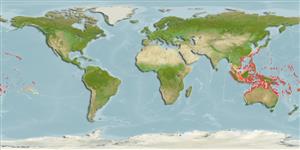
marino asociado a arrecife; rango de profundidad 0 - 35 m (Ref. 90102), usually 2 - 30 m (Ref. 27115). Tropical; 24°C - 28°C (Ref. 27115); 30°N - 30°S, 43°E - 143°W
Indo-Pacific: Cocos-Keeling to the Hawaiian, Marquesas and Tuamoto islands, north to southern Japan, south to Rowley Shoals in the eastern Indian Ocean and Lord Howe and Rapa islands. Replaced by Gomphosus caeruleus in the Indian Ocean (Ref. 37816). Hybrid with Thalassoma lunare documented from Cassini Island, Western Australia and reported from the Great Barrier Reef; with Thalassoma duperrey, observed from Hawaii (Ref. 57557).
Tamaño / Peso / Edad
Madurez: Lm? range ? - ? cm Max length : 30.0 cm SL macho / no sexado; (Ref. 9823)
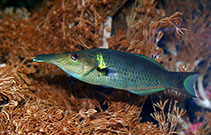
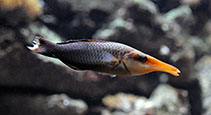
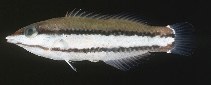
Espinas dorsales (total) : 8; Radios blandos dorsales (total) : 13; Espinas anales: 3; Radios blandos anales: 11. Identified by long snout when adult and distinguished by color or geography from its sibling G. caeruleus (Ref. 48636). Small juveniles lack the elongate snout (Ref. 37816). Body shape (shape guide): fusiform / normal; Cross section: compressed.
A solitary species (Ref. 90102) found in coral-rich areas of lagoon and seaward reefs to a depth of at least 30 m (Ref. 1602, 58302). Benthopelagic (Ref. 58302). Feeds mainly on small benthic crustaceans, sometimes on small fishes, brittle stars, and mollusks (Ref. 2334). Minimum depth reported taken from Ref. 128797.
Ciclo vital y comportamiento de apareamiento Madurez | Reproducción | Puesta | Huevos | Fecundidad | Larva
Oviparous, distinct pairing during breeding (Ref. 205).
Randall, J.E., G.R. Allen and R.C. Steene, 1990. Fishes of the Great Barrier Reef and Coral Sea. University of Hawaii Press, Honolulu, Hawaii. 506 p. (Ref. 2334)
Situación en la Lista Roja de la UICN (Ref. 130435: Version 2025-2 (Global))
Fisiología Composición corporal Nutrientes Consumo del oxígeno Tipo de natación Velocidad de natación Pigmentos visuales Sonido de peces Enfermedades y parásitos Toxicidad (CL50)
Temperatura preferida (Referencia 123201): 24.5 - 29, mean 27.8 °C (based on 1030 cells).
Índice de diversidad filogenética (Referencia 82804): PD50 = 0.7500 [Uniqueness, from 0.5 = low to 2.0 = high].
Bayesian length-weight: a=0.00646 (0.00379 - 0.01100), b=2.97 (2.82 - 3.12), in cm total length, based on LWR estimates for this species & (Sub)family-body (Ref. 93245).
Nivel trófico (Referencia 69278): 3.7 ±0.0 se; based on diet studies.
Resiliencia (Referencia 120179): Medio, población duplicada en un tiempo mínimo de 1.4-4.4 años (Preliminary K or Fecundity.).
Vulnerabilidad pesquera (Ref. 59153): Low to moderate vulnerability (27 of 100). 🛈