This website uses cookies to enhance your browsing experience and ensure the functionality of our site. For more detailed information about the types of cookies we use and how we protect your privacy, please visit our Privacy Information page.
×
Cookie Settings
This website uses different types of cookies to enhance your experience. Please select your preferences below:
> Eupercaria/misc (Various families in series Eupercaria) > Labridae (Wrasses) > Xyrichtyinae
Etymology: Iniistius:Latin, in = in + Greek, istion = sail. More on author: Valenciennes.
Ambiente: milieu / zona climatica / distribuzione batimetrica / gamma di distribuzione Ecologia
marino associati a barriera corallina; distribuzione batimetrica 1 - 100 m (Ref. 1602), usually 20 - ? m (Ref. 9710). Tropical; 24°C - 28°C (Ref. 27115); 30°N - 30°S
Indo-Pacific: Red Sea and East Africa to the Society Islands, north to southern Japan and Hawaii, south to the Lord Howe Island. Eastern Pacific: Gulf of California to Panama and the Galapagos Islands (Ref. 5227).
Dimensione / Peso / Età
Maturità: Lm? range ? - ? cm Max length : 42.0 cm TL maschio/sesso non determinato; (Ref. 97145)
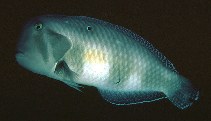
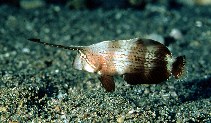
Spine dorsali (totale) : 9; Raggi dorsali molli (totale) : 12 - 13; Spine anali: 3; Raggi anali molli: 12 - 13. Identified by the dark vertical bar below the eye. Usually with 5 dark bars when adult and belly of female turns red. Juveniles with black anal fin and two large ocelli, thinly edged with white, in dorsal fin (Ref. 48636). First two dorsal spines form a separate fin. Juveniles this fin forms a long, bannerlike filament but shortens with age (Ref. 37816). Body shape (shape guide): fusiform / normal; Cross section: compressed.
Usually solitary in lagoon and seaward reef areas with fine to loose, coarse sand bottoms (Ref. 1602). Juveniles sometimes in shallow estuaries (Ref. 48636). Adults rare in less than 20 m (Ref. 9710). Benthic and benthopelagic (Ref. 58302). Dives into sand to sleep safely at night or to hide when alarmed (Ref. 9311, 90102). Feed on hard-shelled invertebrates, including mollusks and crustaceans (Ref. 9311). Juveniles mimic drifting dead leaves by holding the elongate detached front part of dorsal fin forward over head. Good to eat, flesh very white (Ref. 7364). Minimum depth reported from Ref. 27115.
Ciclo vitale e comportamento di accoppiamento Maturità | Riproduzione | Deposizione | Uova | Fecondità | Larve
Randall, J.E., G.R. Allen and R.C. Steene, 1990. Fishes of the Great Barrier Reef and Coral Sea. University of Hawaii Press, Honolulu, Hawaii. 506 p. (Ref. 2334)
Stato della Lista Rossa IUCN (Ref. 130435: Version 2025-2 (Global))
Ciclo di vita Riproduzione Maturità Maturità/Gli occhielli sono relativi. Fecondità Deposizione Aggregazioni riproduttive Uova Sviluppo delle uova Larve Dinamica popolazioni larvali
Fisiologia Composizione corporea Nutrienti Consumo di ossigeno Tipo di nuoto Velocità di nuoto Pigmenti visivi Suono del pesce Malattie e parassiti Tossicità (LC50)
Temperatura preferita (Fonte Biblio. 123201): 24.2 - 29, mean 27.8 °C (based on 1216 cells).
Indice di diversità filogenetica (Fonte Biblio. 82804): PD50 = 0.5000 [Uniqueness, from 0.5 = low to 2.0 = high].
Bayesian length-weight: a=0.01072 (0.00537 - 0.02137), b=3.09 (2.91 - 3.27), in cm total length, based on LWR estimates for this species & (Sub)family-body (Ref. 93245).
Livello trofico (Fonte Biblio. 69278): 3.5 ±0.46 se; based on food items.
Resilienza (Fonte Biblio. 120179): Medio, tempo minimo di raddoppiamento della popolazione 1.4 - 4.4 anni (Preliminary K or Fecundity.).
Vulnerabilità della pesca (Ref. 59153): Low to moderate vulnerability (32 of 100). 🛈