This website uses cookies to enhance your browsing experience and ensure the functionality of our site. For more detailed information about the types of cookies we use and how we protect your privacy, please visit our Privacy Information page.
×
Cookie Settings
This website uses different types of cookies to enhance your experience. Please select your preferences below:
> Eupercaria/misc (Various families in series Eupercaria) > Labridae (Wrasses) > Cheilininae
Etymology: Epibulus:Greek, epi = over, in front + Greek, boleo = to throw (Ref. 45335). More on author: Pallas.
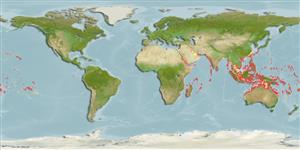
Environnement : milieu / zone climatique / profondeur / gamme de distribution Écologie
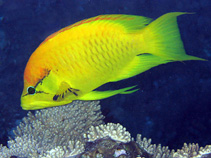
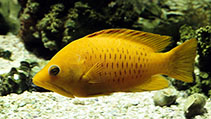
Épines dorsales (Total) : 9 - 10; Rayons mous dorsaux (Total) : 9 - 11; Épines anales: 3; Rayons mous anaux: 8 - 9. The mouth of this species is protrusible and unfolds into a tube easily half the body length. The jaws swing forward into a long tube that strong suction to catch prey. When not in use, the entire apparatus is conveniently folded under the head. Small juveniles are brown with thin white bars and closely resemble a species of Wetmorella. Color varies with age and sex, but adult color varies additional, including with an all-yellow xanthic form. Sub adults and females are brown or, not uncommonly, uniformly yellow. Terminal males are dark with a white head and a dark streak extending horizontally through the eye. Male becomes ornamented with orange and yellow over the back. Juveniles dark with fine vertical white lines. Intermediates with yellow blotches, pale tail and sometimes with black pectoral fins (Ref. 48636). Body shape (shape guide): short and / or deep; Cross section: compressed.
Inhabit coral-rich areas of lagoon and seaward reefs (Ref. 1602, 58302). Benthopelagic (Ref. 58302). Generally solitary (Ref. 5213). Feed on small coral-dwelling crustaceans and fishes (Ref. 9710). Capable of drift migration along with floating leaves (Ref. 27153). Adults usually along deep slopes or drop-offs. Sometimes they visit cleaning stations holding their mouth open and out for inspection (Ref. 48636).
Cycle de vie et comportement reproducteur Maturité | Reproduction | Frai | Œufs | Fécondité | Larves
Males have been observed patrolling their mating territory (see Ref. 27152). Protogyny was proposed but not confirmed (Ref. 103751).
Randall, J.E., G.R. Allen and R.C. Steene, 1990. Fishes of the Great Barrier Reef and Coral Sea. University of Hawaii Press, Honolulu, Hawaii. 506 p. (Ref. 2334)
Statut dans la liste rouge de l'IUCN (Ref. 130435: Version 2025-2 (Global))
Cycle de vie Reproduction Maturité Maturité/épines rel. Fécondité Frai Agrégats de frai Œufs Développement de l'œuf Larves Dynamique des populations larvaires
Physiologie Composition corporelle Nutriments Consommation d'oxygène Type de natation Vitesse de nage Pigments visuels Son de poisson Maladies et parasites Toxicité (CL50)
Température préférée (Réf. 123201): 24.7 - 29, mean 27.9 °C (based on 790 cells).
Indice de diversité phylogénétique (Réf. 82804): PD50 = 0.7500 [Uniqueness, from 0.5 = low to 2.0 = high].
Bayesian length-weight: a=0.02188 (0.01206 - 0.03969), b=2.95 (2.79 - 3.11), in cm total length, based on LWR estimates for this species & (Sub)family-body (Ref. 93245).
Niveau trophique (Réf. 69278): 4.0 ±0.66 se; based on food items.
Résilience (Réf. 120179): Faible, temps minimum de doublement de population : 4,5 à 14 années (Preliminary K or Fecundity.).
Vulnérabilité de la pêche (Ref. 59153): Moderate to high vulnerability (46 of 100). 🛈