



Lepadichthys erythraeus Briggs & Link, 1963
Lägg till din observation i Fish Watcher
| Native range | All suitable habitat | Point map | Year 2050 |
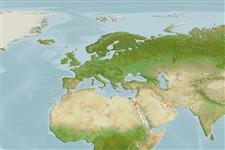
|
| This map was computer-generated and has not yet been reviewed. |
| Lepadichthys erythraeus AquaMaps Data sources: GBIF OBIS |
Ladda upp din foton och Videor
Bilder | Google image Lepadichthys erythraeus
Bild av Bogorodsky, S.V.
Bilder | Google image
Bild av Bogorodsky, S.V.
Klassificering / Namn Populärnamn | synonymer | Catalog of Fishes(Släkte, Arter) | ITIS | CoL | WoRMS | Cloffa
> Gobiesociformes (Clingfishes) > Gobiesocidae (Clingfishes and singleslits) > Diademichthyinae
Etymology: Lepadichthys: Greek, lepas, -ados = limpet + Greek, ichtys = fish (Ref. 45335); erythraeus: From the Greek for red, in reference to the Mare Erythraeum, an ancient name for Red Sea (Ref. 42101).
More on authors: Briggs & Link.
Etymology: Lepadichthys: Greek, lepas, -ados = limpet + Greek, ichtys = fish (Ref. 45335); erythraeus: From the Greek for red, in reference to the Mare Erythraeum, an ancient name for Red Sea (Ref. 42101).
More on authors: Briggs & Link.
Miljö: miljö / Klimatzon / djupintervall / distributionsområde Ekologi
marina bottenlevande; djupintervall 1 - 3 m (Ref. 103877). Tropical
Utbredning Territorier | FAO områden | Ekosystem | Förekomster | Prickkarta | Utplanteringar | Faunafri
Western Indian Ocean: Red Sea, from the Gulf of Aqaba and Gulf of Suez, south to Al Wajh (northeastern Saudi Arabia).
Storlek / Vikt / Ålder
Kort beskrivning Bestämningsnycklar | Morfologi | Morfometri
Taggstrålar i ryggfenan (totalt) : 0; Mjukstrålar i ryggfenan (totalt) : 15 - 16; Taggstrålar i analfenan: 0; Mjukstrålar i analfenan: 13; Ryggkotor: 34. This species is distinguished by the following characters: a membrane joining dorsal and anal fins with the caudal fin; the anus is closer to anal fin than to disc, about two-thirds the distance from the rear margin of the disc to the origin of anal fin; upper attachment of gill membrane opposite ninth pectoral-fin ray; second gill arch with 8 rakers; postdorsal-caudal distance 6.4-7.3 in dorsal-fin length; D 15-16; A 13; pectoral-fin rays 26-28 (rarely 28); principle caudal-fin rays 12; total caudal-fin rays 20 (Ref. 103877).
Cross section: compressed.
Cross section: compressed.
Specimens were collected from the base of a coral block on a reef flat with mixed sand and flat rock with patches of dead corals, from within live coral head in a sheltered bay, from a fringing reef at a depth of 1-3 m and from an isolated coral block. All were collected in close association with sea urchins of the genus Diadema, utilizing the long spines for shelter (Ref. 103877).
Livscykel och parningsbeteende Könsmognad | Reproduktion | Lek | Ägg | Fekunditet | Larver
Oviparous, distinct pairing during breeding (Ref. 205).
Huvudreferens
Ladda upp dina referenser | referenser | Koordinator : Williams, Jeffrey T. | Medarbetare
McAllister, D.E., 1990. A working list of fishes of the world. Copies available from D.E. McAllister, Canadian Museum of Nature, P.O. Box 3443, Ottawa, Ontario K1P 6P4, Canada. 2661 p. plus 1270 p. Index. (Ref. 27116)
Status på IUCN:s rödlista (Ref. 130435: Version 2025-2 (Global))
Least Concern (LC) ; Date assessed: 19 March 2024
CITES
Not Evaluated
Hot mot människor
Harmless
Mänskliga användningsområden
FAO - Publication: search | FishSource |
Ytterligare information
Trofisk ekologi
Livsmedelsartiklar (preys)
Födosammansättning
Födointag
Matransoner
Predatorer
Livsmedelsartiklar (preys)
Födosammansättning
Födointag
Matransoner
Predatorer
Ekologi
Ekologi
Ekologi
Populationsdynamik
Tillväxtparametrar
Max. åldrar / storlekar
Längd-vikt rel.
Längd-längd rel.
Längd-frekvenser
Massakonvertering
Rekrytering
Abundans
Tillväxtparametrar
Max. åldrar / storlekar
Längd-vikt rel.
Längd-längd rel.
Längd-frekvenser
Massakonvertering
Rekrytering
Abundans
Livscykel
Reproduktion
Könsmognad
Mognad/Gills rel.
Fekunditet
Lek
Lekande aggregat
Ägg
Utveckling av ägg
Larver
Larvdynamik
Reproduktion
Könsmognad
Mognad/Gills rel.
Fekunditet
Lek
Lekande aggregat
Ägg
Utveckling av ägg
Larver
Larvdynamik
Anatomi
Gälyta
Hjärna
Otolit
Gälyta
Hjärna
Otolit
Fysiologi
Kroppssammansättning
Näringsämnen
Syreförbrukning
Typ av simning
Simhastighet
Visuella pigment
Ljud från fisk
Sjukdomar & Parasiter
Toxicitet (LC50)
Kroppssammansättning
Näringsämnen
Syreförbrukning
Typ av simning
Simhastighet
Visuella pigment
Ljud från fisk
Sjukdomar & Parasiter
Toxicitet (LC50)
Genetik
Genom
Genetik
Heterozygositet
Ärftlighet
Genetisk mångfald
Genom
Genetik
Heterozygositet
Ärftlighet
Genetisk mångfald
Människorelaterad
Vattenbrukssystem
Vattenbruksprofiler
Avelslinjer
Ciguatera-fall
Frimärken, mynt, diverse.
Vattenbrukssystem
Vattenbruksprofiler
Avelslinjer
Ciguatera-fall
Frimärken, mynt, diverse.
Verktyg
Särskilda rapporter
Kontrollera för underhåll av akvarium | Kontrollera om det finns faktablad om arter | Kontrollera om det finns faktablad om vattenbruk
Ladda ner XML
Internet-källor
AFORO (otoliths) | Aquatic Commons | BHL | Cloffa | Websites from users | Check FishWatcher | CISTI | Catalog of Fishes: Släkte, Arter | DiscoverLife | ECOTOX | FAO - Publication: search | Faunafri | Fishipedia | Fishtrace | GloBI | Google Books | Google Scholar | Google | IGFA World Record | OneZoom | Open Tree of Life | Otolith Atlas of Taiwan Fishes | PubMed | Reef Life Survey | Socotra Atlas | TreeBase | Tree of Life | Wikipedia: Go, sök | World Records Freshwater Fishing | Zoobank | Zoologiskt register
Uppskattningar baserade på modeller
Önskad temperatur (Ref. 123201): 23.5 - 27.7, mean 26.1 °C (based on 72 cells).
Index för fylogenetisk mångfald (Ref. 82804): PD50 = 0.5010 [Uniqueness, from 0.5 = low to 2.0 = high].
Bayesian length-weight: a=0.00389 (0.00180 - 0.00842), b=3.12 (2.94 - 3.30), in cm total length, based on all LWR estimates for this body shape (Ref. 93245).
Trofisk nivå (Ref. 69278): 3.5 ±0.2 se; based on size and trophs of closest relatives
Resiliens (Ref. 120179): Hög, lägsta populationsfördubblingstid mindre än 15 månader (Preliminary K or Fecundity.).