This website uses cookies to enhance your browsing experience and ensure the functionality of our site. For more detailed information about the types of cookies we use and how we protect your privacy, please visit our Privacy Information page.
×
Cookie Settings
This website uses different types of cookies to enhance your experience. Please select your preferences below:
Indo-Pacific: Red Sea and East Africa to the Hawaiian, Marquesan, and Ducie islands, north to southern Japan, south to the Great Barrier Reef and Lord Howe Island. Throughout Micronesia.
Größe / Gewicht / Alter
Geschlechtsreife: Lm? range ? - ? cm Max length : 30.0 cm TL Männchen/unbestimmt; (Ref. 5372); max. veröff. Alter: 10 Jahre (Ref. 72479)
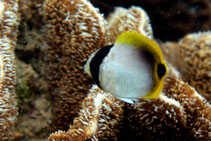
Rückenflossenstacheln (insgesamt) : 12; Rückenflossenweichstrahlen (insgesamt) : 24 - 27; Afterflossenstacheln: 3; Afterflossenweichstrahlen: 19 - 22. The dorsal caudal and anal fins are bright yellow. Body color is white with a black elliptical marking along the edge of the posterior portion of the back extending across the caudal peduncle to the base of the posterior anal fin rays. A series of thin vertical black lines run across the sides, and a prominent vertical black band runs across the eye (Ref. 4855). Snout length 2.0-2.7 in HL. Body depth 1.4-1.7 in SL (Ref. 90102). Body shape (shape guide): short and / or deep; Cross section: compressed.
Adults occur in lagoon and seaward reefs, usually in pairs in coral rich areas (Ref. 1602). Benthopelagic (Ref. 58302). They feed mainly on coral polyps and anemones, but also on small invertebrates and algae (Ref. 1602). Largest species in the genus (Ref. 9710). Oviparous (Ref. 205). Form pairs during breeding (Ref. 205).
Bevorzugte Temperatur (Ref. 123201): 23.7 - 28.9, mean 27.6 °C (based on 1534 cells).
Phylogenetischer Diversitätsindex (Ref. 82804): PD50 = 0.5000 [Uniqueness, from 0.5 = low to 2.0 = high].
Bayesian length-weight: a=0.02344 (0.01420 - 0.03869), b=2.94 (2.80 - 3.08), in cm total length, based on LWR estimates for this species & Genus-body shape (Ref. 93245).
Trophische Ebene (Ref. 69278): 3.4 ±0.55 se; based on food items.
Widerstandsfähigkeit (Ref. 120179): hoch, Verdopplung der Population dauert weniger als 15 Monate. (Preliminary K or Fecundity.).
Anfälligkeit der Fischerei (Ref. 59153): Low vulnerability (20 of 100). 🛈