This website uses cookies to enhance your browsing experience and ensure the functionality of our site. For more detailed information about the types of cookies we use and how we protect your privacy, please visit our Privacy Information page.
×
Cookie Settings
This website uses different types of cookies to enhance your experience. Please select your preferences below:
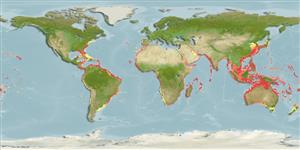
Western Atlantic: off the coast of New Jersey (USA), Bermuda, Bahamas, Gulf of Mexico and throughout the island groups of the Caribbean to the southernmost coast of Brazil. Eastern Atlantic: off the African coast, from Senegal to Southwest Africa, with a single record from St. Helena. Indo-Pacific: Red Sea and the East African coast to the Society and Hawaiian islands, north to Japan, south to Australia and New Zealand.
Not in Eastern Pacific (Ref. 123477 ver. 09Nov2021).
Taille / Poids / Âge
Maturité: Lm? range ? - ? cm Max length : 25.0 cm TL mâle / non sexé; (Ref. 48635); common length : 10.0 cm TL mâle / non sexé; (Ref. 3585); poids max. publié: 32.90 g (Ref. 118626)
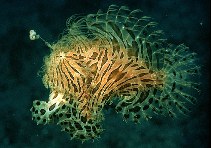
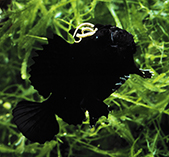
Épines dorsales (Total) : 3; Rayons mous dorsaux (Total) : 11 - 12; Épines anales: 0; Rayons mous anaux: 7. Diagnosis: body short and globose; mouth large with many small, villiform teeth; skin rough, covered with bifurcate dermal spinules; pectoral-fin lobes attached to sides of body; illicium at most as long as second dorsal-fin spine; head, body and fins entirely covered with rough, parallel, dark streaks (Ref. 57225).
Body shape (shape guide): short and / or deep; Cross section: compressed.
Inhabit rocky and coral reefs, on rocks, sand or rubble (Ref. 9710). Found in weedy estuaries along the east coast of southern Africa (Ref. 4113). Occurring in marine or brackish waters (Ref. 57225). In the Atlantic, it is found at an average depth of 40 m (Ref. 5288). Benthic (Ref. 58302). Observed to inflate itself greatly like the puffers (Ref. 5521). Oviparous. Males have more intense coloration and extended cutaneous appendages than females (Ref. 205). Eggs are bound in ribbon-like sheath or mass of gelatinous mucus called 'egg raft' or 'veil' (Ref. 6773).
Cycle de vie et comportement reproducteur Maturité | Reproduction | Frai | Œufs | Fécondité | Larves
Oviparous. Males have more intense coloration and extended cutaneous appendages than females (Ref. 205). Eggs are bound in ribbon-like sheath or mass of gelatinous mucus called 'egg raft' or 'veil' (Ref. 6773).
Pietsch, T.W. and D.B. Grobecker, 1987. Frogfishes of the world. Systematics, zoogeography, and behavioral ecology. Stanford University Press, Stanford, California. 420 p. (Ref. 6773)
Statut dans la liste rouge de l'IUCN (Ref. 130435: Version 2025-2 (Global))
Cycle de vie Reproduction Maturité Maturité/épines rel. Fécondité Frai Agrégats de frai Œufs Développement de l'œuf Larves Dynamique des populations larvaires
Physiologie Composition corporelle Nutriments Consommation d'oxygène Type de natation Vitesse de nage Pigments visuels Son de poisson Maladies et parasites Toxicité (CL50)
Température préférée (Réf. 123201): 18.2 - 28.6, mean 27 °C (based on 287 cells).
Indice de diversité phylogénétique (Réf. 82804): PD50 = 0.5002 [Uniqueness, from 0.5 = low to 2.0 = high].
Bayesian length-weight: a=0.02692 (0.01067 - 0.06789), b=2.96 (2.73 - 3.19), in cm total length, based on LWR estimates for this (Sub)family-body shape (Ref. 93245).
Niveau trophique (Réf. 69278): 4.2 ±0.7 se; based on diet studies.
Résilience (Réf. 120179): Haut, temps minimum de doublement de population inférieur à 15 mois (Fec = 73,000).
Vulnérabilité de la pêche (Ref. 59153): Low vulnerability (15 of 100). 🛈