This website uses cookies to enhance your browsing experience and ensure the functionality of our site. For more detailed information about the types of cookies we use and how we protect your privacy, please visit our Privacy Information page.
×
Cookie Settings
This website uses different types of cookies to enhance your experience. Please select your preferences below:
> Eupercaria/misc (Various families in series Eupercaria) > Labridae (Wrasses) > Julidinae
Etymology: Labroides:Greek, labrax, -akos = a fish, Dicentrarchus labrax + Greek, suffix, oides = similar to (Ref. 45335). More on author: Valenciennes.
Indo-Pacific: Persian Gulf (Ref.80050); Red Sea and East Africa (Ref. 4392) to the Line, Marquesas, and Ducie islands, north to southern Japan, south to Lord Howe and Rapa islands.
Μέγεθος / Βάρος / Ηλικία
Γεννητική Ωρίμανση: Lm? range ? - ? cm Max length : 14.0 cm TL αρσενικό/απροσδιόριστο; (Ref. 55367); μεγ. αναφερόμενη ηλικία: 4 έτη (Ref. 3426)
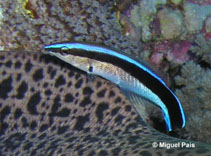
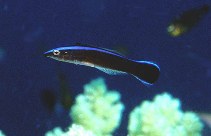
Ραχιαίες άκανθες (συνολικά) : 9; Μαλακές ραχιαίες ακτίνες (συνολικά) : 10 - 11; Εδρικές άκανθες: 3; Μαλακές εδρικές ακτίνες: 10. Often with yellow back in deep water (Ref. 48636). Scales on lateral line: 50-52 (+2 past hypural) (Ref. 1602). Body shape (shape guide): elongated; Cross section: compressed.
Adults inhabit coral rich areas of inner lagoons and subtidal reef flats to seaward reefs (Ref. 1602). They feed on crustacean ectoparasites and mucus of other fishes (Ref. 9823, 48636). Monogamous (Ref. 52884). A protogynous hermaphrodite (Ref. 55367). Stays in stations where other fish come to be cleaned. Cleaning intensity is not related to client size or commonness (Ref. 28019). Cleaning stations are occupied by a pair of adults, a group of juveniles or a group of females accompanied by a dominant male where a female becomes a functional male if the dominant male disappears (Ref. 5503). Some adults solitary and territorial. An unfamiliar visitor is usually greeted by dance-like movements with the tail maneuvering the back part of the body up and down. Juveniles behave this way when divers approach closely (Ref. 48636). Minimum depth range of 1 meter in Ref. 27115.
Κύκλος ζωής και συμπεριφορά ζευγαρώματος Γεννητική Ωρίμανση | Αναπαραγωγή | Γεννοβολία | Αβγά | Γονιμότητα | Προνύμφες
Bi-directional sex change has been confirmed for this species (Ref. 103751). Oviparous, distinct pairing during breeding (Ref. 205). Pelagic spawners. Sex reversal is completed in 14-18 days (Ref. 34185, 34258). A monandric species (Ref. 55367). Length at sex change = 8.8 cm TL (Ref. 55367). Monogamous mating is observed as both facultative and social (Ref. 52884).
Randall, J.E., G.R. Allen and R.C. Steene, 1990. Fishes of the Great Barrier Reef and Coral Sea. University of Hawaii Press, Honolulu, Hawaii. 506 p. (Ref. 2334)
Κατάσταση Κόκκινου Καταλόγου IUCN (Ref. 130435: Version 2025-2 (Global))
Προτιμώμενη θερμοκρασία (Αναφ. 123201): 24.6 - 29, mean 27.8 °C (based on 1388 cells).
Δείκτης φυλογενετικής ποικιλότητας (Αναφ. 82804): PD50 = 0.5156 [Uniqueness, from 0.5 = low to 2.0 = high].
Bayesian length-weight: a=0.00603 (0.00337 - 0.01079), b=3.16 (2.99 - 3.33), in cm total length, based on LWR estimates for this species & (Sub)family-body (Ref. 93245).
Τροφικό Επίπεδο (Αναφ. 69278): 3.5 ±0.4 se; based on diet studies.
Ελαστικότητα (Αναφ. 120179): Μεσαίο(α), ελάχιστος χρόνος για διπλασιασμό πληθυσμού 1,4 - 4,4 έτη (tmax=4).
Ευπάθεια στην αλιεία (Ref. 59153): Low vulnerability (10 of 100). 🛈