



Pseudobatos prahli (Acero P. & Franke, 1995)
Gorgona guitarfish
Carica il tuo foto e Video
Immagini | Google image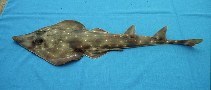 Pseudobatos prahli
Immagine di Béarez, P.
Immagini | Google image
Immagine di Béarez, P.
Classificazione / Nomi Nomi Comuni | Sinonimi | Catalog of Fishes(Genere, Specie) | ITIS | CoL | WoRMS | Cloffa
Elasmobranchi (squali e razze) (sharks and rays) > Rhinopristiformes (Shovelnose rays) > Rhinobatidae (Guitarfishes)
Eponymy: Henry von Prahl (1948–1989) was a pioneering Colombian marine biologist who studied Gorgona Island (the type locality) and whose family emigrated from Germany (1953). He was killed by a bomb, which exploded on Avianca Airlines Flight 203 over Bogotá. (Ref. 128868), visit book page.
Eponymy: Henry von Prahl (1948–1989) was a pioneering Colombian marine biologist who studied Gorgona Island (the type locality) and whose family emigrated from Germany (1953). He was killed by a bomb, which exploded on Avianca Airlines Flight 203 over Bogotá. (Ref. 128868), visit book page.
Ambiente: milieu / zona climatica / distribuzione batimetrica / gamma di distribuzione Ecologia
marino demersale; distribuzione batimetrica ? - 70 m (Ref. 26282). Tropical; 14°N - 6°S, 92°W - 82°W (Ref. 114953)
Distribuzione Territories | Aree FAO | Ecosistemi | Presenze | Mappa dei ritrovamenti | Introduzioni | Faunafri
Eastern Pacific: from Mexico and from north-western Costa Rica to northern Peru.
Dimensione / Peso / Età
Maturità: Lm ? range ? - ? cm
Max length : 90.0 cm TL maschio/sesso non determinato; (Ref. 101827); peso massimo pubblicato: 1.4 kg (Ref. 37888)
Max length : 90.0 cm TL maschio/sesso non determinato; (Ref. 101827); peso massimo pubblicato: 1.4 kg (Ref. 37888)
Breve descrizione Chiavi di identificazione | Morfologia | Morfometria
Rostral cartilage distally enlarged; anterior nasal prolongations reaching medial margin of nostrils; posterior margin of spiracle with 2 folds, the medial one rudimentary; a line of about 77 prickles between nuchal region and first dorsal fin; 3 or 4 prickles on shoulders, few tubercles on snout and small prickles on anterior margin of orbits; body covered dorsally with about 80 white dots (3 to 5 mm in diameter) over a brown body; underbody white except snout with a black diamond shape blotch, extending backward laterally (Ref. 13259).
Body shape (shape guide): elongated.
Body shape (shape guide): elongated.
Living individuals reported to be in sandy and rocky environments near coral-reefs at 18-24 m depth of the Colombian coast (Ref. 101827). In contrast the type specimen was taken from a depth of 70 m (Ref. 26282). Ovoviviparous (Ref. 50449). Males mature at ca. 71 cm TL (Ref. 114953).
Ciclo vitale e comportamento di accoppiamento Maturità | Riproduzione | Deposizione | Uova | Fecondità | Larve
Exhibit ovoviparity (aplacental viviparity), with embryos feeding initially on yolk, then receiving additional nourishment from the mother by indirect absorption of uterine fluid enriched with mucus, fat or protein through specialised structures (Ref. 50449).
Riferimento principale
Caricare le referenze | Bibliografia | Coordinatore : McEachran, John | Collaboratori
Compagno, L.J.V., 1999. Checklist of living elasmobranchs. p. 471-498. In W.C. Hamlett (ed.) Sharks, skates, and rays: the biology of elasmobranch fishes. Johns Hopkins University Press, Maryland. (Ref. 35766)
Stato della Lista Rossa IUCN (Ref. 130435: Version 2025-2 (Global))
Vulnerabile (VU) (A2d); Date assessed: 24 February 2020
Minaccia per l'uomo
Harmless
Usi umani
Pesca: di nessun interesse
FAO - Publication: search | FishSource |
Informazioni ulteriori
Ecologia trofica
Articoli alimentari (prede)
Alimentazione
Consumo di cibo
Razioni alimentari
Predatori
Articoli alimentari (prede)
Alimentazione
Consumo di cibo
Razioni alimentari
Predatori
Ecologia
Ecologia
Ecologia
Dinamica della popolazione
Parametri di crescita
Età massima / dimensioni massime
Rapporto lunghezza-peso.
Lunghezza-lunghezza rel.
Lunghezza-frequenze
Conversione di massa
Reclutamento
Abbondanza
Parametri di crescita
Età massima / dimensioni massime
Rapporto lunghezza-peso.
Lunghezza-lunghezza rel.
Lunghezza-frequenze
Conversione di massa
Reclutamento
Abbondanza
Ciclo di vita
Riproduzione
Maturità
Maturità/Gli occhielli sono relativi.
Fecondità
Deposizione
Aggregazioni riproduttive
Uova
Sviluppo delle uova
Larve
Dinamica popolazioni larvali
Riproduzione
Maturità
Maturità/Gli occhielli sono relativi.
Fecondità
Deposizione
Aggregazioni riproduttive
Uova
Sviluppo delle uova
Larve
Dinamica popolazioni larvali
Anatomia
Area branchiale
Cervello
Otolite
Area branchiale
Cervello
Otolite
Fisiologia
Composizione corporea
Nutrienti
Consumo di ossigeno
Tipo di nuoto
Velocità di nuoto
Pigmenti visivi
Suono del pesce
Malattie e parassiti
Tossicità (LC50)
Composizione corporea
Nutrienti
Consumo di ossigeno
Tipo di nuoto
Velocità di nuoto
Pigmenti visivi
Suono del pesce
Malattie e parassiti
Tossicità (LC50)
Genetica
Genome
Genetica
Eterozigosi
Ereditarietà
Diversità genetica
Genome
Genetica
Eterozigosi
Ereditarietà
Diversità genetica
Legato all'uomo
Sistemi di acquacoltura
Profili di acquacoltura
Varietà
Casi di Ciguatera
Francobolli, monete, materiale vario.
Sistemi di acquacoltura
Profili di acquacoltura
Varietà
Casi di Ciguatera
Francobolli, monete, materiale vario.
Strumenti
Libro elettronico | Giuda pratica | Generatore frequenze di lunghezza | Strumento Parametri Biologici | Mappa dei ritrovamenti |
Cattura-MSY |
Rapporti speciali
Controllo della manutenzione dell'acquario | Verificare la presenza di schede informative sulle specie | Verifica delle schede informative sull'acquacoltura
Scarica XML
Fonti Internet
AFORO (otoliths) | Aquatic Commons | BHL | Cloffa | Websites from users | Check FishWatcher | CISTI | Catalog of Fishes: Genere, Specie | DiscoverLife | ECOTOX | FAO - Publication: search | Faunafri | Fishipedia | Fishtrace | GloBI | Google Books | Google Scholar | Google | IGFA World Record | OneZoom | Open Tree of Life | Otolith Atlas of Taiwan Fishes | PubMed | Reef Life Survey | Socotra Atlas | TreeBase | Tree of Life | Wikipedia: Go, ricerca | World Records Freshwater Fishing | Record zoologico
Stime basate su modelli
Indice di diversità filogenetica (Fonte Biblio. 82804): PD50 = 0.5020 [Uniqueness, from 0.5 = low to 2.0 = high].
Bayesian length-weight: a=0.00282 (0.00168 - 0.00474), b=3.10 (2.95 - 3.25), in cm total length, based on LWR estimates for this species & Genus-body shape (Ref. 93245).
Livello trofico (Fonte Biblio. 69278): 3.6 ±0.5 se; based on size and trophs of closest relatives
Resilienza (Fonte Biblio. 120179): Basso, tempo minimo di raddoppiamento della popolazione 4.5 - 14 anni (Fec assumed to be <100).