



muatnaik fotos/gambar dan video
Gambar | imej Google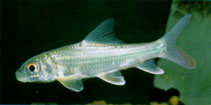 Probarbus jullieni
foto/gambar oleh Freyhof, J.
Gambar | imej Google
foto/gambar oleh Freyhof, J.
klasifikasi / Nama Nama-nama umum | Sinonim (persamaan) | Catalog of Fishes(Marga, Jenis) | ITIS | CoL | WoRMS | Cloffa
> Cypriniformes (Carps) > Cyprinidae (Minnows or carps) > Probarbinae
Etymology: Probarbus: Greek, pro = first, in front of + Latin, barbus = barbel (Ref. 45335).
Eponymy: The etymology only helps to the extent that a ‘J Jullien’ collected both holotypes. [...] (Ref. 128868), visit book page.
More on author: Sauvage.
Etymology: Probarbus: Greek, pro = first, in front of + Latin, barbus = barbel (Ref. 45335).
Eponymy: The etymology only helps to the extent that a ‘J Jullien’ collected both holotypes. [...] (Ref. 128868), visit book page.
More on author: Sauvage.
Lingkungan: lingkungan / zona iklim / kisaran kedalaman / jangkauan distribusi Ekologi
; air tawar; payau dasar (demersal); potamodromous (Ref. 37770). Tropical; 28°N - 5°N
Penyebaran Wilayah | Daerah-daerah FAO | Ekosistem | Kemunculan | peta titik | Introduksi | Faunafri
Asia: Mekong, Chao Phraya and Meklong basins of Indo-China and Thailand, and the Pahang and Perak basins of Malaysia (Ref. 7427). Catch, trade and transportation forbidden in Laos (Ref. 12217).
Ukuran / Berat / umur
Kematangan: Lm ? range ? - ? cm
Max length : 150 cm SL jantan/; (Ref. 30857); common length : 28.0 cm TL jantan/; (Ref. 2073); Berat maksimum terpublikasi: 70.0 kg (Ref. 12369)
Max length : 150 cm SL jantan/; (Ref. 30857); common length : 28.0 cm TL jantan/; (Ref. 2073); Berat maksimum terpublikasi: 70.0 kg (Ref. 12369)
deskripsi pendek Kunci identifiaksi (pengenalan) | Morfologi | Morfometrik
duri punggung lunak (Keseluruhan (total)) : 13; Sirip dubur lunak: 8. Differs from P. labeamajor in having only 5 (instead of 6) stripes between lateral line scale row and dorsal fin base; lips not enlarged, free posterior margin of lower lip interrupted at midline; large adults without mentum; maxillary barbel invariably well developed, length one-third or more of eye diameter. The only species in which body stripes may extend to every scale row, but this only occurs in some larger and more darkly pigmented individuals. P. labeamajor and P. labeaminor have no more than three stripes below lateral line scale row, and the abdomen is uniformly white. Adults and larger juveniles of P. jullieni usually have much more red and sometimes yellow coloration on head, body, and fins than the other two species. Scale rows between lateral line scale row and pelvic fin 4.
Body shape (shape guide): elongated; Cross section: compressed.
Body shape (shape guide): elongated; Cross section: compressed.
Inhabits mainly the mainstream of large rivers (Ref. 10431), with sand or gravel substrates and abundant mollusks populations (Ref. 12693). Occurs in deep slow reaches (Ref. 37769). Feeds on aquatic plants, insects and shelled mollusks. Spawns in winter (late December-early February) in big riverine deltas over sand and gravel substrate with water current of 1.3 m/sec (Ref. 6459). Undertakes spawning and trophic migrations in the Mekong basin. Trophic migrations occurs throughout its occurrence range which takes place mainly at the onset of the flood season and are mainly undertaken by juveniles and subadults (Ref. 37770). Upstream spawning migrations take place between October and February from Kompong Cham in Cambodia to Chiang Khong in Thailand. At Chiang Khong , fishermen reported that Probarbus moves up the tributary Nam Ta in Laos to breed in March-April. Three Probarbus species were also reported to migrate together, but spawn separately, in January-February at Sungkom, Nong Khai Province in Thailand (Ref. 37770). Egg is buoyant, yellow and 2 mm in diameter. Hatching occurs in 32 hrs at 23°C (Ref. 6459). An excellent foodfish, sometimes consumed raw, but rather scarce so it fetches a high market price (Ref. 2686). Eggs are especially priced (Ref. 12369). Used to be cultured commercially in Thailand (Ref. 7306). May be caught individually or in small numbers of any size incidentally with gillnetting and other fishing activities, at virtually any time or place in the Mekong mainstream (Ref. 10431), but mostly caught during November-January spawning migration, when it is by far the most important species in fisheries catch (Ref. 12369). In the Mekong this important fisheries species is under serious long-term decline and this decline evidently is basin wide and the most obvious (but not necessarily only) reason is overfishing with gillnets during the reproductive migrations and spawning periods (Ref. 10431). Attains 70 kg or more, but mostly marketed size nowadays are 5-20 kg (Ref. 12369).
Siklus hidup dan perilaku kawin Kematangan | Reproduksi, perkembang biakan | Pemijahan | telur-telur | Fekunditas | Larva
rujukan utama
Unggah referensi Anda | Acuan | Koordinator | mitra
Roberts, T.R., 1992. Revision of the Southeast Asian cyprinid fish genus Probarbus, with two new species threatened by proposed construction of dams on the Mekong River. Ichthyol. Explor. Freshwat. 3(1):37-48. (Ref. 7427)
Status IUCN Red List (Ref. 130435: Version 2025-2 (Global))
sangat terancam (CR) (A2d); Date assessed: 29 January 2019
ancaman kepada manusia
Harmless
penggunaan manusia
Perikanan: komersial; Budidaya air: percobaan; Ikan buruan: ya
FAO - Sistem akuakultur: produksi; ; Publication: search | FishSource |
informasi lanjut
Dinamika populasi
Parameter pertumbuhan
Maks. usia / ukuran
Panjang-berat rel.
Panjang-panjang rel.
ukuran frekuensi
Konversi massa
pemulihan
Kelimpahan
Parameter pertumbuhan
Maks. usia / ukuran
Panjang-berat rel.
Panjang-panjang rel.
ukuran frekuensi
Konversi massa
pemulihan
Kelimpahan
Siklus hidup
Reproduksi, perkembang biakan
Kematangan
Kedewasaan / insang rel.
Fekunditas
Pemijahan
Agregasi pemijahan
telur-telur
pekembangan telor
Larva
Dinamika larva
Reproduksi, perkembang biakan
Kematangan
Kedewasaan / insang rel.
Fekunditas
Pemijahan
Agregasi pemijahan
telur-telur
pekembangan telor
Larva
Dinamika larva
Anatomi
Area insang
Otak
Otolith
Area insang
Otak
Otolith
Fisiologi
Komposisi tubuh
Nutrisi
Konsumsi oksigen
Jenis renang
Kecepatan berenang
Pigmen visual
Suara ikan
Penyakit & Parasit
Toksisitas (LC50)
Komposisi tubuh
Nutrisi
Konsumsi oksigen
Jenis renang
Kecepatan berenang
Pigmen visual
Suara ikan
Penyakit & Parasit
Toksisitas (LC50)
Yang berhubungan dengan manusia
Sistem akuakultur
profil budidaya air
Strain
Kasus Ciguatera
Perangko, koin, dll.
Sistem akuakultur
profil budidaya air
Strain
Kasus Ciguatera
Perangko, koin, dll.
Alat, peralatan
Kuis organik | E-book | Penuntun lapangan | tanda freqkuenci panjang | peringkat sejarah hidup | peta titik |
Tangkap-MSY |
laporan khas
muat turun XML
Sumber internet
AFORO (otoliths) | Aquatic Commons | BHL | Cloffa | Websites from users | semak peneliti ikan | CISTI | Catalog of Fishes: Marga, Jenis | DiscoverLife | ECOTOX | FAO - Sistem akuakultur: produksi; ; Publication: search | Faunafri | Fishipedia | Fishtrace | GloBI | Google Books | Google Scholar | Google | IGFA World Record | OneZoom | Open Tree of Life | Otolith Atlas of Taiwan Fishes | Akuarium publik | PubMed | Reef Life Survey | Socotra Atlas | TreeBase | Tree of Life | Wikipedia: pergi, Cari | World Records Freshwater Fishing | Zoobank | Catatan Zoologi
Estimasi berdasarkan model
Indeks keanekaragaman filogenetik (Acuan 82804): PD50 = 0.6250 [Uniqueness, from 0.5 = low to 2.0 = high].
Bayesian length-weight: a=0.00468 (0.00189 - 0.01159), b=3.12 (2.90 - 3.34), in cm total length, based on LWR estimates for this (Sub)family-body shape (Ref. 93245).
Tingkat Trofik (Acuan 69278): 3.2 ±0.40 se; based on food items.
Daya lenting (Acuan 120179): sangat rendah, Waktu penggandaan populasi minimum lebih dari 14 tahun (Preliminary K or Fecundity.).
Nutrisi (Ref. 124155): Calcium = 119 [58, 216] mg/100g; Iron = 1.03 [0.59, 1.83] mg/100g; Protein = 17.5 [16.4, 18.5] %; Omega3 = 0.136 [0.063, 0.292] g/100g; Selenium = 68.7 [31.3, 150.8] μg/100g; VitaminA = 15.2 [5.2, 47.7] μg/100g; Zinc = 1.27 [0.87, 1.85] mg/100g (wet weight);