



Serranochromis jallae (Boulenger, 1896)
Nembwe
Uploaden van uw Foto's en video's
Afbeeldingen | Google afbeelding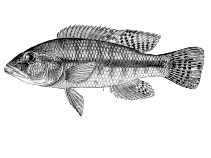 Serranochromis jallae
Afbeelding van Mertens, P.
Afbeeldingen | Google afbeelding
Afbeelding van Mertens, P.
Classificatie / Namen Lokale namen | Synoniemen | Catalog of Fishes(Genus, Soort(en)) | ITIS | CoL | WoRMS | Cloffa
> Cichliformes (Cichlids, convict blennies) > Cichlidae (Cichlids) > Pseudocrenilabrinae
Etymology: Serranochromis: Latin, serra = saw + Greek, chromis = a fish, perhaps a perch (Ref. 45335).
Eponymy: Rev. Luigi (Louis) David Jalla (1860–1943) was an Italian protestant missionary for the Société des Missions Évangeliques, Paris. He was ordained (1886) and sent to Africa, being in Northern Rhodesia (Zambia) and Southern Rhodesia [...] (Ref. 128868), visit book page.
More on author: Boulenger.
Etymology: Serranochromis: Latin, serra = saw + Greek, chromis = a fish, perhaps a perch (Ref. 45335).
Eponymy: Rev. Luigi (Louis) David Jalla (1860–1943) was an Italian protestant missionary for the Société des Missions Évangeliques, Paris. He was ordained (1886) and sent to Africa, being in Northern Rhodesia (Zambia) and Southern Rhodesia [...] (Ref. 128868), visit book page.
More on author: Boulenger.
Milieu: milieu / Klimaatzone / Diepte / verspreidingsgebied Ecologie
; zoet water demersaal. Tropical
Verspreiding Gebieden | FAO regio's | Ecosystemen | Voorkomen | Verspreidingskaart | Introducties | Faunafri
Africa: Okavango, upper Zambezi, Kafue, Kasai and Zambian Congo systems (Ref. 11970, 13332, 94654, 97233, 97235, 128638), including upper Lualaba in Democratic Republic of the Congo (Ref. 97233) and Mweru-Bangweulu area of Upper Congo River basin (Ref. 95585, 97233); also Cunene River (Ref. 13332, 120641). It has been introduced to Lake Kariba and elsewhere in Zimbabwe (Ref. 94654, 128638), including Sabi River catchment (Ref. 13721), and to Shashi Dam in Botswana (Ref. 6465) and South Africa (Ref. 6465).
Grootte / Gewicht / Leeftijd
Maturiteit: Lm ? range ? - ? cm
Max length : 39.6 cm SL mannelijk / geslacht onbekend; (Ref. 5693); max. gepubliceerd gewicht: 4.0 kg (Ref. 128638)
Max length : 39.6 cm SL mannelijk / geslacht onbekend; (Ref. 5693); max. gepubliceerd gewicht: 4.0 kg (Ref. 128638)
Korte beschrijving Determinatiesleutels | Morfologie | Morfometrie
Dorsale stekels (totaal) : 15 - 17; Dorsale zachte stralen (totaal) : 14 - 16; Anale stekels: 3; Anale zachte stralen: 10 - 12. Diagnosis: The presence of four or five scale rows between the posterior margin of the orbit and the ascending arm of the preoperculum, the presence of widely set unicuspid teeth on the jaws, widely separated gill rakers, and anal fins with egg ocelli places this species in Serranochromis (Ref. 128638). Breeding males of S. jallae possess ocelli that are restricted to the posterior 4-5 membranes of the anal fin, which delimits them from all other Serranochromis species, which have ocelli throughout the anal fin in breeding males, with the exception of S. robustus (Ref. 128638). Serranochromis robustus generally has a longer lower jaw than S. jallae, 50.7-59.6% of head length vs. 49.2-52.7%; it is not as deep-bodied as S. jallae as evidenced by the distance between the posterior insertion of the dorsal fin and the posterior insertion of the anal fin, 13.4-15.1% of standard length in S. robustus vs. 14.9-18.4% in S. jallae; additionally, S. robustus has a narrower least caudal peduncle depth than S. jallae, 10.9-12.8% of standard length vs. 11.3-14.2%, the least caudal peduncle depth of all S. robustus was less than 12.8% of standard length while for S. jallae, except for the smallest specimen, the least caudal peduncle depth was greater than 13.2%; Serranochromis robustus has a smaller horizontal eye diameter than S. jallae, 17.7-27.4% of head length vs. 18.6-25.5%; in general, S. robustus has more teeth in the outer row of the left lower jaw than S. jallae, 14-23 vs. 13-14 (Ref. 128638). Adults in breeding colour of Serranochromis robustus are blue/green laterally with a narrow yellow marginal band on the dorsal fin and usually a small yellowish tip to the upper caudal-fin lobe; adults in breeding colour of S. jallae are yellow/green laterally with a bright orange marginal band on the dorsal and caudal fins in fish from the Okavango River system, but creamy yellow bands in fish from the upper Zambezi River system; the throat and belly of S. jallae becomes more intensely yellow-orange in breeding dress hence the local name 'yellow-belly'; rarely, specimens from the Okavango River in Namibia also have yellow rather than orange marginal bands (Ref. 128638).
Juveniles occur mostly on the floodplain and in lagoons and secondary channels, but larger adults appear to prefer mainstream habitats, like deep main channels and permanent lagoons,and are associated with in-stream structures such as woody debris, macrophyte beds, reeds, and eroded clay cliffs on outside bends of the rivers (Ref. 7248, 94654, 128638). Large specimens patrol open water of rivers and lakes, never very far from shore (Ref. 246) and live in well-vegetated quiet waters or near submerged trees or rocks in the lee of the river’s main current, lunging out to capture prey (Ref. 5614). Predator on fish but also feeds on aquatic and terrestrial insects, shrimps and small crabs (Ref. 13337). Adults often feed on squeakers (Ref. 7248, 13337, 94654). Mouthbrooder (Ref. 246, 13337, 13721) and multiple spawner (Ref. 13337). Constructs shallow nest on sandy or muddy substrate in shallow water (Ref. 13337). Reported to have adverse impact on native fish species in Zimbabwe (Ref. 94654).
Levenscyclus en paargedrag Maturiteit | Voortplanting | Paaien | Eieren | Fecunditeit | Larven
Incubates eggs in the mouth. Constructs a shallow concave nest on a sandy or muddy substrate in fairly shallow water.
Hoofdreferentie
Upload uw referenties | Referenties | Coördinator : Kullander, Sven O. | Medewerkers
Stauffer, J.R. Jr., R. Bills, P.H. Skelton and O.L.F. Weyl, 2020. Re-evaluation to species level and redescription of Serranochromis jallae and Serranochromis robustus (Teleostei: Cichlidae). Zootaxa 4858(1):126-134. (Ref. 128638)
Status op de Rode Lijst van het IUCN (Ref. 130435: Version 2025-2 (Global))
Niet bedreigd (LC) ; Date assessed: 01 May 2009
CITES
Not Evaluated
Gevaar voor de mens
Harmless
Gebruik door de mens
Visserij: van minder commercieel belang; Aquarium: Commercieel
FAO - Publication: search | FishSource |
Meer informatie
Trofische ecologie
Voedsel (prooien)
Dieetsamenstelling
Voedselconsumptie
Voedselrantsoenen
Predatoren
Voedsel (prooien)
Dieetsamenstelling
Voedselconsumptie
Voedselrantsoenen
Predatoren
Populatiedynamica
Groeiparameters
Max. leeftijden / maten
Lengte-gewicht rel.
Lengte-lengte rel.
Lengtefrequenties
Massaconversie
Rekrutering
Abundantie
Groeiparameters
Max. leeftijden / maten
Lengte-gewicht rel.
Lengte-lengte rel.
Lengtefrequenties
Massaconversie
Rekrutering
Abundantie
Levenscyclus
Voortplanting
Maturiteit
Rijpheid/kieuwen rel.
Fecunditeit
Paaien
Paaibestanden
Eieren
Ontwikkeling van de eieren
Larven
Larvale populatiedynamiek
Voortplanting
Maturiteit
Rijpheid/kieuwen rel.
Fecunditeit
Paaien
Paaibestanden
Eieren
Ontwikkeling van de eieren
Larven
Larvale populatiedynamiek
Anatomie
Kieuwoppervlak
Hersenen
Otoliet
Kieuwoppervlak
Hersenen
Otoliet
Fysiologie
Lichaamssamenstelling
Voedingsstoffen
Zuurstofverbruik
Type zwemmen
Zwemsnelheid
Visuele pigmenten
Vis geluid
Ziekten en parasieten
Toxiciteit (LC50)
Lichaamssamenstelling
Voedingsstoffen
Zuurstofverbruik
Type zwemmen
Zwemsnelheid
Visuele pigmenten
Vis geluid
Ziekten en parasieten
Toxiciteit (LC50)
Menselijk gerelateerd
Aquacultuursystemen
Aquacultuurprofielen
Kweeklijnen
Ciguatera gevallen
Postzegels, munten, diversen.
Aquacultuursystemen
Aquacultuurprofielen
Kweeklijnen
Ciguatera gevallen
Postzegels, munten, diversen.
Tools
Speciale rapporten
Bekijk gegevens voor het houden in een aquarium | Bekijk Fact Sheets voor de soort | Bekijk Aquacultuur Fact Sheets
Download XML
Internetbronnen
AFORO (otoliths) | Exoten/Invasieve soorten database | Aquatic Commons | BHL | Cloffa | Websites from users | Bekijk FishWatcher | CISTI | Catalog of Fishes: Genus, Soort(en) | DiscoverLife | ECOTOX | FAO - Publication: search | Faunafri | Fishipedia | Fishtrace | GloBI | Google Books | Google Scholar | Google | IGFA World Record | OneZoom | Open Tree of Life | Otolith Atlas of Taiwan Fishes | PubMed | Reef Life Survey | Socotra Atlas | TreeBase | Tree of Life | Wikipedia: ga naar, zoek | World Records Freshwater Fishing | Zoological Record
Schattingen op basis van modellen
Fylogenetische diversiteitsindex (Ref. 82804): PD50 = 0.5000 [Uniqueness, from 0.5 = low to 2.0 = high].
Bayesian length-weight: a=0.01413 (0.00689 - 0.02895), b=3.01 (2.84 - 3.18), in cm total length, based on LWR estimates for this species & (Sub)family-body (Ref. 93245).
Trofisch niveau (Ref. 69278): 4.1 ±0.7 se; based on size and trophs of closest relatives
Weerstandsvermogen (Ref. 120179): Gemiddeld, minimale populatieverdubbelingstijd 1,4-4,4 jaar (Preliminary K or Fecundity.).