



Uploaden van uw Foto's en video's
Google afbeelding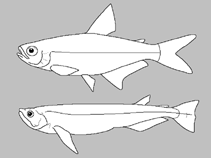 No image available for this species;
drawing shows typical species in Characidae.
Google afbeelding
drawing shows typical species in Characidae.
Classificatie / Namen Lokale namen | Synoniemen | Catalog of Fishes(Genus, Soort(en)) | ITIS | CoL | WoRMS | Cloffa
> Characiformes (Characins) > Characidae (Characins; tetras) > Aphyocharacinae
Etymology: Amazonichthys: Name from the Greek 'Amazon' (a race of warrior women) and 'ichthys' for fishes; referring to the indigenous Icamiabas that battled against Spanish troops led by Francisco Orellana in 1542 (who led an aggressive expedition into the Amazon region). The Icamiabas resembled the Amazons from Greek mythology, fighting with bows and arrows and forbidding the presence of men inside their tribe (Medina, 1894).
Eponymy: Mrs Linde Geisler collected the holotype with her husband, German biologist and aquarist Rolf Geisler (q.v.). (Ref. 128868), visit book page.
More on author: Géry.
Etymology: Amazonichthys: Name from the Greek 'Amazon' (a race of warrior women) and 'ichthys' for fishes; referring to the indigenous Icamiabas that battled against Spanish troops led by Francisco Orellana in 1542 (who led an aggressive expedition into the Amazon region). The Icamiabas resembled the Amazons from Greek mythology, fighting with bows and arrows and forbidding the presence of men inside their tribe (Medina, 1894).
Eponymy: Mrs Linde Geisler collected the holotype with her husband, German biologist and aquarist Rolf Geisler (q.v.). (Ref. 128868), visit book page.
More on author: Géry.
Milieu: milieu / Klimaatzone / Diepte / verspreidingsgebied Ecologie
; zoet water benthopelagisch. Tropical
Verspreiding Gebieden | FAO regio's | Ecosystemen | Voorkomen | Verspreidingskaart | Introducties | Faunafri
South America: Brazil.
Grootte / Gewicht / Leeftijd
Korte beschrijving Determinatiesleutels | Morfologie | Morfometrie
This species is distinguished from A. camelierae by having the anterior midlateral stripe reaching dorsal-fin region (vs. stripe reaching caudal peduncle blotch), second unbranched dorsal-fin ray hyaline (vs. proximal half of second unbranched dorsal-fin ray densely pigmented), caudal peduncle blotch triangular (vs. roundish), lateral line incomplete (vs. complete), longitudinal scales 31-33 (vs. 37-39), ventral margin of third infraorbital bone usually reaching anterodorsal margin of preopercle (vs. surpassing that point), and precaudal vertebrae 12 (vs. 13); differs from A. lu distinguished by the dense concentration of dark brown chromatophores over the first unbranched dorsal and all unbranched anal-fin rays (vs. dorsal and anal unbranched fin rays are poorly pigmented), with two symmetrical conspicuous small dark blotches at the base of the caudal-fin rays (vs. usually absent, very diffuse when present), pectoral-fin rays i9-10 (vs. i8), and with just one unilateral hook at the medial region of each ray segment (vs. one to two (Ref. 130247).
Cross section: compressed.
Cross section: compressed.
Levenscyclus en paargedrag Maturiteit | Voortplanting | Paaien | Eieren | Fecunditeit | Larven
Hoofdreferentie
Upload uw referenties | Referenties | Coördinator | Medewerkers
Esguícero, A.L.H. and M.B. Mendonça, 2023. A new genus and two new species of tetras (Characiformes: Characidae), with a redescription and generic reassignment of Axelrodia lindeae Géry. Ichthyology & Herpetology 111(3):426-447. (Ref. 130247)
CITES
Not Evaluated
Gevaar voor de mens
Harmless
Gebruik door de mens
Visserij: van geen belang
FAO - Publication: search | FishSource |
Meer informatie
Trofische ecologie
Voedsel (prooien)
Dieetsamenstelling
Voedselconsumptie
Voedselrantsoenen
Predatoren
Voedsel (prooien)
Dieetsamenstelling
Voedselconsumptie
Voedselrantsoenen
Predatoren
Ecologie
Ecologie
Ecologie
Populatiedynamica
Groeiparameters
Max. leeftijden / maten
Lengte-gewicht rel.
Lengte-lengte rel.
Lengtefrequenties
Massaconversie
Rekrutering
Abundantie
Groeiparameters
Max. leeftijden / maten
Lengte-gewicht rel.
Lengte-lengte rel.
Lengtefrequenties
Massaconversie
Rekrutering
Abundantie
Levenscyclus
Voortplanting
Maturiteit
Rijpheid/kieuwen rel.
Fecunditeit
Paaien
Paaibestanden
Eieren
Ontwikkeling van de eieren
Larven
Larvale populatiedynamiek
Voortplanting
Maturiteit
Rijpheid/kieuwen rel.
Fecunditeit
Paaien
Paaibestanden
Eieren
Ontwikkeling van de eieren
Larven
Larvale populatiedynamiek
Anatomie
Kieuwoppervlak
Hersenen
Otoliet
Kieuwoppervlak
Hersenen
Otoliet
Fysiologie
Lichaamssamenstelling
Voedingsstoffen
Zuurstofverbruik
Type zwemmen
Zwemsnelheid
Visuele pigmenten
Vis geluid
Ziekten en parasieten
Toxiciteit (LC50)
Lichaamssamenstelling
Voedingsstoffen
Zuurstofverbruik
Type zwemmen
Zwemsnelheid
Visuele pigmenten
Vis geluid
Ziekten en parasieten
Toxiciteit (LC50)
Genetica
genoom
Genetica
Heterozygositeit
Erfelijkheid
Genetische diversiteit
genoom
Genetica
Heterozygositeit
Erfelijkheid
Genetische diversiteit
Menselijk gerelateerd
Aquacultuursystemen
Aquacultuurprofielen
Kweeklijnen
Ciguatera gevallen
Postzegels, munten, diversen.
Aquacultuursystemen
Aquacultuurprofielen
Kweeklijnen
Ciguatera gevallen
Postzegels, munten, diversen.
Tools
Speciale rapporten
Bekijk gegevens voor het houden in een aquarium | Bekijk Fact Sheets voor de soort | Bekijk Aquacultuur Fact Sheets
Download XML
Internetbronnen
AFORO (otoliths) | Aquatic Commons | BHL | Cloffa | Websites from users | Bekijk FishWatcher | CISTI | Catalog of Fishes: Genus, Soort(en) | DiscoverLife | ECOTOX | FAO - Publication: search | Faunafri | Fishipedia | Fishtrace | GloBI | Google Books | Google Scholar | Google | IGFA World Record | OneZoom | Open Tree of Life | Otolith Atlas of Taiwan Fishes | PubMed | Reef Life Survey | Socotra Atlas | TreeBase | Tree of Life | Wikipedia: ga naar, zoek | World Records Freshwater Fishing | Zoological Record
Schattingen op basis van modellen
Fylogenetische diversiteitsindex (Ref. 82804): PD50 = 0.6250 [Uniqueness, from 0.5 = low to 2.0 = high].
Bayesian length-weight: a=0.00692 (0.00283 - 0.01691), b=3.09 (2.88 - 3.30), in cm total length, based on LWR estimates for this (Sub)family-body shape (Ref. 93245).
Trofisch niveau (Ref. 69278): 3.1 ±0.4 se; based on size and trophs of closest relatives