



Phractolaemus ansorgii Boulenger, 1901
Hingemouth
Hochladen Photos und videos
Bilder | Google Bild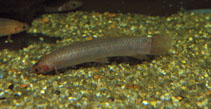 Phractolaemus ansorgii
Photo von Sazima, I.
Bilder | Google Bild
Photo von Sazima, I.
Klassifizierung / Names Namen | Synonyme | Catalog of Fishes(Gattung, Arten) | ITIS | CoL | WoRMS | Cloffa
> Gonorynchiformes (Milkfishes) > Phractolaemidae (Hingemouths)
Etymology: Phractolaemus: Greek, phraktos = fence + Greek, laimos = throttle (Ref. 45335).
Eponymy: Dr William John Ansorge (1850–1913) was an English explorer and collector who was active in Africa in the second half of the 19th century. [...] (Ref. 128868), visit book page.
More on author: Boulenger.
Etymology: Phractolaemus: Greek, phraktos = fence + Greek, laimos = throttle (Ref. 45335).
Eponymy: Dr William John Ansorge (1850–1913) was an English explorer and collector who was active in Africa in the second half of the 19th century. [...] (Ref. 128868), visit book page.
More on author: Boulenger.
Umwelt: Milieu / Klimazone / Tiefenbereich / Verbreitungsgebiet Ökologie
; süßwasser benthopelagisch; pH range: 6.0 - 8.0; dH range: ? - 25. Tropical; 25°C - 30°C (Ref. 13371)
Verbreitung Territorien | FAO Gebiete | Ökosysteme | Vorkommen | Punkt Karte | Einführungen | Faunafri
Africa: in West Africa from Lake Nokoué (Ouémé River, Benin) (Ref. 81277) to Cross River (Cameroon) (Ref. 52397), including Ogun, Osse and Niger Delta (Ref. 81277). Also in the middle Congo River basin (Ref. 93183) in Republic of Congo and Democratic Republic of the Congo.
Größe / Gewicht / Alter
Kurzbeschreibung Bestimmungsschlüssel | Morphologie | Morphometrie
Rückenflossenstacheln (insgesamt) : 0; Rückenflossenweichstrahlen (insgesamt) : 6; Afterflossenstacheln: 0; Afterflossenweichstrahlen: 6; Wirbelzahl: 34 - 38. Diagnosis: head depressed and strongly ossified; anterior nostril elongate, forming an oblique, forward-pointing tube; posterior nostril crescent-shaped, located just behind the narial tube (Ref. 2913, 81277). Mouth small, protrusible (Ref. 245, 31256, 81277), placed at tip of a proboscis and opening upwards between the narial tubes (Ref. 2913, 81277), on upper surface of snout (Ref. 245, 31256). Narrow gill opening, but opercles very well developed, covering also the underside of the head where they overlap (Ref. 2913, 81277, 93183).
Body shape (shape guide): elongated; Cross section: circular.
Body shape (shape guide): elongated; Cross section: circular.
Facultative or obligate air-breathing (Ref. 126274); Lives in forest pools and swamps (Ref. 41580). Microphagous (Ref. 4910, 41580, 45483), especially phytophagous (epiphytes), and detritiphagous (Ref. 41580). Swim bladder entirely alveolar, functioning like a lung; this adaptation to aerial breathing allows the fish to survive under poor oxygenation conditions (Ref. 2913, 81277); recorded from nearly deoxygenated lungfish nest in Pool Malebo, Congo DR (Ref. 41585). Gonads, which are largely fused, are situated ventrally, not dorsally, in abdominal cavity (Ref. 41580). Mouth can be projected as a small trunk (Ref. 2913). Eggs transparent, yellow-greenish, 1.5-1.7mm diameter; large females may have several thousands of eggs (Ref. 41580). Particular blood system, with dark coloured and an abundant amouth of blood (Ref. 4910).
Lebenszyklus und Paarungsverhalten Geschlechtsreife | Fortpflanzung | Ablaichen | Eier | Fruchtbarkeit | Larven
Males and females have lateral tubercles on their body which probably aid in maintaining contact during spawning (Ref. 38266).
Hauptreferenz
Laden Sie Ihre Referenzen hoch | Referenzen | Koordinator | Partner
Lévêque, C., 1990. Phractolaemidae. p. 189-191. In C. Lévêque, D. Paugy and G.G. Teugels (eds.) Faune des poissons d'eaux douces et saumâtres d'Afrique de l'Ouest. Tome I. Coll. Faune Tropicale n° XXVIII. Musée Royal de l'Afrique Centrale, Tervuren, and O.R.S.T.O.M.,Paris, 384 p. (Ref. 2913)
IUCN Rote Liste Status (Ref. 130435: Version 2025-2 (Global))
nicht bedroht (LC) ; Date assessed: 05 June 2019
CITES
Not Evaluated
Bedrohung für Menschen
Harmless
Nutzung durch Menschen
FAO - Publication: search | FishSource |
Mehr Information
Trophische Ökologie
Lebensmittel (Beutetiere)
Nahrungszusammensetzung
Nahrungsaufnahme
Lebensmittelrationen
Räuber
Lebensmittel (Beutetiere)
Nahrungszusammensetzung
Nahrungsaufnahme
Lebensmittelrationen
Räuber
Populationsdynamik
Wachstumsparameter
Max. Alter/Größen
Länge-Gewicht-Rel.
Länge-Länge-Verhältnis.
Längenhäufigkeiten
Massenkonvertierung
Rekrutierung
Dichte
Wachstumsparameter
Max. Alter/Größen
Länge-Gewicht-Rel.
Länge-Länge-Verhältnis.
Längenhäufigkeiten
Massenkonvertierung
Rekrutierung
Dichte
Lebenszyklus
Fortpflanzung
Geschlechtsreife
Reifung/Kiemen rel.
Fruchtbarkeit
Ablaichen
Laichaggregationen
Eier
Eientwicklung
Larven
Larven Pop.Dyn.
Fortpflanzung
Geschlechtsreife
Reifung/Kiemen rel.
Fruchtbarkeit
Ablaichen
Laichaggregationen
Eier
Eientwicklung
Larven
Larven Pop.Dyn.
Anatomie
Kiemenoberfläche
Gehirn
Otolith
Kiemenoberfläche
Gehirn
Otolith
Physiologie
Körperliche Zusammensetzung
Nährstoffe
Sauerstoffverbrauch
Schwimmart
Schwimmgeschwindigkeit
Visuelle Pigmente
Fischgeräusche
Krankheiten und Parasiten
Toxizität (LC50s)
Körperliche Zusammensetzung
Nährstoffe
Sauerstoffverbrauch
Schwimmart
Schwimmgeschwindigkeit
Visuelle Pigmente
Fischgeräusche
Krankheiten und Parasiten
Toxizität (LC50s)
Menschenbezogen
Aquakultur-Systeme
Aquakultur Profile
Zuchtlinien
Ciguatera-Fälle
Briefmarken, Münzen, Verschiedenes.
Aquakultur-Systeme
Aquakultur Profile
Zuchtlinien
Ciguatera-Fälle
Briefmarken, Münzen, Verschiedenes.
Tools
Bio-Quiz | E-Book | Feldführer | Längenhäufigkeits Tool | Lebensdaten Tool | Punkt Karte |
Catch-MSY |
Zusatzinformationen
Download XML
Zusammenfassung | Punktdaten | Namen | Photos
Internet Quellen
AFORO (otoliths) | Aquatic Commons | BHL | Cloffa | Websites from users | FishWatcher Einträge suchen | CISTI | Catalog of Fishes: Gattung, Arten | DiscoverLife | ECOTOX | FAO - Publication: search | Faunafri | Fishipedia | Fishtrace | GloBI | Google Books | Google Scholar | Google | IGFA World Record | OneZoom | Open Tree of Life | Otolith Atlas of Taiwan Fishes | PubMed | Reef Life Survey | Socotra Atlas | TreeBase | Tree of Life | Wikipedia: Gehe zu, Suchen | World Records Freshwater Fishing | Zoobank | Zoologischer Rekord
Schätzungen auf der Grundlage von Modellen
Phylogenetischer Diversitätsindex (Ref. 82804): PD50 = 1.5000 [Uniqueness, from 0.5 = low to 2.0 = high].
Bayesian length-weight: a=0.00437 (0.00168 - 0.01136), b=3.13 (2.90 - 3.36), in cm total length, based on LWR estimates for this (Sub)family-body shape (Ref. 93245).
Trophische Ebene (Ref. 69278): 2.3 ±0.1 se; based on diet studies.