



Pollimyrus isidori (Valenciennes, 1847)
Elephant Fish
Uploaden van uw Foto's en video's
Afbeeldingen | Postzegels, munten, diversen. | Google afbeelding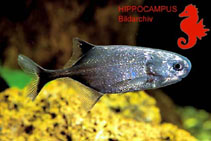 Pollimyrus isidori
Afbeelding van Hippocampus-Bildarchiv
Afbeeldingen | Postzegels, munten, diversen. | Google afbeelding
Afbeelding van Hippocampus-Bildarchiv
Classificatie / Namen Lokale namen | Synoniemen | Catalog of Fishes(Genus, Soort(en)) | ITIS | CoL | WoRMS | Cloffa
> Osteoglossiformes (Bony tongues) > Mormyridae (Elephantfishes)
Etymology: Pollimyrus: Because of Dr. Max Poll, ichthyologist + Greek, myros, -ou = the male of the morey eel.
Eponymy: Dr Max Fernand Leon Poll (1908–1991) was a Belgian ichthyologist, and ‘connoisseur of the fish fauna’. [...] Isidore Geoffroy Saint-Hilaire (1805–1861) was a French zoologist. [...] (Ref. 128868), visit book page.
More on author: Valenciennes.
Etymology: Pollimyrus: Because of Dr. Max Poll, ichthyologist + Greek, myros, -ou = the male of the morey eel.
Eponymy: Dr Max Fernand Leon Poll (1908–1991) was a Belgian ichthyologist, and ‘connoisseur of the fish fauna’. [...] Isidore Geoffroy Saint-Hilaire (1805–1861) was a French zoologist. [...] (Ref. 128868), visit book page.
More on author: Valenciennes.
Milieu: milieu / Klimaatzone / Diepte / verspreidingsgebied Ecologie
; zoet water demersaal; pH range: 6.0 - 8.0; dH range: 5 - 19; potamodroom (Ref. 51243). Tropical; 22°C - 24°C (Ref. 12468)
Verspreiding Gebieden | FAO regio's | Ecosystemen | Voorkomen | Verspreidingskaart | Introducties | Faunafri
Africa: Senegal (Ref. 2915), Gambia, middle Niger (Ref. 3203) including the Benue (Ref. 2915), Volta and Chad basins, coastal rivers of Côte d'Ivoire (Sassandra, Bandama, Mé) and the Nile (Ref. 3203). Subspecies Pollimyrus isidori fasciaticeps and Pollimyrus isidori osborni are restricted to the Congo river basin (Ref. 3203).
Lengte bij maturiteit / Grootte / Gewicht / Leeftijd
Maturiteit: Lm 6.5 range ? - ? cm
Max length : 10.3 cm TL mannelijk / geslacht onbekend; (Ref. 57961); max. gepubliceerd gewicht: 7.00 g (Ref. 3799)
Max length : 10.3 cm TL mannelijk / geslacht onbekend; (Ref. 57961); max. gepubliceerd gewicht: 7.00 g (Ref. 3799)
Korte beschrijving Determinatiesleutels | Morfologie | Morfometrie
Dorsale stekels (totaal) : 0; Dorsale zachte stralen (totaal) : 17 - 22; Anale stekels: 0; Anale zachte stralen: 21 - 27. Body depth 2.8-4.2 x SL. Sokomo and Comoe forms longer with SL/Depth ratio 3-4. Head 3.8-5.0 x SL. Eye diameter 3.3-6.4 x head length. Dorsal origin slightly behind anal fin origin. Pectorals slightly shorter or equal to head length, 2-3 x longer than pelvic fins, its posterior end reaching past origin of pelvic fins. Caudal peduncle height 2.3-3.9 x of its length, 12.3-20.6 x SL. Middle reaches fish silvery in color with lots of small spots on sides and head, higher reaches fish darker with darker and fewer spots.
Body shape (shape guide): fusiform / normal; Cross section: compressed.
Body shape (shape guide): fusiform / normal; Cross section: compressed.
Occupies floodplain pools in Sudd. Feeds on mud, vegetable debris and small invertebrates (Ref. 28714). Affinities: only to P. adspersus, morphologically similar; distinguished through scales on caudal peduncle, dorsal and anal fin rays and body coloration. Generates electric organ discharge (EOD) of short duration (0.08 ms) that seems to correlate with aggregative behavior of the species (Ref. 10460; 10601). During the breeding season, males build nests and while patrolling their territory sporadically emit EODs at a mean rate of 18 Hz. Participating females, on the other hand, discharge at a fairly regular rate (8-11 Hz) and this has been shown to play a role in sex recognition during courtship and spawning. Male and female EOD waveforms also differ in the amplitude ratio of the first and third phase (Ref. 10764). Also produce natural sounds ('grunts', 'moans', 'growl', etc.) at different phases of courtship, nesting and territorial defense (Ref. 10832). A fractional spawner; females able to spawn up to 26 times in the course of one reproductive cycle, laying about 125 eggs per spawning episode. Larval electric organ situated in the deep lateral musculature; that of adults in the caudal peduncle (Ref. 10605).
Levenscyclus en paargedrag Maturiteit | Voortplanting | Paaien | Eieren | Fecunditeit | Larven
30-200 eggs are spawned evey 5-8 days. Male builds nest and tends eggs and larvae. Eggs hatch after 4 days and feed after 12 days.
Hoofdreferentie
Upload uw referenties | Referenties | Coördinator | Medewerkers
Bigorne, R., 1990. Mormyridae. p. 122-184. In C. Lévêque, D. Paugy and G.G. Teugels (eds.) Faune des poissons d'eaux saumâtres d'Afrique de l'Ouest. tome 1. Faune Trop. 28. Musée Royal de l'Afrique Centrale, Tervuren, and ORSTOM, Paris. (Ref. 2915)
Status op de Rode Lijst van het IUCN (Ref. 130435: Version 2025-2 (Global))
Niet bedreigd (LC) ; Date assessed: 03 November 2019
CITES
Not Evaluated
Gevaar voor de mens
Harmless
Gebruik door de mens
Visserij: van geen belang; Aquarium: Commercieel
FAO - Publication: search | FishSource |
Meer informatie
Trofische ecologie
Voedsel (prooien)
Dieetsamenstelling
Voedselconsumptie
Voedselrantsoenen
Predatoren
Voedsel (prooien)
Dieetsamenstelling
Voedselconsumptie
Voedselrantsoenen
Predatoren
Populatiedynamica
Groeiparameters
Max. leeftijden / maten
Lengte-gewicht rel.
Lengte-lengte rel.
Lengtefrequenties
Massaconversie
Rekrutering
Abundantie
Groeiparameters
Max. leeftijden / maten
Lengte-gewicht rel.
Lengte-lengte rel.
Lengtefrequenties
Massaconversie
Rekrutering
Abundantie
Levenscyclus
Voortplanting
Maturiteit
Rijpheid/kieuwen rel.
Fecunditeit
Paaien
Paaibestanden
Eieren
Ontwikkeling van de eieren
Larven
Larvale populatiedynamiek
Voortplanting
Maturiteit
Rijpheid/kieuwen rel.
Fecunditeit
Paaien
Paaibestanden
Eieren
Ontwikkeling van de eieren
Larven
Larvale populatiedynamiek
Fysiologie
Lichaamssamenstelling
Voedingsstoffen
Zuurstofverbruik
Type zwemmen
Zwemsnelheid
Visuele pigmenten
Vis geluid
Ziekten en parasieten
Toxiciteit (LC50)
Lichaamssamenstelling
Voedingsstoffen
Zuurstofverbruik
Type zwemmen
Zwemsnelheid
Visuele pigmenten
Vis geluid
Ziekten en parasieten
Toxiciteit (LC50)
Genetica
genoom
Genetica
Heterozygositeit
Erfelijkheid
Genetische diversiteit
genoom
Genetica
Heterozygositeit
Erfelijkheid
Genetische diversiteit
Menselijk gerelateerd
Aquacultuursystemen
Aquacultuurprofielen
Kweeklijnen
Ciguatera gevallen
Postzegels, munten, diversen.
Aquacultuursystemen
Aquacultuurprofielen
Kweeklijnen
Ciguatera gevallen
Postzegels, munten, diversen.
Tools
Biologische quiz | E-boek | Veldgids | Determinatiesleutels | Lengtefrequentie Tool | Levenscyclus tool | Verspreidingskaart |
Vangst-MSY |
Speciale rapporten
Bekijk gegevens voor het houden in een aquarium | Bekijk Fact Sheets voor de soort | Bekijk Aquacultuur Fact Sheets
Download XML
Internetbronnen
AFORO (otoliths) | Aquatic Commons | BHL | Cloffa | Websites from users | Bekijk FishWatcher | CISTI | Catalog of Fishes: Genus, Soort(en) | DiscoverLife | ECOTOX | FAO - Publication: search | Faunafri | Fishipedia | Fishtrace | GloBI | Google Books | Google Scholar | Google | IGFA World Record | OneZoom | Open Tree of Life | Otolith Atlas of Taiwan Fishes | Publieke aquaria | PubMed | Reef Life Survey | Socotra Atlas | TreeBase | Tree of Life | Wikipedia: ga naar, zoek | World Records Freshwater Fishing | Zoological Record
Schattingen op basis van modellen
Fylogenetische diversiteitsindex (Ref. 82804): PD50 = 0.5000 [Uniqueness, from 0.5 = low to 2.0 = high].
Bayesian length-weight: a=0.01175 (0.00648 - 0.02132), b=2.82 (2.66 - 2.98), in cm total length, based on LWR estimates for this species & (Sub)family-body (Ref. 93245).
Trofisch niveau (Ref. 69278): 2.6 ±0.22 se; based on food items.
Weerstandsvermogen (Ref. 120179): Hoog, minimale populatieverdubbelingstijd minder dan 15 maanden (tm=0.5).
Voedingsstoffen (Ref. 124155): Calcium = 492 [244, 1,584] mg/100g; Iron = 3.22 [1.38, 7.00] mg/100g; Protein = 17.3 [14.8, 19.8] %; Omega3 = 0.606 [0.206, 1.757] g/100g; Selenium = 91.2 [29.7, 293.3] μg/100g; VitaminA = 26.9 [8.8, 87.6] μg/100g; Zinc = 3.37 [1.98, 7.02] mg/100g (wet weight);