



Enneapterygius rubicauda Shen, 1994
Redtail triplefin
Beobachtung melden im Fish Watcher
| Native range | All suitable habitat | Point map | Year 2050 |

|
| This map was computer-generated and has not yet been reviewed. |
| Enneapterygius rubicauda AquaMaps Data sources: GBIF OBIS |
Hochladen Photos und videos
Bilder | Google Bild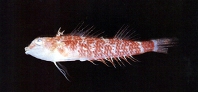 Enneapterygius rubicauda
Photo von Shao, K.T.
Bilder | Google Bild
Photo von Shao, K.T.
Klassifizierung / Names Namen | Synonyme | Catalog of Fishes(Gattung, Arten) | ITIS | CoL | WoRMS | Cloffa
> Blenniiformes (Blennies) > Tripterygiidae (Triplefin blennies) > Tripterygiinae
Etymology: Enneapterygius: Greek, ennea = nine times + Greek, pterygion = little fin (Ref. 45335).
Etymology: Enneapterygius: Greek, ennea = nine times + Greek, pterygion = little fin (Ref. 45335).
Taxonomic Remarks
Synonym of Enneapterygius flavoccipitis Shen, 1994; Enneapterygius erythrosoma Shen, 1994.
Umwelt: Milieu / Klimazone / Tiefenbereich / Verbreitungsgebiet Ökologie
seewasser demersal; tiefenbereich 0 - 12 m (Ref. 79877). Subtropical
Verbreitung Territorien | FAO Gebiete | Ökosysteme | Vorkommen | Punkt Karte | Einführungen | Faunafri
Western Pacific: Ryukyu and Ogasawara islands, Taiwan, Philippines, New Caledonia, and Vanuatu.
Größe / Gewicht / Alter
Kurzbeschreibung Bestimmungsschlüssel | Morphologie | Morphometrie
Rückenflossenstacheln (insgesamt) : 14 - 18; Rückenflossenweichstrahlen (insgesamt) : 8 - 11; Afterflossenstacheln: 1; Afterflossenweichstrahlen: 18 - 21. Red and orange, marbled with white, broad orange or red bar on caudal peduncle of female, black head "mask" and caudal peduncle in male, and reddish caudal fin. Head, chest, and pectoral-fin base scaleless; tiny orbital tentacle; mandibular pores 3-4 + 1 + 3-4. Maximum size to 4.4 cm TL (Ref. 90102).
Body shape (shape guide): elongated; Cross section: oval.
Body shape (shape guide): elongated; Cross section: oval.
Adults inhabit rock and coral reefs at 7 m or shallower (Ref. 90102). Eggs are hemispherical and covered with numerous sticky threads that anchor them in the algae on the nesting sites (Ref. 240). Larvae are planktonic which occur primarily in shallow, nearshore waters (Ref. 94114).
Lebenszyklus und Paarungsverhalten Geschlechtsreife | Fortpflanzung | Ablaichen | Eier | Fruchtbarkeit | Larven
Hauptreferenz
Laden Sie Ihre Referenzen hoch | Referenzen | Koordinator : Fricke, Ronald | Partner
Fricke, R., 1997. Tripterygiid fishes of the western and central Pacific, with descriptions of 15 new species, including an annotated checklist of world Tripterygiidae (Teleostei). Theses Zool. 29:1-607. (Ref. 27223)
IUCN Rote Liste Status (Ref. 130435: Version 2025-2 (Global))
nicht bedroht (LC) ; Date assessed: 16 March 2010
CITES
Not Evaluated
Bedrohung für Menschen
Harmless
Nutzung durch Menschen
Fischereien: nicht kommerziell
FAO - Publication: search | FishSource |
Mehr Information
Trophische Ökologie
Lebensmittel (Beutetiere)
Nahrungszusammensetzung
Nahrungsaufnahme
Lebensmittelrationen
Räuber
Lebensmittel (Beutetiere)
Nahrungszusammensetzung
Nahrungsaufnahme
Lebensmittelrationen
Räuber
Ökologie
Ökologie
Ökologie
Populationsdynamik
Wachstumsparameter
Max. Alter/Größen
Länge-Gewicht-Rel.
Länge-Länge-Verhältnis.
Längenhäufigkeiten
Massenkonvertierung
Rekrutierung
Dichte
Wachstumsparameter
Max. Alter/Größen
Länge-Gewicht-Rel.
Länge-Länge-Verhältnis.
Längenhäufigkeiten
Massenkonvertierung
Rekrutierung
Dichte
Anatomie
Kiemenoberfläche
Gehirn
Otolith
Kiemenoberfläche
Gehirn
Otolith
Physiologie
Körperliche Zusammensetzung
Nährstoffe
Sauerstoffverbrauch
Schwimmart
Schwimmgeschwindigkeit
Visuelle Pigmente
Fischgeräusche
Krankheiten und Parasiten
Toxizität (LC50s)
Körperliche Zusammensetzung
Nährstoffe
Sauerstoffverbrauch
Schwimmart
Schwimmgeschwindigkeit
Visuelle Pigmente
Fischgeräusche
Krankheiten und Parasiten
Toxizität (LC50s)
Genetik
Genom
Genetik
Heterozygotie
Vererbbarkeit
Genetische Vielfalt
Genom
Genetik
Heterozygotie
Vererbbarkeit
Genetische Vielfalt
Menschenbezogen
Aquakultur-Systeme
Aquakultur Profile
Zuchtlinien
Ciguatera-Fälle
Briefmarken, Münzen, Verschiedenes.
Aquakultur-Systeme
Aquakultur Profile
Zuchtlinien
Ciguatera-Fälle
Briefmarken, Münzen, Verschiedenes.
Tools
Zusatzinformationen
Download XML
Zusammenfassung | Punktdaten | Namen | Photos
Internet Quellen
AFORO (otoliths) | Aquatic Commons | BHL | Cloffa | Websites from users | FishWatcher Einträge suchen | CISTI | Catalog of Fishes: Gattung, Arten | DiscoverLife | ECOTOX | FAO - Publication: search | Faunafri | Fishipedia | Fishtrace | GloBI | Google Books | Google Scholar | Google | IGFA World Record | Nationale Datenbanken | OneZoom | Open Tree of Life | Otolith Atlas of Taiwan Fishes | PubMed | Reef Life Survey | Socotra Atlas | TreeBase | Tree of Life | Wikipedia: Gehe zu, Suchen | | Zoobank | Zoologischer Rekord
Schätzungen auf der Grundlage von Modellen
|
Phylogenetischer Diversitätsindex (Ref. 82804) |
PD50 = 0.5000 [Uniqueness, from 0.5 = low to 2.0 = high]. |
| Bayesian length-weight | a=0.00617 (0.00292 - 0.01304), b=3.03 (2.85 - 3.21), in cm total length, based on LWR estimates for this (Sub)family-body shape (Ref. 93245). |
|
Trophische Ebene (Ref. 69278) |
3.2 ±0.3 se; based on size and trophs of closest relatives |
|
Widerstandsfähigkeit (Ref. 120179) |
hoch, Verdopplung der Population dauert weniger als 15 Monate. (Preliminary K or Fecundity.). |
|
Anfälligkeit der Fischerei (Ref. 59153) |
Low vulnerability (10 of 100). 🛈 |