This website uses cookies to enhance your browsing experience and ensure the functionality of our site. For more detailed information about the types of cookies we use and how we protect your privacy, please visit our Privacy Information page.
×
Cookie Settings
This website uses different types of cookies to enhance your experience. Please select your preferences below:
> Gonorynchiformes (Milkfishes) > Kneriidae (Shellears)
Etymology: Kneria:From Kner, that studied fishes in the Imperial Museum of Vienna, with Jean Natterer (1817) (Ref. 45335); uluguru:Named for the Uluguru Mountains, Tanzania, where the fish have first been collected; a noun in apposition (Ref. 26644). Eponymy: Dr Rudolf Kner (1810–1869) was an Austrian zoologist specialising in ichthyology. [...] This is a toponym referring to the Uluguru Mountains in Tanzania, where the species appears to be endemic. (Ref. 128868), visit book page.
Environnement : milieu / zone climatique / profondeur / gamme de distribution Écologie
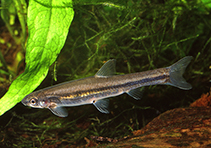
Épines dorsales (Total) : 0; Rayons mous dorsaux (Total) : 9 - 10; Épines anales: 0; Rayons mous anaux: 9 - 11. Diagnosis: small species with long head, 18.8-25.0% SL; snout relatively long, 28.6-37.0% SL, with narrow cleft and peculiar structure of the inferior positioned mouth; opercular disc of males shallow, with rounded outer edge; pectoral fin long, 14.9-17.7% SL; preanal length relatively short, 65.0-71.9% SL; 79-87 lateral line scales, which tends to increase with increasing length of the fish; distinct blackish streak from tip of snout to caudal fin, which may be coverd by dark bluish spots; dorsal fin origin clearly behind pelvic fin origin (Ref. 26644).
Body shape (shape guide): elongated; Cross section: circular.
Maximum total length recorded is 5.31cm TL; inhabits clear streams and rivers with very fast current to more gentle waterflow, but more numerous in the quieter stretches; omnivorous, but feeds mainly on algae and aufwuchs rasped off from stones; apparently no marked spawning season (Ref. 26644).
Cycle de vie et comportement reproducteur Maturité | Reproduction | Frai | Œufs | Fécondité | Larves
Seegers, L., 1995. Revision of the Kneriidae of Tanzania with description of three new Kneria species (Teleostei: Gonorhynchifromes). Ichthyol. Explor. Freshwat. 6(2):97-128. (Ref. 26644)
Statut dans la liste rouge de l'IUCN (Ref. 130435: Version 2025-2 (Global))
Dynamique des populations Paramètres de croissance Âges / tailles maximales Longueur-poids rel. Rel. longueur-longueur. Fréquences de longueurs Conversion de masse Recrutement Abondance
Cycle de vie Reproduction Maturité Maturité/épines rel. Fécondité Frai Agrégats de frai Œufs Développement de l'œuf Larves Dynamique des populations larvaires
Physiologie Composition corporelle Nutriments Consommation d'oxygène Type de natation Vitesse de nage Pigments visuels Son de poisson Maladies et parasites Toxicité (CL50)