



muatnaik fotos/gambar dan video
Gambar | imej Google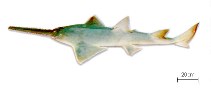 Pristis perotteti
foto/gambar oleh IBAMA
Gambar | imej Google
foto/gambar oleh IBAMA
klasifikasi / Nama Nama-nama umum | Sinonim (persamaan) | Catalog of Fishes(Marga, Jenis) | ITIS | CoL | WoRMS | Cloffa
Ikan bertulang rawan (sharks and rays) > Rhinopristiformes (Shovelnose rays) > Pristidae (Sawfishes)
Etymology: Pristis: Greek, pristis = saw (Ref. 45335).
Eponymy: George Samuel Perrottet (1790–1870), also known as Georges Guerrard-Samuel Perrottet (and whose surname is sometimes given as Pérotet or Perrotet), was a Swiss-born French botanist and horticulturalist. [...] (Ref. 128868), visit book page.
More on authors: Müller & Henle.
Etymology: Pristis: Greek, pristis = saw (Ref. 45335).
Eponymy: George Samuel Perrottet (1790–1870), also known as Georges Guerrard-Samuel Perrottet (and whose surname is sometimes given as Pérotet or Perrotet), was a Swiss-born French botanist and horticulturalist. [...] (Ref. 128868), visit book page.
More on authors: Müller & Henle.
Taxonomic Remarks
Synonym of Pristis pristis (Linnaeus, 1758) according to Faria et al., 2012 (Ref. 93006:11) and Weigmann, 2016 (Ref. 106604); status confirmed by William White (pers. Comm., Feb 2016).
Lingkungan: lingkungan / zona iklim / kisaran kedalaman / jangkauan distribusi Ekologi
laut; air tawar; payau bentopelagis; amphidromus (Ref. 51243); kisaran kedalaman 1 - 122 m (Ref. 55273), usually ? - 10 m (Ref. 55273). Tropical; 32°N - 19°S, 106°W - 15°E (Ref. 55273)
Penyebaran Wilayah | Daerah-daerah FAO | Ekosistem | Kemunculan | peta titik | Introduksi | Faunafri
Northwest Atlantic: Texas, Florida. Northeast Atlantic: West Africa. Eastern and Western Central Pacific: off northern Australia. Indo-China: East Indies. South America: Amazon near Santárem, Brazil.
Panjang pada saat jatuh tempo pertama / Ukuran / Berat / umur
Kematangan: Lm ?, range 300 - ? cm
Max length : 650 cm TL jantan/; (Ref. 6902); Berat maksimum terpublikasi: 591.0 kg (Ref. 6902)
Max length : 650 cm TL jantan/; (Ref. 6902); Berat maksimum terpublikasi: 591.0 kg (Ref. 6902)
deskripsi pendek Kunci identifiaksi (pengenalan) | Morfologi | Morfometrik
Fewer sawteeth (normally 19, rarely 20 on a side). First dorsal fin originate in advance of the origin of the pelvic fins and much more deeply concave posterior margins of the dorsal fins. Saltwater species when fresh-caught, either dark gray or golden brown, while freshwater species are mouse gray with reddish along midback posterior to first dorsal fin, reddish posterior to lower part of sides, first dorsal pale yellow with reddish free rear corner; second dorsal, pelvic fins, caudal and lower sides posterior to first dorsal dull brick red. Reddish tint either normal or result of suffusion with blood below the skin (Ref. 6902).
Body shape (shape guide): elongated.
Body shape (shape guide): elongated.
Inhabits shallow water in the vicinity of the shore and estuarine, particularly lagoons. Generally thought to rarely descend below 10m but have been found at 122m in Lake Nicaragua (Ref. 55273). Tends to run farther upstream in large rivers. Found in temperatures higher than 20-30°C (Ref. 6902). Ovoviviparous (Ref. 50449). Minor commercial, for the curio trade (Ref. 37548).
Siklus hidup dan perilaku kawin Kematangan | Reproduksi, perkembang biakan | Pemijahan | telur-telur | Fekunditas | Larva
Ovoviviparous, embryos feed solely on yolk (Ref. 50449).
rujukan utama
Unggah referensi Anda | Acuan | Koordinator : McEachran, John | mitra
Ferreira, E.J.G., J.A.S. Zuanon and G.M. dos Santos, 1998. Peixes comerciais do médio Amazonas. Instituto Brasileiro do Meio Ambiente e dos Recursos Naturais Renováveis. 211p. (Ref. 27548)
CITES
Not Evaluated
ancaman kepada manusia
Harmless
penggunaan manusia
Perikanan: nilai komersial kecil; Ikan buruan: ya
FAO - Publication: search | FishSource |
informasi lanjut
Ekologi trofik
Item makanan (mangsa)
Komposisi makanan
Konsumsi makanan
Ransum makanan
Pemangsa
Item makanan (mangsa)
Komposisi makanan
Konsumsi makanan
Ransum makanan
Pemangsa
Ekologi
Ekologi
Ekologi
Dinamika populasi
Parameter pertumbuhan
Maks. usia / ukuran
Panjang-berat rel.
Panjang-panjang rel.
ukuran frekuensi
Konversi massa
pemulihan
Kelimpahan
Parameter pertumbuhan
Maks. usia / ukuran
Panjang-berat rel.
Panjang-panjang rel.
ukuran frekuensi
Konversi massa
pemulihan
Kelimpahan
Siklus hidup
Reproduksi, perkembang biakan
Kematangan
Kedewasaan / insang rel.
Fekunditas
Pemijahan
Agregasi pemijahan
telur-telur
pekembangan telor
Larva
Dinamika larva
Reproduksi, perkembang biakan
Kematangan
Kedewasaan / insang rel.
Fekunditas
Pemijahan
Agregasi pemijahan
telur-telur
pekembangan telor
Larva
Dinamika larva
Anatomi
Area insang
Otak
Otolith
Area insang
Otak
Otolith
Fisiologi
Komposisi tubuh
Nutrisi
Konsumsi oksigen
Jenis renang
Kecepatan berenang
Pigmen visual
Suara ikan
Penyakit & Parasit
Toksisitas (LC50)
Komposisi tubuh
Nutrisi
Konsumsi oksigen
Jenis renang
Kecepatan berenang
Pigmen visual
Suara ikan
Penyakit & Parasit
Toksisitas (LC50)
Genetika
genom
Genetika
Heterozigositas
Diturunkan
Keanekaragaman Genetik
genom
Genetika
Heterozigositas
Diturunkan
Keanekaragaman Genetik
Yang berhubungan dengan manusia
Sistem akuakultur
profil budidaya air
Strain
Kasus Ciguatera
Perangko, koin, dll.
Sistem akuakultur
profil budidaya air
Strain
Kasus Ciguatera
Perangko, koin, dll.
Alat, peralatan
E-book | Penuntun lapangan | tanda freqkuenci panjang | peringkat sejarah hidup | peta titik |
Tangkap-MSY |
laporan khas
muat turun XML
Sumber internet
AFORO (otoliths) | Aquatic Commons | BHL | Cloffa | Websites from users | semak peneliti ikan | CISTI | Catalog of Fishes: Marga, Jenis | DiscoverLife | ECOTOX | FAO - Publication: search | Faunafri | Fishipedia | Fishtrace | GloBI | Google Books | Google Scholar | Google | IGFA World Record | OneZoom | Open Tree of Life | Otolith Atlas of Taiwan Fishes | PubMed | Reef Life Survey | Socotra Atlas | TreeBase | Tree of Life | Wikipedia: pergi, Cari | World Records Freshwater Fishing | Zoobank | Catatan Zoologi
Estimasi berdasarkan model
Suhu yang disukai (Acuan 123201): 26.1 - 28.5, mean 27.6 °C (based on 544 cells).
Indeks keanekaragaman filogenetik (Acuan 82804): PD50 = 0.5234 [Uniqueness, from 0.5 = low to 2.0 = high].
Bayesian length-weight: a=0.00832 (0.00402 - 0.01720), b=3.00 (2.80 - 3.20), in cm total length, based on LWR estimates for this species & (Sub)family-body (Ref. 93245).
Tingkat Trofik (Acuan 69278): 4.0 ±0.6 se; based on size and trophs of closest relatives
Generation time: 12.3 ( na - na) years. Estimated as median ln(3)/K based on 1 growth studies.
Daya lenting (Acuan 120179): Rendah, Waktu penggandaan populasi minimum 4.5 - 14 tahun (Fec assumed to be <100).