



Adicionar o seu Fotografias e vídeos
Imagem do Google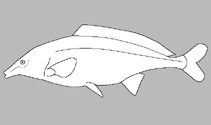 No image available for this species;
drawing shows typical species in Mormyridae.
Imagem do Google
drawing shows typical species in Mormyridae.
Classificação / Nomes Nomes comuns | Sinónimos | Catalog of Fishes(Género, Espécies) | ITIS | CoL | WoRMS | Cloffa
> Osteoglossiformes (Bony tongues) > Mormyridae (Elephantfishes)
Etymology: Marcusenius: Becasue of J. Marcusen, author of "Zur Phauna des Schwarzen Meeres", 1867; ichthyologist.
Eponymy: Dr Johann Andreas Marcusen (1817–1894) was a Latvian of German descent who was a physician, ichthyologist and zoologist. [...] (Ref. 128868), visit book page.
More on author: Linnaeus.
Etymology: Marcusenius: Becasue of J. Marcusen, author of "Zur Phauna des Schwarzen Meeres", 1867; ichthyologist.
Eponymy: Dr Johann Andreas Marcusen (1817–1894) was a Latvian of German descent who was a physician, ichthyologist and zoologist. [...] (Ref. 128868), visit book page.
More on author: Linnaeus.
Ambiente: milieu / zona climática / intervalo de profundidade / gama de distribuição Ecologia
; Água doce demersal; potamódromo (Ref. 138143). Tropical
Distribuição Territórios | Áreas FAO | Ecossistemas | Ocorrências | Mapa dos pontos | Introduções | Faunafri
Africa: Nile (delta to Bahr-el-Jebel), Niger (Lower Niger and Benoué) and Chad basins (Ref. 3203, 81274).Also reported from the Albert Nile and Aswa River (White Nile basin) in Uganda and from the upper Congo (Ref. 4903), but the latter seems outside the species distribution area and is questionable.
Tamanho / Peso / Idade
Maturidade: Lm ? range ? - ? cm
Max length : 33.0 cm SL macho/indeterminado; (Ref. 2915); peso máx. Publicado: 458.00 g (Ref. 2915)
Max length : 33.0 cm SL macho/indeterminado; (Ref. 2915); peso máx. Publicado: 458.00 g (Ref. 2915)
Descrição breve Chaves de identificação | Morfologia | Morfometria
Espinhos dorsais (total) : 0; Raios dorsais moles (total) : 25 - 31; Espinhos anais: 0; Raios anais moles: 30 - 37. Diagnosis: teeth small and conical (Ref. 4903, 81274), arranged in a single series confined to the middle of each jaw, 5-6 in both jaws (Ref. 4903). 16(-18) scales around caudal peduncle (Ref. 4903, 81274). Body depth 3.0-4.7 times in standard length; anal-fin base 0.7-0.9 times in dorsal-fin base (Ref. 81274). Head length 4-5.5 times in SL; upper head profile gently curved; snout 1/3-1/4 length of head; eye 1/2-2/3 length of snout; mouth small, a globular, fleshy swelling on the chin (Ref. 4903). Dorsal fin beginning slightly behind level of anal fin-origin (Ref. 2915, 81274), above the the 6th-9th anal fin ray (Ref. 4903) and comprising 25-31 rays (Ref. 2915, 4903, 81274). 70-92 lateral-line scales (Ref. 4903, 81274). Caudal-peduncle 2.0-3.4 times longer than deep (Ref. 2915, 4903, 81274). Caudal fin partly covered with small scales, its lobes pointed (Ref. 4903).
Coloration: silvery-grey, sometimes dark grey to blackish (Ref. 81274) or dark bluish-green dorsally (Ref. 4903).
Body shape (shape guide): fusiform / normal; Cross section: compressed.
Body shape (shape guide): fusiform / normal; Cross section: compressed.
Adults inhabit lakes, lagoons, reservoirs and (irrigation) canals. They are bottom feeding insectivores that breed during the flood season and enters the floodplain for this purpose (Ref. 28714). Thay show three 'preferred' modes of intervals between electric organ discharges (inter-EOD) when at rest: 10-35 ms, 50-120 ms and 200-350 ms (Ref. 10833).
Ciclo de vida e comportamento de acasalamento Maturidade | Reprodução | Desova | Ovos | Fecundidade | Larvas
Referência principal
Carregar as suas referências | Referências | Coordenador | Colaboradores
Bigorne, R., 1990. Mormyridae. p. 122-184. In C. Lévêque, D. Paugy and G.G. Teugels (eds.) Faune des poissons d'eaux saumâtres d'Afrique de l'Ouest. tome 1. Faune Trop. 28. Musée Royal de l'Afrique Centrale, Tervuren, and ORSTOM, Paris. (Ref. 2915)
Categoria na Lista Vermelha da IUCN (Ref. 130435: Version 2025-2 (Global))
Preocupação menor (LC) ; Date assessed: 04 September 2019
CITES
Not Evaluated
Ameaça para o homem
Harmless
Utilização humana
Pescarias: pouco comercial
FAO - Publication: search | FishSource |
Mais informação
Ecologia Trófica
Produtos alimentares (presas)
Composição da dieta
Consumo alimentar
Rações alimentares
Predadores
Produtos alimentares (presas)
Composição da dieta
Consumo alimentar
Rações alimentares
Predadores
Dinâmica das populações
Parâmetros de crescimento
Idades / tamanhos máximos
Comprimento-peso rel.
Comprimento-comprimento rel.
Frequência de comprimento
Conversão de massa
Recrutamento
Abundância
Parâmetros de crescimento
Idades / tamanhos máximos
Comprimento-peso rel.
Comprimento-comprimento rel.
Frequência de comprimento
Conversão de massa
Recrutamento
Abundância
Ciclo de vida
Reprodução
Maturidade
Maturidade/Rel. das guelras
Fecundidade
Desova
Agregações de desova
Ovos
Desenvolvimento dos ovos
Larvas
Dinâmica larvar
Reprodução
Maturidade
Maturidade/Rel. das guelras
Fecundidade
Desova
Agregações de desova
Ovos
Desenvolvimento dos ovos
Larvas
Dinâmica larvar
Anatomia
Área branquial
Cérebro
Otólitos
Área branquial
Cérebro
Otólitos
Fisiologia
Composição corporal
Nutrientes
Consumo de oxigénio
Tipo de natação
Velocidade de natação
Pigmentos visuais
Som de peixe
Doenças e Parasitas
Toxicidade (LC50s)
Composição corporal
Nutrientes
Consumo de oxigénio
Tipo de natação
Velocidade de natação
Pigmentos visuais
Som de peixe
Doenças e Parasitas
Toxicidade (LC50s)
Genética
genoma
Genética
Heterozigotia
Hereditariedade
Diversidade genética
genoma
Genética
Heterozigotia
Hereditariedade
Diversidade genética
Relacionado com o ser humano
Sistemas de aquacultura
Perfis para aquacultura
Estirpes
Casos de Ciguatera
Selos, moedas, diversos.
Sistemas de aquacultura
Perfis para aquacultura
Estirpes
Casos de Ciguatera
Selos, moedas, diversos.
Ferramentas
E-book | Guia de campo | Chaves de identificação | Ferramenta auxiliar de frequências de comprimento | Ferramenta sobre a história de vida | Mapa dos pontos |
Captura-MSY |
Relatórios especiais
Descarregue XML
Fontes da internet
AFORO (otoliths) | Aquatic Commons | BHL | Cloffa | Websites from users | Consultar FishWatcher | CISTI | Catalog of Fishes: Género, Espécies | DiscoverLife | ECOTOX | FAO - Publication: search | Faunafri | Fishipedia | Fishtrace | GloBI | Google Books | Google Scholar | Google | IGFA World Record | OneZoom | Open Tree of Life | Otolith Atlas of Taiwan Fishes | PubMed | Reef Life Survey | Socotra Atlas | TreeBase | Árvore da vida | Wikipedia: ir para, procurar | World Records Freshwater Fishing | Registo zoológico
Estimativas baseadas em modelos
Índice de diversidade filogenética (Ref. 82804): PD50 = 0.5000 [Uniqueness, from 0.5 = low to 2.0 = high].
Bayesian length-weight: a=0.01122 (0.00638 - 0.01972), b=2.86 (2.71 - 3.01), in cm total length, based on LWR estimates for this species & Genus-body shape (Ref. 93245).
Nível Trófico (Ref. 69278): 3.0 ±0.37 se; based on food items.
Resiliência (Ref. 120179): Médio, tempo mínimo de duplicação da população 1,4 - 4,4 anos (Preliminary K or Fecundity.).