



Lepidotrigla robinsi Richards, 1997
Envoyez vos Photos et vidéos
Images Google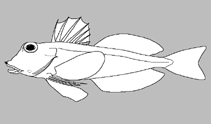 No image available for this species;
drawing shows typical species in Triglidae.
Images Google
drawing shows typical species in Triglidae.
Classification / Noms Noms communs | Synonymes | Catalog of Fishes(Genre, Espèce) | ITIS | CoL | WoRMS | Cloffa
> Perciformes/Scorpaenoidei (Scorpionfishes) > Triglidae (Searobins) > Triglinae
Etymology: Lepidotrigla: Greek, lepis, lepidos = scale + Greek, trigla, es = red mullet (Ref. 45335); robinsi: Named for C. Richard Robins (Maytag Professor of Ichthyology at the Rosenstiel School of Marine and Atmospheric Science, University of Miami).
Eponymy: Dr Charles Richard ‘Dick’ Robins (1928–2020) was an American systematic ichthyologist whom one etymology honoured as an ‘eelologist’; as well as a colleague, advisor and friend, for his contributions to the knowledge of fishes (including [...] (Ref. 128868), visit book page.
Etymology: Lepidotrigla: Greek, lepis, lepidos = scale + Greek, trigla, es = red mullet (Ref. 45335); robinsi: Named for C. Richard Robins (Maytag Professor of Ichthyology at the Rosenstiel School of Marine and Atmospheric Science, University of Miami).
Eponymy: Dr Charles Richard ‘Dick’ Robins (1928–2020) was an American systematic ichthyologist whom one etymology honoured as an ‘eelologist’; as well as a colleague, advisor and friend, for his contributions to the knowledge of fishes (including [...] (Ref. 128868), visit book page.
Environnement : milieu / zone climatique / profondeur / gamme de distribution Écologie
marin démersal; profondeur 110 - 146 m (Ref. 26892). Subtropical
Distribution Territoires | Zones FAO | Écosystèmes | Occurrences | Carte par point | Introductions | Faunafri
Southwest Pacific: known only from the Kermadec Islands.
Taille / Poids / Âge
Description synthétique Clés d'identification | Morphologie | Morphométrie
Épines dorsales (Total) : 9; Rayons mous dorsaux (Total) : 16 - 18; Rayons mous anaux: 16 - 18; Vertèbres: 34. This species is distinguished by the following characters: a prominent spiny projection of the
rostral process of the first infraorbital bone [type M of Richards (1992)]; short opercular spine, barely projecting to edge of opercular flap; moderate length of pectoral fin (30.9-38.2%SL), reaching anal fin origin; weakly attached scales, ctenoid above and immediately below lateral line (transforming cteni type of Roberts, 1993), grading to cycloid on the belly; scaled nape, naked breast and interpelvic area; lateral line scales 64-67, 3 to 5 scale rows above and 21 to 26 rows below the lateral line; D1 IX, D2 16-18; A16-18; 11 plus 3 free pectoral rays; 25-26 bucklers along base of dorsal fins; vertebrae 34 (precaudal 11, caudal 23); head length short (27.1-29.7%SL); interorbital width narrow (5.3-6.0%SL); gill rakers on first ceratobranchial 6-7 short (1.3-1.7%SL) (Ref. 26892).
Cycle de vie et comportement reproducteur Maturité | Reproduction | Frai | Œufs | Fécondité | Larves
Référence principale
Téléchargez vos références | Références | Coordinateur | Collaborateurs
Richards, W.J., 1997. A new species of Lepidotrigla (Pisces, Triglidae) from the Kermadec Islands of the South Pacific. Bull. Mar. Sci. 60(3):1050-1059. (Ref. 26892)
CITES
Not Evaluated
Menace pour l'homme
Harmless
Utilisations par l'homme
Pêcheries: sans intérêt
FAO - Publication: search | FishSource |
Plus d'informations
Écologie trophique
Aliments (proies)
Composition du régime alimentaire
Consommation alimentaire
Rations alimentaires
Prédateurs
Aliments (proies)
Composition du régime alimentaire
Consommation alimentaire
Rations alimentaires
Prédateurs
Écologie
Écologie
Écologie
Dynamique des populations
Paramètres de croissance
Âges / tailles maximales
Longueur-poids rel.
Rel. longueur-longueur.
Fréquences de longueurs
Conversion de masse
Recrutement
Abondance
Paramètres de croissance
Âges / tailles maximales
Longueur-poids rel.
Rel. longueur-longueur.
Fréquences de longueurs
Conversion de masse
Recrutement
Abondance
Cycle de vie
Reproduction
Maturité
Maturité/épines rel.
Fécondité
Frai
Agrégats de frai
Œufs
Développement de l'œuf
Larves
Dynamique des populations larvaires
Reproduction
Maturité
Maturité/épines rel.
Fécondité
Frai
Agrégats de frai
Œufs
Développement de l'œuf
Larves
Dynamique des populations larvaires
Anatomie
Surface branchiale
Cerveau
Otolithe
Surface branchiale
Cerveau
Otolithe
Physiologie
Composition corporelle
Nutriments
Consommation d'oxygène
Type de natation
Vitesse de nage
Pigments visuels
Son de poisson
Maladies et parasites
Toxicité (CL50)
Composition corporelle
Nutriments
Consommation d'oxygène
Type de natation
Vitesse de nage
Pigments visuels
Son de poisson
Maladies et parasites
Toxicité (CL50)
Génétique
génôme
Génétique
Hétérozygotie
Héritabilité
Diversité génétique
génôme
Génétique
Hétérozygotie
Héritabilité
Diversité génétique
Liées à l'homme
Systèmes d'aquaculture
Profils d'aquaculture
Souches
Cas de ciguatera
Timbres, pièces de monnaie, divers
Systèmes d'aquaculture
Profils d'aquaculture
Souches
Cas de ciguatera
Timbres, pièces de monnaie, divers
Outils
E-book | Guide de terrain | Générateur de fréquences de longueur | Outil de dynamique de population | Carte par point |
Capture-MSY |
Articles particuliers
Télécharger en XML
Sources Internet
AFORO (otoliths) | Aquatic Commons | BHL | Cloffa | Websites from users | FishWatcher | CISTI | Catalog of Fishes: Genre, Espèce | DiscoverLife | ECOTOX | FAO - Publication: search | Faunafri | Fishipedia | Fishtrace | GloBI | Google Books | Google Scholar | Google | IGFA World Record | OneZoom | Open Tree of Life | Otolith Atlas of Taiwan Fishes | PubMed | Reef Life Survey | Socotra Atlas | TreeBase | Arbre de Vie | Wikipedia: aller à, chercher | | Zoobank | Zoological Record
Estimations basées sur des modèles
|
Indice de diversité phylogénétique (Réf. 82804) |
PD50 = 0.5000 [Uniqueness, from 0.5 = low to 2.0 = high]. |
| Bayesian length-weight | a=0.00661 (0.00317 - 0.01379), b=3.07 (2.89 - 3.25), in cm total length, based on LWR estimates for this (Sub)family-body shape (Ref. 93245). |
|
Niveau trophique (Réf. 69278) |
3.4 ±0.3 se; based on size and trophs of closest relatives |
|
Résilience (Réf. 120179) |
Haut, temps minimum de doublement de population inférieur à 15 mois (Preliminary K or Fecundity.). |
|
Vulnérabilité de la pêche (Ref. 59153) |
Low to moderate vulnerability (26 of 100). 🛈 |