



Envoyez vos Photos et vidéos
Images Google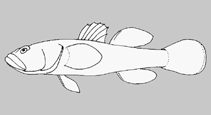 No image available for this species;
drawing shows typical species in Odontobutidae.
Images Google
drawing shows typical species in Odontobutidae.
Classification / Noms Noms communs | Synonymes | Catalog of Fishes(Genre, Espèce) | ITIS | CoL | WoRMS | Cloffa
> Gobiiformes (Gobies) > Odontobutidae (Freshwater sleepers)
Etymology: Terateleotris: Greek, tera = marvel + see under Eleotris.
More on author: Kottelat.
Etymology: Terateleotris: Greek, tera = marvel + see under Eleotris.
More on author: Kottelat.
Environnement : milieu / zone climatique / profondeur / gamme de distribution Écologie
; eau douce benthopélagique. Tropical
Distribution Territoires | Zones FAO | Écosystèmes | Occurrences | Carte par point | Introductions | Faunafri
Asia: Xe Bangfai of the Mekong basin in Laos.
Taille / Poids / Âge
Description synthétique Clés d'identification | Morphologie | Morphométrie
Épines dorsales (Total) : 9; Rayons mous dorsaux (Total) : 9; Épines anales: 1. Distinguishable by its shallower body (depth 2.1-2.4 times in SL) with relatively narrow vertical bars; bar 1 usually not continued onto thorax or across ventral surface of the body; bar 2 originating at base of 5th-6th dorsal spine; usually 11 branched anal fin rays (Ref. 27732). First dorsal fin with 8 rays; small genitalia not extending backwards to base of first anal fin ray (Ref. 43281); presence of connection between oculoscapular and preopercular canals; short and stout gill rakers on lower half outer surface of first gill arch with small spines; presence of furrow on all mid-lateral line scales; complete cephalic sensory canals; sensory papillae on chin forming transverse pattern, separate right and left lines; transverse pattern formed by sensory papillae on tip of snout; right and left gill membrane united at vertical from a point of near posterior edge of eye; wide gill opening, extending to a vertical from anterior margin of pupil; width of interorbital narrower than eye diameter; ctenoid predorsal scales, extending forward to posterior part of interorbital space; 5th pelvic ray branched; presence of distal radial of first-dorsal fin element; presence of suborbital bone; three epurals; presence of large extrascapula; absence of prevomerine teeth; absence of ventral transverse shelf on posterior half of urohyal; gill rakers separated bon inner part of 4th ceratobranchial; presence of anterior projection on anterior tip of metapterygoid; absence of overlap with lower part of ectopterygoid and quadrate (Ref. 92840).
Body shape (shape guide): fusiform / normal.
Body shape (shape guide): fusiform / normal.
Found in backwaters (Ref. 27732). Inhabits gravelly-sandy bottom of a shallow-flowing area just downstream of the exit of river underground course (Ref. 42922).
Cycle de vie et comportement reproducteur Maturité | Reproduction | Frai | Œufs | Fécondité | Larves
Référence principale
Téléchargez vos références | Références | Coordinateur | Collaborateurs
Shibukawa, K., A. Iwata and S. Viravong, 2001. Terateleotris, a new gobioid fish genus from the Laos (Teleostei, Perciformes), with comments on its relationships. Bull. Natl. Sci. Mus. Ser. A 27(4):229-257. (Ref. 42922)
Statut dans la liste rouge de l'IUCN (Ref. 130435: Version 2025-2 (Global))
Menacé (EN) (B1ab(iii)+2ab(iii)); Date assessed: 11 November 2011
CITES
Not Evaluated
Menace pour l'homme
Harmless
Utilisations par l'homme
FAO - Publication: search | FishSource |
Plus d'informations
Écologie trophique
Aliments (proies)
Composition du régime alimentaire
Consommation alimentaire
Rations alimentaires
Prédateurs
Aliments (proies)
Composition du régime alimentaire
Consommation alimentaire
Rations alimentaires
Prédateurs
Écologie
Écologie
Écologie
Dynamique des populations
Paramètres de croissance
Âges / tailles maximales
Longueur-poids rel.
Rel. longueur-longueur.
Fréquences de longueurs
Conversion de masse
Recrutement
Abondance
Paramètres de croissance
Âges / tailles maximales
Longueur-poids rel.
Rel. longueur-longueur.
Fréquences de longueurs
Conversion de masse
Recrutement
Abondance
Cycle de vie
Reproduction
Maturité
Maturité/épines rel.
Fécondité
Frai
Agrégats de frai
Œufs
Développement de l'œuf
Larves
Dynamique des populations larvaires
Reproduction
Maturité
Maturité/épines rel.
Fécondité
Frai
Agrégats de frai
Œufs
Développement de l'œuf
Larves
Dynamique des populations larvaires
Anatomie
Surface branchiale
Cerveau
Otolithe
Surface branchiale
Cerveau
Otolithe
Physiologie
Composition corporelle
Nutriments
Consommation d'oxygène
Type de natation
Vitesse de nage
Pigments visuels
Son de poisson
Maladies et parasites
Toxicité (CL50)
Composition corporelle
Nutriments
Consommation d'oxygène
Type de natation
Vitesse de nage
Pigments visuels
Son de poisson
Maladies et parasites
Toxicité (CL50)
Génétique
génôme
Génétique
Hétérozygotie
Héritabilité
Diversité génétique
génôme
Génétique
Hétérozygotie
Héritabilité
Diversité génétique
Liées à l'homme
Systèmes d'aquaculture
Profils d'aquaculture
Souches
Cas de ciguatera
Timbres, pièces de monnaie, divers
Systèmes d'aquaculture
Profils d'aquaculture
Souches
Cas de ciguatera
Timbres, pièces de monnaie, divers
Outils
E-book | Guide de terrain | Générateur de fréquences de longueur | Outil de dynamique de population | Carte par point |
Capture-MSY |
Articles particuliers
Télécharger en XML
Sources Internet
AFORO (otoliths) | Aquatic Commons | BHL | Cloffa | Websites from users | FishWatcher | CISTI | Catalog of Fishes: Genre, Espèce | DiscoverLife | ECOTOX | FAO - Publication: search | Faunafri | Fishipedia | Fishtrace | GloBI | Google Books | Google Scholar | Google | IGFA World Record | OneZoom | Open Tree of Life | Otolith Atlas of Taiwan Fishes | PubMed | Reef Life Survey | Socotra Atlas | TreeBase | Arbre de Vie | Wikipedia: aller à, chercher | | Zoological Record
Estimations basées sur des modèles
|
Indice de diversité phylogénétique (Réf. 82804) |
PD50 = 1.0000 [Uniqueness, from 0.5 = low to 2.0 = high]. |
| Bayesian length-weight | a=0.00912 (0.00392 - 0.02121), b=3.10 (2.91 - 3.29), in cm total length, based on LWR estimates for this (Sub)family-body shape (Ref. 93245). |
|
Niveau trophique (Réf. 69278) |
3.2 ±0.5 se; based on size and trophs of closest relatives |
|
Résilience (Réf. 120179) |
Milieu, temps minimum de doublement de population : 1,4 à 4,4 années (Preliminary K or Fecundity.). |
|
Vulnérabilité de la pêche (Ref. 59153) |
Moderate vulnerability (40 of 100). 🛈 |