



Polypterus senegalus Cuvier, 1829
Gray bichir
Carregue seu(sua) Fotos e vídeos
Fotos | Imagem do Google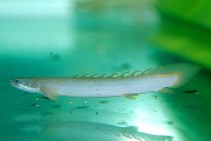 Polypterus senegalus
Foto de JJPhoto
Fotos | Imagem do Google
Foto de JJPhoto
Classificação / Nomes Nomes comuns | Sinônimos | Catalog of Fishes(Gênero, Espécies) | ITIS | CoL | WoRMS | Cloffa
> Polypteriformes (Bichirs) > Polypteridae (Bichirs)
Etymology: Polypterus: Greek, poly = a lot of + Greek, pteron = wing, fin (Ref. 45335).
More on author: Cuvier.
Etymology: Polypterus: Greek, poly = a lot of + Greek, pteron = wing, fin (Ref. 45335).
More on author: Cuvier.
Meio ambiente: milieu / Zona climática / intervalo de profundidade / faixa de distribuição Ecologia
; Água doce demersal; pH range: 6.0 - 8.0; dH range: 5 - 19; potamódromo (Ref. 51243). Tropical; 25°C - 28°C (Ref. 2060); 16°N - 2°S, 17°W - 37°E
Distribuição Territórios | Áreas da FAO | Ecossistemas | Ocorrências | Mapa de pontos | Introduções | Faunafri
Africa: subspecies Polypterus senegalus senegalus known from West Africa, in Senegal, Gambia, Niger, Volta and Chad basins (Ref. 2835, 3188, 81263), up to Nile River basin (Ref. 2835, 3188) and lakes Turkana (Ref. 3188) and Albert (Ref. 41590, 48922, 48960). Subspecies Polypterus senegalus meridionalis known from middle and upper Congo River basin (Ref. 2835, 3188, 4910, 45434).
Comprimento de primeira maturação / Tamanho / Peso / Idade
Maturidade: Lm 19.0, range 15 - 23 cm
Max length : 70.0 cm SL macho/indeterminado; (Ref. 3188); peso máx. publicado: 207.00 g (Ref. 3013)
Max length : 70.0 cm SL macho/indeterminado; (Ref. 3188); peso máx. publicado: 207.00 g (Ref. 3013)
Descrição suscinta Chaves de identificação | Morfologia | Morfometria
Espinhos dorsais (total) : 8 - 11; Espinhos anais: 14 - 17; Vértebras: 53 - 59. Diagnosis: Polypterus senegalus is characterized by jaws of equal length or an upper jaw slightly longer than lower jaw and a pectoral fin not reaching the first dorsal ray (Ref. 2756, 2835, 42908, 43035, 81263).
Body shape (shape guide): elongated; Cross section: circular.
Body shape (shape guide): elongated; Cross section: circular.
Facultative air-breathing (Ref. 126274); This species inhabits marginal swamps and freshwater lagoons (Ref. 3066) and it appears to favor sheltered inshore habitats (Ref. 3034); it inhabits the muddy regions at the sides of rivers and swampy waters, where it lies quiet or glides about with snake-like movements (Ref. 49805). During the hottest hours of the day, it comes to the surface just on the outer edge of the vegetation, and it goes back to the bottom when disturbed (Ref. 45962). It feeds on insects, crustaceans, mollusks, frogs and fishes (Ref. 4903, Ref. 28714). Polypterus senegalus senegalus is mainly insectivorous (Ref. 367). Longevity of Polypterus senegalus in captivity can be 34 years and more (Ref. 48954).
Larval fish 1.1-3.8 cm SL were found in papyrus root mat and juveniles up to 10 cm SL retaining external gills were found in fringing water hyacinth. Feeds mainly on fishes (Ref. 9695), insects, crustaceans, mollusks, frogs as well as on plant fragments and seeds.
Ciclo de vida ou comportamento de acasalamento Maturidade | Reprodução | Desova | Ovos | Fecundidade | Larvas
In Polypterus senegalus courtship starts with a series of leaps from the surface by usually only one of the pair at a time, followed by a slow descent through the water; after a while the male stays very close to the female and at times the female will remain motionless in the water and the male will come up to her from behind and nudge her with sidewise movements of his head; the enlarged and swollen anal fin of the male is folded in a cup-like fashion and is used to brush the female (Ref. 42791). No nest is constructed, but the eggs are laid a few at a time throughout the thick vegetation (Ref. 42791). The larvae, which move about with the male parent in a dense school, are provided with accessory gills and appear very salamander-like (Ref. 42791).
Referência principal
Carregar suas referências | Referências | Coordenador | Colaboradores
Gosse, J.P. and J. Daget, 2003. Polypteridae. p. 101-112. In D. Paugy, C. Lévêque and G.G Teugels (eds.) The fresh and brackish water fishes of West Africa Volume 1. Coll. faune et flore tropicales 40. Institut de recherche de développement, Paris, France, Muséum national d'histoire naturelle, Paris, France and Musée royal de l'Afrique Central, Tervuren, Belgium, 457p. (Ref. 81263)
Status na Lista Vermelha da UICN (Ref. 130435: Version 2025-2 (Global))
Segura ou pouco preocupante (LC) ; Date assessed: 07 June 2019
CITES
Not Evaluated
Ameaça para os humanos
Harmless
Uso pelos humanos
Pescarias: espécies comerciais
FAO - Publication: search | FishSource |
Mais informação
Ecologia Trófica
Itens alimentares (presas)
Composição da dieta
Consumo alimentar
Rações alimentares
Predadores
Itens alimentares (presas)
Composição da dieta
Consumo alimentar
Rações alimentares
Predadores
Dinâmica populacional
Parâmetros de crescimento
Idade máxima / tamanhos
Relação comprimento-peso.
Relação comprimento-comprimento.
Frequências de comprimento
Conversão de massa
Recrutamento
Abundância
Parâmetros de crescimento
Idade máxima / tamanhos
Relação comprimento-peso.
Relação comprimento-comprimento.
Frequências de comprimento
Conversão de massa
Recrutamento
Abundância
Ciclo de vida
Reprodução
Maturidade
Maturidade/Rel. das guelras
Fecundidade
Desova
Agregações de desova
Ovos
Desenvolvimento dos ovos
Larvas
Dinâmica larval
Reprodução
Maturidade
Maturidade/Rel. das guelras
Fecundidade
Desova
Agregações de desova
Ovos
Desenvolvimento dos ovos
Larvas
Dinâmica larval
Anatomia
Área branquial
Cérebro
Otólito
Área branquial
Cérebro
Otólito
Fisiologia
Composição corporal
Nutrientes
Consumo de oxigênio
Tipo de natação
Velocidade de natação
Pigmentos visuais
Som de peixe
Doenças e Parasitas
Toxicidade (LC50s)
Composição corporal
Nutrientes
Consumo de oxigênio
Tipo de natação
Velocidade de natação
Pigmentos visuais
Som de peixe
Doenças e Parasitas
Toxicidade (LC50s)
Relacionado a humanos
Sistemas de aquicultura
Perfis para aquacultura
Estirpes
Casos de Ciguatera
Selos, moedas, diversos.
Sistemas de aquicultura
Perfis para aquacultura
Estirpes
Casos de Ciguatera
Selos, moedas, diversos.
Ferramentas
Questionário orgânico | Livro eletrônico | Guia de campo | Chaves de identificação | Ferramenta auxiliar de frequências de comprimento | Ferramenta sobre a história de vida | Mapa de pontos |
Catch-MSY |
Relatórios especiais
Checar Manutenção em Aquário | Checar Planilhas de Fatos sobre as Espécies | Checar Planilhas de Fatos sobre Aquicultura
Baixar XML
Fontes da internet
AFORO (otoliths) | Aquatic Commons | BHL | Cloffa | Websites from users | Checar Observador de Peixes (FishWatcher) | CISTI | Catalog of Fishes: Gênero, Espécies | DiscoverLife | ECOTOX | FAO - Publication: search | Faunafri | Fishipedia | Fishtrace | GloBI | Google Books | Google Scholar | Google | IGFA World Record | OneZoom | Open Tree of Life | Otolith Atlas of Taiwan Fishes | Aquários públicos | PubMed | Reef Life Survey | Socotra Atlas | TreeBase | Árvore da vida | Wikipedia: Ir para, procura | World Records Freshwater Fishing | Zoobank | Registro zoológico
Estimativas baseadas em modelos
Índice de diversidade filogenética (Ref. 82804): PD50 = 0.5003 [Uniqueness, from 0.5 = low to 2.0 = high].
Bayesian length-weight: a=0.00447 (0.00313 - 0.00637), b=2.99 (2.89 - 3.09), in cm total length, based on LWR estimates for this species (Ref. 93245).
Nível Trófico (Ref. 69278): 3.5 ±0.2 se; based on diet studies.
Resiliência (Ref. 120179): Baixo, tempo mínimo de duplicação da população 4,5 - 14 anos (tmax=34 in Aquarium; Fec < 1,000).
Nutrientes (Ref. 124155): Calcium = 124 [54, 216] mg/100g; Iron = 1.39 [0.84, 2.25] mg/100g; Protein = 18.1 [17.1, 19.2] %; Omega3 = 0.27 [0.11, 0.64] g/100g; Selenium = 76.3 [34.4, 176.1] μg/100g; VitaminA = 18.8 [7.8, 43.0] μg/100g; Zinc = 1.38 [0.99, 1.92] mg/100g (wet weight);