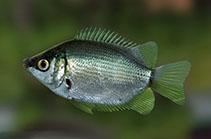
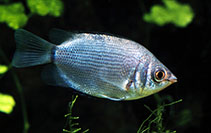
Helostoma temminckii, Kissing gourami : fisheries, aquaculture, gamefish, aquarium

Helostoma temminckii Cuvier, 1829

Kissing gourami
muatnaik fotos/gambar dan video
Gambar | imej Google

klasifikasi / Nama Nama-nama umum | Sinonim (persamaan) | Catalog of Fishes(Marga, Jenis) | ITIS | CoL | WoRMS | Cloffa

> Anabantiformes (Gouramies, snakeheads) > Helostomatidae (Kissing gouramies)
Etymology: Helostoma: Greek, helo = nail + Greek, stoma = mouth (Helos has the "e" long) (Ref. 45335).
Eponymy: Coenraad Jacob Temminck (1778–1858) was a Dutch zoologist, illustrator and collector. [...] (Ref. 128868), visit book page.
More on author: Cuvier.

Lingkungan: lingkungan / zona iklim / kisaran kedalaman / jangkauan distribusi Ekologi

; air tawar bentopelagis; pH range: 6.0 - 8.0; dH range: 5 - 19; potamodromous (Ref. 126106); kisaran kedalaman 2 - ? m. Tropical; 22°C - 28°C (Ref. 1672); 16°N - 6°S

Penyebaran Wilayah | Daerah-daerah FAO | Ekosistem | Kemunculan | peta titik | Introduksi | Faunafri

Asia: Thailand to Indonesia.

Ukuran / Berat / umur

Kematangan: Lm ?  range ? - ? cm
Max length : 30.0 cm TL jantan/; (Ref. 7050)

Biologi     Daftar kata (contoh epibenthic)

Adults occur in lakes and rivers (Ref. 56749). An air-breathing species (Ref. 118402). They prefer slow-moving water with thick vegetation. They feed on a variety of plants and animals, including green algae and zooplankton (Ref. 6459) as well as aquatic insects near the water surface (Ref. 12693). Utilized fresh for steaming, pan-frying, broiling and baking (Ref. 9987); also processed as dried or salted fish; ripe ovaries are collected and separately eaten (Ref. 56749). Large quantities of small fish are exported for aquarium use in Japan, Europe, North America, Australia and other parts of the world (Ref. 9987). Very popular with aquarists due to its habit of sucking its lips and kissing other fishes, plants and other objects (Ref. 4833). Aquarium keeping: not recommended for home aquariums; minimum aquarium size 150 cm (Ref. 51539).

Siklus hidup dan perilaku kawin Kematangan | Reproduksi, perkembang biakan | Pemijahan | telur-telur | Fekunditas | Larva

Spawning usually occurs under floating vegetation. Eggs hatch in a day and fry become free-swimming 2 days after.

rujukan utama Unggah referensi Anda | Acuan | Koordinator | mitra

Kottelat, M., 2013. The fishes of the inland waters of Southeast Asia: a catalogue and core bibliography of the fishes known to occur in freshwaters, mangroves and estuaries. The Raffles Bulletin of Zoology 2013 (Suppl. 27):1-663. (Ref. 94476)

Status IUCN Red List (Ref. 130435: Version 2025-2 (Global))

  kurang bimbang (LC) ; Date assessed: 19 September 2019

CITES

Not Evaluated

CMS (Ref. 116361)

Not Evaluated

ancaman kepada manusia

  Harmless


penggunaan manusia

Perikanan: bernilai komersial tinggi; Budidaya air: komersial; Ikan buruan: ya; Akuarium: Bernilai komersial tinggi
FAO - Sistem akuakultur: produksi; Perikanan: pendaratan, profail spesis; Publication: search | FishSource |

informasi lanjut

Ekologi trofik
Item makanan (mangsa)
Komposisi makanan
Konsumsi makanan
Ransum makanan
Pemangsa
Ekologi
Ekologi
Dinamika populasi
Parameter pertumbuhan
Maks. usia / ukuran
Panjang-berat rel.
Panjang-panjang rel.
ukuran frekuensi
Konversi massa
pemulihan
Kelimpahan
Siklus hidup
Reproduksi, perkembang biakan
Kematangan
Kedewasaan / insang rel.
Fekunditas
Pemijahan
Agregasi pemijahan
telur-telur
pekembangan telor
Larva
Dinamika larva
Anatomi
Area insang
Otak
Otolith
Fisiologi
Komposisi tubuh
Nutrisi
Konsumsi oksigen
Jenis renang
Kecepatan berenang
Pigmen visual
Suara ikan
Penyakit & Parasit
Toksisitas (LC50)
Genetika
genom
Genetika
Heterozigositas
Diturunkan
Keanekaragaman Genetik
Yang berhubungan dengan manusia
Sistem akuakultur
profil budidaya air
Strain
Kasus Ciguatera
Perangko, koin, dll.
Penjangkauan
mitra
Acuan
Acuan

Alat, peralatan

laporan khas

muat turun XML

Sumber internet

AFORO (otoliths) | Alien/Invasive Species database | Aquatic Commons | BHL | Cloffa | Websites from users | semak peneliti ikan | CISTI | Catalog of Fishes: Marga, Jenis | DiscoverLife | ECOTOX | FAO - Sistem akuakultur: produksi; Perikanan: pendaratan, profail spesis; Publication: search | Faunafri | Fishipedia | Fishtrace | GloBI | Google Books | Google Scholar | Google | IGFA World Record | OneZoom | Open Tree of Life | Otolith Atlas of Taiwan Fishes | Akuarium publik | PubMed | Reef Life Survey | Socotra Atlas | TreeBase | Tree of Life | Wikipedia: pergi, Cari | World Records Freshwater Fishing | Catatan Zoologi

Estimasi berdasarkan model

Indeks keanekaragaman filogenetik (Acuan 82804):  PD50 = 1.5000   [Uniqueness, from 0.5 = low to 2.0 = high].
Bayesian length-weight: a=0.01995 (0.00906 - 0.04395), b=3.01 (2.83 - 3.19), in cm total length, based on all LWR estimates for this body shape (Ref. 93245).
Tingkat Trofik (Acuan 69278):  2.8   ±0.33 se; based on food items.
Generation time: 1.3 ( na - na) years. Estimated as median ln(3)/K based on 1 growth studies.
Daya lenting (Acuan 120179):  Tinggi, Waktu penggandaan populasi minimum kurang dari 15 bulan (K=0.8; assuming tm<=1; Fec=40,000).
Kerentanan Penangkapan Ikan (Ref. 59153):  Low vulnerability (19 of 100). 🛈
kategori harga (Ref. 80766):   Unknown.
Nutrisi (Ref. 124155):  Calcium = 74.3 [26.2, 531.9] mg/100g; Iron = 1.17 [0.54, 2.41] mg/100g; Protein = 18.7 [16.0, 20.7] %; Omega3 = 0.357 [0.135, 0.972] g/100g; Selenium = 104 [36, 237] μg/100g; VitaminA = 32.3 [7.7, 145.1] μg/100g; Zinc = 1.84 [0.94, 3.65] mg/100g (wet weight); based on nutrient studies.