This website uses cookies to enhance your browsing experience and ensure the functionality of our site. For more detailed information about the types of cookies we use and how we protect your privacy, please visit our Privacy Information page.
×
Cookie Settings
This website uses different types of cookies to enhance your experience. Please select your preferences below:
> Eupercaria/misc (Various families in series Eupercaria) > Labridae (Wrasses) > Scarinae
Etymology: Scarus:Greek, skaros = a fish described by anciente writers as a parrot fish; 1601 (Ref. 45335). More on author: Valenciennes.
Umwelt: Milieu / Klimazone / Tiefenbereich / Verbreitungsgebiet Ökologie
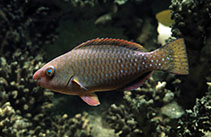
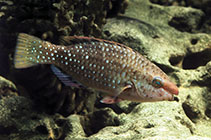
Indo-West Pacific: Maldives to New Ireland in Papua New Guinea, including Cocos-Keeling Islands, north to Ryukyu Islands and south to the Philippines, including Palau. This species is the terminal male of Scarus singaporensis. Possibly replaced by Scarus falcipinnis in the western Indian Ocean (Ref. 2689).
Größe / Gewicht / Alter
Geschlechtsreife: Lm? range ? - ? cm Max length : 70.0 cm TL Männchen/unbestimmt; (Ref. 9710)
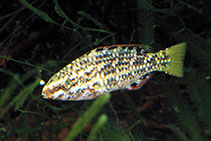
Rückenflossenstacheln (insgesamt) : 9; Rückenflossenweichstrahlen (insgesamt) : 10; Afterflossenstacheln: 3; Afterflossenweichstrahlen: 9. Scales large. Median predorsal scales 6; 3 scale rows on cheek, with 1-3 scales in ventral row. Caudal fins emarginate in initial phase to deeply concave in large terminal phase. Lips nearly covering dental plates; terminal males with 0-2 canines posteriorly on side of upper plate, none on lower. The initial phase closely resembles that of S. altipinnis (Ref. 1602). The terminal phase has the distinctive brilliant green throat and lacks the filamentous middle dorsal spine (Ref. 1602). Body shape (shape guide): elongated; Cross section: compressed.
Found in seaward slopes and reef flats (Ref. 90102). Usually associated with outer reefs but will enter shallow water in protected areas. Often in large schools (Ref. 9710). Grazes on benthic algae (Ref. 3488). Also caught with nets and other types of artisanal gear (Ref. 2689). Minimum depth of 1 m reported from Ref. 30874.
Randall, J.E. and J.H. Choat, 1980. Two new parrotfishes of the genus Scarus from the Central and South Pacific, with further examples of sexual dichromatism. Zool. J. Linn. Soc. 70:383-419. (Ref. 2689)
IUCN Rote Liste Status (Ref. 130435: Version 2025-2 (Global))
Bevorzugte Temperatur (Ref. 123201): 26.1 - 29.3, mean 28.7 °C (based on 2454 cells).
Phylogenetischer Diversitätsindex (Ref. 82804): PD50 = 0.5000 [Uniqueness, from 0.5 = low to 2.0 = high].
Bayesian length-weight: a=0.01122 (0.00482 - 0.02609), b=3.06 (2.88 - 3.24), in cm total length, based on LWR estimates for this Genus-body shape (Ref. 93245).
Trophische Ebene (Ref. 69278): 2.0 ±0.0 se; based on diet studies.
Widerstandsfähigkeit (Ref. 120179): niedrig, Verdopplung der Population dauert 4,5 - 14 Jahre. (Preliminary K or Fecundity.).
Anfälligkeit der Fischerei (Ref. 59153): Moderate to high vulnerability (48 of 100). 🛈