



Labeobarbus aeneus (Burchell, 1822)
Smallmouth yellowfish
Hochladen Photos und videos
Bilder | Google Bild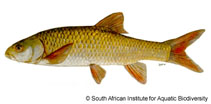 Labeobarbus aeneus
Photo von South African Institute for Aquatic Biodiversity
Bilder | Google Bild
Photo von South African Institute for Aquatic Biodiversity
Klassifizierung / Names Namen | Synonyme | Catalog of Fishes(Gattung, Arten) | ITIS | CoL | WoRMS | Cloffa
Umwelt: Milieu / Klimazone / Tiefenbereich / Verbreitungsgebiet Ökologie
; süßwasser benthopelagisch; potamodrom (Ref. 51243). Subtropical; 24°S - 33°S
Verbreitung Territorien | FAO Gebiete | Ökosysteme | Vorkommen | Punkt Karte | Einführungen | Faunafri
Africa: originally endemic to the Orange-Vaal River system, South Africa. Has been introduced into the Gouritz River, South Cape and the Olifants River, Limpopo River system where it is now established.
Größe / Gewicht / Alter
Geschlechtsreife: Lm ? range ? - ? cm
Max length : 50.0 cm FL Männchen/unbestimmt; (Ref. 7248); max. veröff. Gewicht: 7.8 kg (Ref. 7248); max. veröff. Alter: 12 Jahre (Ref. 6465)
Max length : 50.0 cm FL Männchen/unbestimmt; (Ref. 7248); max. veröff. Gewicht: 7.8 kg (Ref. 7248); max. veröff. Alter: 12 Jahre (Ref. 6465)
Kurzbeschreibung Bestimmungsschlüssel | Morphologie | Morphometrie
Rückenflossenstacheln (insgesamt) : 4; Rückenflossenweichstrahlen (insgesamt) : 7 - 9; Afterflossenstacheln: 3; Afterflossenweichstrahlen: 5.
Body shape (shape guide): fusiform / normal.
Body shape (shape guide): fusiform / normal.
Occurs in impoundments and rivers. Prefers clear-flowing waters over sandy or rocky substrates. An omnivorous bottom feeder. Diet includes water fleas, snails, plankton, small mussels, insects, small fish, algae and detritus. Breeds in spring through to midsummer after the first substantial rains of the season. Migrates upstream to spawn over suitable gravel beds (Ref. 7248).
Lebenszyklus und Paarungsverhalten Geschlechtsreife | Fortpflanzung | Ablaichen | Eier | Fruchtbarkeit | Larven
Breeds in flowing water therefore must ascend the rivers to spawn in gravel beds. Eggs are laid in a shallow saucer-like nest which is constructed in the gravel by a female (or perhaps male) using the snout and caudal fin. Eggs are covered with gravel after fertilization. A 45 cm female carries 30, 000 eggs.
Hauptreferenz
Laden Sie Ihre Referenzen hoch | Referenzen | Koordinator | Partner
Lévêque, C. and J. Daget, 1984. Cyprinidae. p. 217-342. In J. Daget, J.-P. Gosse and D.F.E. Thys van den Audenaerde (eds.) Check-list of the freshwater fishes of Africa (CLOFFA). ORSTOM, Paris and MRAC, Tervuren. Vol. 1. (Ref. 2801)
IUCN Rote Liste Status (Ref. 130435: Version 2025-2 (Global))
nicht bedroht (LC) ; Date assessed: 01 September 2017
CITES
Not Evaluated
Bedrohung für Menschen
Harmless
Nutzung durch Menschen
Fischereien: kommerziell; Sportfisch: ja
FAO - Publication: search | FishSource |
Mehr Information
Trophische Ökologie
Lebensmittel (Beutetiere)
Nahrungszusammensetzung
Nahrungsaufnahme
Lebensmittelrationen
Räuber
Lebensmittel (Beutetiere)
Nahrungszusammensetzung
Nahrungsaufnahme
Lebensmittelrationen
Räuber
Populationsdynamik
Wachstumsparameter
Max. Alter/Größen
Länge-Gewicht-Rel.
Länge-Länge-Verhältnis.
Längenhäufigkeiten
Massenkonvertierung
Rekrutierung
Dichte
Wachstumsparameter
Max. Alter/Größen
Länge-Gewicht-Rel.
Länge-Länge-Verhältnis.
Längenhäufigkeiten
Massenkonvertierung
Rekrutierung
Dichte
Lebenszyklus
Fortpflanzung
Geschlechtsreife
Reifung/Kiemen rel.
Fruchtbarkeit
Ablaichen
Laichaggregationen
Eier
Eientwicklung
Larven
Larven Pop.Dyn.
Fortpflanzung
Geschlechtsreife
Reifung/Kiemen rel.
Fruchtbarkeit
Ablaichen
Laichaggregationen
Eier
Eientwicklung
Larven
Larven Pop.Dyn.
Anatomie
Kiemenoberfläche
Gehirn
Otolith
Kiemenoberfläche
Gehirn
Otolith
Physiologie
Körperliche Zusammensetzung
Nährstoffe
Sauerstoffverbrauch
Schwimmart
Schwimmgeschwindigkeit
Visuelle Pigmente
Fischgeräusche
Krankheiten und Parasiten
Toxizität (LC50s)
Körperliche Zusammensetzung
Nährstoffe
Sauerstoffverbrauch
Schwimmart
Schwimmgeschwindigkeit
Visuelle Pigmente
Fischgeräusche
Krankheiten und Parasiten
Toxizität (LC50s)
Menschenbezogen
Aquakultur-Systeme
Aquakultur Profile
Zuchtlinien
Ciguatera-Fälle
Briefmarken, Münzen, Verschiedenes.
Aquakultur-Systeme
Aquakultur Profile
Zuchtlinien
Ciguatera-Fälle
Briefmarken, Münzen, Verschiedenes.
Tools
E-Book | Feldführer | Bestimmungsschlüssel | Längenhäufigkeits Tool | Lebensdaten Tool | Punkt Karte |
Catch-MSY |
Zusatzinformationen
Download XML
Zusammenfassung | Punktdaten | Namen | Photos
Internet Quellen
AFORO (otoliths) | Alien/Invasive Species database | Aquatic Commons | BHL | Cloffa | Websites from users | FishWatcher Einträge suchen | CISTI | Catalog of Fishes: Gattung, Arten | DiscoverLife | ECOTOX | FAO - Publication: search | Faunafri | Fishipedia | Fishtrace | GloBI | Google Books | Google Scholar | Google | IGFA World Record | OneZoom | Open Tree of Life | Otolith Atlas of Taiwan Fishes | PubMed | Reef Life Survey | Socotra Atlas | TreeBase | Tree of Life | Wikipedia: Gehe zu, Suchen | | Zoologischer Rekord
Schätzungen auf der Grundlage von Modellen
|
Phylogenetischer Diversitätsindex (Ref. 82804) |
PD50 = 0.5000 [Uniqueness, from 0.5 = low to 2.0 = high]. |
| Bayesian length-weight | a=0.00955 (0.00430 - 0.02123), b=3.02 (2.84 - 3.20), in cm total length, based on LWR estimates for this (Sub)family-body shape (Ref. 93245). |
|
Trophische Ebene (Ref. 69278) |
3.1 ±0.42 se; based on food items. |
| Generation time | 8.2 ( na - na) years. Estimated as median ln(3)/K based on 2 growth studies. |
|
Widerstandsfähigkeit (Ref. 120179) |
niedrig, Verdopplung der Population dauert 4,5 - 14 Jahre. (K=0.13-0.27; tmax=12). |
|
Anfälligkeit der Fischerei (Ref. 59153) |
Moderate vulnerability (39 of 100). 🛈 |
|
Preiskategorie (Ref. 80766) |
Unknown. |
|
Nährstoffe (Ref. 124155) |
Calcium = 95.8 [63.6, 169.1] mg/100g; Iron = 1.51 [1.02, 2.14] mg/100g; Protein = 18.4 [17.6, 19.1] %; Omega3 = 0.694 [0.335, 1.511] g/100g; Selenium = 29.9 [13.5, 63.4] μg/100g; VitaminA = 36 [16, 88] μg/100g; Zinc = 1.17 [0.87, 1.58] mg/100g (wet weight); |