Clarias macrocephalus, Bighead catfish : fisheries, aquaculture

Clarias macrocephalus Günther, 1864

Bighead catfish
Hochladen Photos und videos
Bilder | Google Bild

Klassifizierung / Names Namen | Synonyme | Catalog of Fishes(Gattung, Arten) | ITIS | CoL | WoRMS | Cloffa

> Siluriformes (Catfishes) > Clariidae (Airbreathing catfishes)
Etymology: Clarias: Greek, chlaros = lively, in reference to the ability of the fish to live for a long time out of water.
More on author: Günther.

Umwelt: Milieu / Klimazone / Tiefenbereich / Verbreitungsgebiet Ökologie

; süßwasser; brackwasser benthopelagisch; potamodrom (Ref. 51243); tiefenbereich 1 - ? m (Ref. 9987). Tropical; 34°N - 4°N

Verbreitung Territorien | FAO Gebiete | Ökosysteme | Vorkommen | Punkt Karte | Einführungen | Faunafri

Asia: Thailand to Viet Nam. Introduced to China, Malaysia, Guam and the Philippines.

Länge bei der ersten Reifung / Größe / Gewicht / Alter

Geschlechtsreife: Lm ?, range 19 - ? cm
Max length : 120 cm TL Männchen/unbestimmt; (Ref. 9987); max. veröff. Gewicht: 45.0 kg (Ref. 9987)

Kurzbeschreibung Bestimmungsschlüssel | Morphologie | Morphometrie

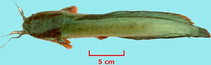
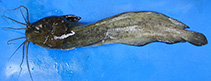
Rückenflossenstacheln (insgesamt) : 0. Distinguished from Southeast Asian congeners by an extremely short and rounded occipital process and by a very high dorsal fin. The combination of these characters are diagnostic for the species (Ref. 33566). Occipital process wide, broadly curved, with length 3-5 times in its width; distance between dorsal and occipital process 5-7 times in distance from tip of snout to end of occipital process (Ref. 43281).
Body shape (shape guide): elongated.

Biologie     Fachlexikon (Englisch) (z.B. epibenthic)

Facultative air-breathing (Ref. 126274); Lives in lowland wetlands and rivers (Ref. 57235). Recorded as having been or being farmed in rice fields (Ref. 119549). Occurs in shallow, open water and is capable of lying buried in mud for lengthy period if ponds and lakes evaporate during dry seasons (Ref. 9987). Can move out of the water using its extended fins (Ref. 9987). Found in medium to large-sized rivers, stagnant water bodies including sluggish flowing canals and flooded fields of the Mekong (Ref. 12975). Spawns in small streams (Ref. 9987). Feeds on aquatic insects, young shrimps and small fishes (Ref. 6459). In Thailand, it was thought wrongly as female of Clarias batrachus (Ref 2686). Important foodfish and in pond cultures (Ref. 57235). Marketed live, fresh and frozen; consumed fried, broiled and baked (Ref. 9987). Cultivated on a small scale but attempts to farm it are increasing (Ref. 9987).

Lebenszyklus und Paarungsverhalten Geschlechtsreife | Fortpflanzung | Ablaichen | Eier | Fruchtbarkeit | Larven

Eggs are attached to the roots of plants. Male takes charge of these eggs until they are hatched out.

Hauptreferenz Laden Sie Ihre Referenzen hoch | Referenzen | Koordinator | Partner

Teugels, G.G., R.C. Diego, L. Pouyaud and M. Legendre, 1999. Redescription of Clarias macrocephalus (Siluriformes: Clariidae) from South-East Asia. Cybium 23(3):285-295. (Ref. 33566)

IUCN Rote Liste Status (Ref. 130435: Version 2025-2 (Global))

  Daten mangelhaft (DD) ; Date assessed: 17 January 2019

CITES

Not Evaluated

CMS (Ref. 116361)

Not Evaluated

Bedrohung für Menschen

  Harmless


Nutzung durch Menschen

Fischereien: kommerziell; Aquakultur: kommerziell
FAO - Publication: search | FishSource |

Mehr Information

Trophische Ökologie
Lebensmittel (Beutetiere)
Nahrungszusammensetzung
Nahrungsaufnahme
Lebensmittelrationen
Räuber
Ökologie
Ökologie
Populationsdynamik
Wachstumsparameter
Max. Alter/Größen
Länge-Gewicht-Rel.
Länge-Länge-Verhältnis.
Längenhäufigkeiten
Massenkonvertierung
Rekrutierung
Dichte
Lebenszyklus
Fortpflanzung
Geschlechtsreife
Reifung/Kiemen rel.
Fruchtbarkeit
Ablaichen
Laichaggregationen
Eier
Eientwicklung
Larven
Larven Pop.Dyn.
Anatomie
Kiemenoberfläche
Gehirn
Otolith
Physiologie
Körperliche Zusammensetzung
Nährstoffe
Sauerstoffverbrauch
Schwimmart
Schwimmgeschwindigkeit
Visuelle Pigmente
Fischgeräusche
Krankheiten und Parasiten
Toxizität (LC50s)
Genetik
Genom
Genetik
Heterozygotie
Vererbbarkeit
Genetische Vielfalt
Menschenbezogen
Aquakultur-Systeme
Aquakultur Profile
Zuchtlinien
Ciguatera-Fälle
Briefmarken, Münzen, Verschiedenes.
Aufsuchen
Partner
Referenzen
Referenzen

Tools

Zusatzinformationen

Download XML

Internet Quellen

AFORO (otoliths) | Alien/Invasive Species database | Aquatic Commons | BHL | Cloffa | Websites from users | FishWatcher Einträge suchen | CISTI | Catalog of Fishes: Gattung, Arten | DiscoverLife | ECOTOX | FAO - Publication: search | Faunafri | Fishipedia | Fishtrace | GloBI | Google Books | Google Scholar | Google | IGFA World Record | OneZoom | Open Tree of Life | Otolith Atlas of Taiwan Fishes | PubMed | Reef Life Survey | Socotra Atlas | TreeBase | Tree of Life | Wikipedia: Gehe zu, Suchen | World Records Freshwater Fishing | Zoobank | Zoologischer Rekord

Schätzungen auf der Grundlage von Modellen

Phylogenetischer Diversitätsindex (Ref. 82804):  PD50 = 0.5000   [Uniqueness, from 0.5 = low to 2.0 = high].
Bayesian length-weight: a=0.00851 (0.00486 - 0.01489), b=2.98 (2.83 - 3.13), in cm total length, based on LWR estimates for this species & Genus-body shape (Ref. 93245).
Trophische Ebene (Ref. 69278):  3.7   ±0.58 se; based on food items.
Widerstandsfähigkeit (Ref. 120179):  hoch, Verdopplung der Population dauert weniger als 15 Monate. (Assuming tm=1; Fec=800-14,000).
Anfälligkeit der Fischerei (Ref. 59153):  High to very high vulnerability (72 of 100). 🛈
Preiskategorie (Ref. 80766):   Unknown.
Nährstoffe (Ref. 124155):  Calcium = 16.9 [7.6, 71.2] mg/100g; Iron = 0.76 [0.42, 1.38] mg/100g; Protein = 16.4 [15.4, 17.5] %; Omega3 = 0.114 [0.052, 0.270] g/100g; Selenium = 111 [45, 288] μg/100g; VitaminA = 16.1 [5.4, 48.7] μg/100g; Zinc = 0.565 [0.400, 0.811] mg/100g (wet weight); based on nutrient studies.