



Envoyez vos Photos et vidéos
Images | Timbres, pièces de monnaie, divers | Images Google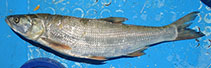 Leuciscus aspius
Photo de Kaya, C.
Images | Timbres, pièces de monnaie, divers | Images Google
Photo de Kaya, C.
Classification / Noms Noms communs | Synonymes | Catalog of Fishes(Genre, Espèce) | ITIS | CoL | WoRMS | Cloffa
> Cypriniformes (Carps) > Leuciscidae (Minnows) > Leuciscinae
Etymology: Leuciscus: Greek, leykiskos = white mullet (Ref. 45335).
More on author: Linnaeus.
Etymology: Leuciscus: Greek, leykiskos = white mullet (Ref. 45335).
More on author: Linnaeus.
Environnement : milieu / zone climatique / profondeur / gamme de distribution Écologie
; eau douce; saumâtre benthopélagique; potamodrome (Ref. 51243); profondeur 10 - ? m (Ref. 30578). Temperate; 4°C - 20°C (Ref. 2059); 66°N - 35°N, 3°E - 72°E
Distribution Territoires | Zones FAO | Écosystèmes | Occurrences | Carte par point | Introductions | Faunafri
Europe and Asia: large rivers draining to North Sea (Weser, Elbe), Baltic Sea (southern tributaries, Norway east of Oslo, southern Sweden, Kokemären drainage in southern Finland), Black Sea, Sea of Azov and Caspian Sea; Aegean Sea basin, from Maritza to Lake Volvi drainages. Absent in Black Sea basin south of Danube and Rioni (Georgia) drainages, but present in Turkey west of Ankara. Introduced in Rhine, Northern Dvina and Lake Balkhash (Asia) (Ref. 59043). The subspecies Aspius aspius iblioides was previously recognized by authors for the Aral Sea (Ref. 13403).
Longueur à la première maturité / Taille / Poids / Âge
Maturité: Lm ? range ? - ? cm
Max length : 120 cm TL mâle / non sexé; (Ref. 35387); common length : 55.0 cm TL mâle / non sexé; (Ref. 30578); poids max. publié: 9.0 kg (Ref. 556); âge max. reporté: 11 années (Ref. 40480)
Max length : 120 cm TL mâle / non sexé; (Ref. 35387); common length : 55.0 cm TL mâle / non sexé; (Ref. 30578); poids max. publié: 9.0 kg (Ref. 556); âge max. reporté: 11 années (Ref. 40480)
Description synthétique Clés d'identification | Morphologie | Morphométrie
Épines dorsales (Total) : 3; Rayons mous dorsaux (Total) : 7 - 9; Épines anales: 3; Rayons mous anaux: 12 - 15. The only species of Aspius in Europe which can be diagnosed from other species of Cyprinidae in Europe by the following characters: anal fin with 12-14½ branched rays; scales on lateral line 64-76; maxilla extending beyond front margin of eye; and sharp keel between pelvic-fin and anal-fin origins covered by scales (Ref. 59043). Long shape body, laterally compressed with a long sharp head. Green back with silver to blue tints. Lighter flanks. Silver white belly. Pectoral, pelvic and anal fins grey to brown. Scale formula: 11-14/64-76/5-6 (Ref. 40476).
Body shape (shape guide): fusiform / normal.
Body shape (shape guide): fusiform / normal.
Occur in open water of large and medium-sized lowland rivers and large lakes (Ref. 59043). Adults inhabit lower reaches of rivers and estuaries (Ref. 30578). Prefer to stay near bridge pillars, near tributaries, under weirs, in deep currents and overgrown parts of river and in quiet bays of river bends (Ref. 9696). One of the rare cyprinids which is piscivore; also prey on small aquatic birds. Juveniles are gregarious predators while adults hunt in small groups or are solitary. Juveniles and adults feed mainly on fish, especially on Alburnus alburnus or Osmerus eperlanus (Ref. 59043). Migrate upstream in tributaries for spawning in April-June (Ref. 556, 30578). Spawn in fast-flowing water on gravel or submerged vegetation. Lake populations migrate to tributaries; semi-anadromous populations or individuals (Terek) forage mainly in estuaries and freshened parts of the sea, migrating to rivers only for spawning. Begins spawning migration in second half of October (Terek) and overwinters in the lower reaches of river. Hybridizes with Leuciscus idus. Threatened due to alteration of river morphology (Ref. 59043).
Cycle de vie et comportement reproducteur Maturité | Reproduction | Frai | Œufs | Fécondité | Larves
Sexual maturity is reached after 4-5 years (Ref. 2059). Reproductive success seems to be associated with low water level and high spring temperatures. Spawning occurs more than one season and lasts about 2 weeks. Deposits eggs which adhere to gravel or submerged plants (Ref. 59034).
Référence principale
Téléchargez vos références | Références | Coordinateur | Collaborateurs
Vostradovsky, J., 1973. Freshwater fishes. The Hamlyn Publishing Group Limited, London. 252 p. (Ref. 9696)
Statut dans la liste rouge de l'IUCN (Ref. 130435: Version 2025-2 (Global))
Préoccupation mineure (LC) ; Date assessed: 28 May 2022
CITES
Not Evaluated
Menace pour l'homme
Harmless
Utilisations par l'homme
Pêcheries: commercial; Aquaculture: commercial; pêche sportive: oui
FAO - Systèmes d'aquaculture: production; pêcheries: débarquements; Publication: search | FishSource | Sea Around Us
Plus d'informations
Écologie trophique
Aliments (proies)
Composition du régime alimentaire
Consommation alimentaire
Rations alimentaires
Prédateurs
Aliments (proies)
Composition du régime alimentaire
Consommation alimentaire
Rations alimentaires
Prédateurs
Dynamique des populations
Paramètres de croissance
Âges / tailles maximales
Longueur-poids rel.
Rel. longueur-longueur.
Fréquences de longueurs
Conversion de masse
Recrutement
Abondance
Paramètres de croissance
Âges / tailles maximales
Longueur-poids rel.
Rel. longueur-longueur.
Fréquences de longueurs
Conversion de masse
Recrutement
Abondance
Cycle de vie
Reproduction
Maturité
Maturité/épines rel.
Fécondité
Frai
Agrégats de frai
Œufs
Développement de l'œuf
Larves
Dynamique des populations larvaires
Reproduction
Maturité
Maturité/épines rel.
Fécondité
Frai
Agrégats de frai
Œufs
Développement de l'œuf
Larves
Dynamique des populations larvaires
Anatomie
Surface branchiale
Cerveau
Otolithe
Surface branchiale
Cerveau
Otolithe
Physiologie
Composition corporelle
Nutriments
Consommation d'oxygène
Type de natation
Vitesse de nage
Pigments visuels
Son de poisson
Maladies et parasites
Toxicité (CL50)
Composition corporelle
Nutriments
Consommation d'oxygène
Type de natation
Vitesse de nage
Pigments visuels
Son de poisson
Maladies et parasites
Toxicité (CL50)
Liées à l'homme
Systèmes d'aquaculture
Profils d'aquaculture
Souches
Cas de ciguatera
Timbres, pièces de monnaie, divers
Systèmes d'aquaculture
Profils d'aquaculture
Souches
Cas de ciguatera
Timbres, pièces de monnaie, divers
Outils
E-book | Guide de terrain | Générateur de fréquences de longueur | Outil de dynamique de population | Carte par point |
Capture-MSY |
Articles particuliers
Télécharger en XML
Sources Internet
AFORO (otoliths) | Alien/Invasive Species database | Aquatic Commons | BHL | Cloffa | Websites from users | FishWatcher | CISTI | Catalog of Fishes: Genre, Espèce | DiscoverLife | DORIS | ECOTOX | FAO - Systèmes d'aquaculture: production; pêcheries: débarquements; Publication: search | Faunafri | Fishipedia | Fishtrace | GloBI | Google Books | Google Scholar | Google | IGFA World Record | Bases de données nationales | OneZoom | Open Tree of Life | Otolith Atlas of Taiwan Fishes | Aquariums publics | PubMed | Reef Life Survey | Socotra Atlas | TreeBase | Arbre de Vie | Wikipedia: aller à, chercher | World Records Freshwater Fishing | Zoological Record
Estimations basées sur des modèles
Indice de diversité phylogénétique (Réf. 82804): PD50 = 0.5000 [Uniqueness, from 0.5 = low to 2.0 = high].
Bayesian length-weight: a=0.00468 (0.00404 - 0.00542), b=3.14 (3.11 - 3.17), in cm total length, based on LWR estimates for this species (Ref. 93245).
Niveau trophique (Réf. 69278): 4.5 ±0.80 se; based on food items.
Generation time: 11.0 ( na - na) years. Estimated as median ln(3)/K based on 2 growth studies.
Résilience (Réf. 120179): Milieu, temps minimum de doublement de population : 1,4 à 4,4 années (tm=3-4; tmax=11; K=0.10-0.33; Fec = 50,000-1 million).
Nutriments (Ref. 124155): Calcium = 51.1 [23.5, 97.4] mg/100g; Iron = 0.656 [0.380, 1.081] mg/100g; Protein = 19.8 [18.0, 21.4] %; Omega3 = 0.669 [0.325, 1.414] g/100g; Selenium = 11.9 [6.0, 24.2] μg/100g; VitaminA = 32 [9, 111] μg/100g; Zinc = 0.504 [0.345, 0.701] mg/100g (wet weight); based on nutrient studies.