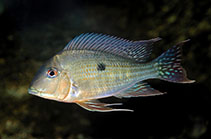
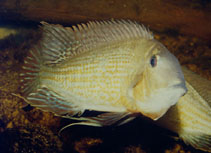
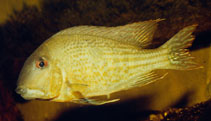
Geophagus surinamensis, Redstriped eartheater : fisheries, aquarium

Geophagus surinamensis (Bloch, 1791)

Redstriped eartheater
Envoyez vos Photos et vidéos
Images | Images Google

Classification / Noms Noms communs | Synonymes | Catalog of Fishes(Genre, Espèce) | ITIS | CoL | WoRMS | Cloffa

> Cichliformes (Cichlids, convict blennies) > Cichlidae (Cichlids) > Geophaginae
Etymology: Geophagus: Greek, gea = the earth + Greek, phagein = to eat (Ref. 45335).
More on author: Bloch.

Taxonomic Remarks
Redescription in Kullander & Nijssen (1986: 31), with bibliography, diagnosis, description, distribution, and illustrations.

Environnement : milieu / zone climatique / profondeur / gamme de distribution Écologie

; eau douce benthopélagique; pH range: 6.0 - 8.0; dH range: 5 - 19; non migrateur (Ref. 126106). Tropical; 22°C - 25°C (Ref. 1672)

Distribution Territoires | Zones FAO | Écosystèmes | Occurrences | Carte par point | Introductions | Faunafri

South America: Saramacca and Suriname Rivers in Suriname; Marowijne River in Suriname and French Guiana.

Taille / Poids / Âge

Maturité: Lm ?  range ? - ? cm
Max length : 17.2 cm SL mâle / non sexé; (Ref. 137577)

Biologie     Glossaire (ex. epibenthic)

Though not so abundant, often caught in the quiet zones of cascades with G. harreri (Ref. 35237). Adults live in mud and sand-bottomed canals. Maximum length 30 cm TL (Ref. 5723). Omnivorous, with a tendency towards herbivory, searches for food by digging into the substrate with its protractile mouth. Can emit sounds through its pharyngeal teeth though it is not known whether it is a form of communication or not. Spawning takes place on a flat stone or in a hole dug in the sand. Parents generally take the eggs into their mouths until hatching occurs three days later. At night or when faced with danger, the alevins seeks shelter in the mother's mouth. Parents take care of their siblings for several weeks (Ref. 35237).

Cycle de vie et comportement reproducteur Maturité | Reproduction | Frai | Œufs | Fécondité | Larves

Parents form pairs. Larvophile mouthbrooder.

Référence principale Téléchargez vos références | Références | Coordinateur : Kullander, Sven O. | Collaborateurs

Kullander, S.O. and H. Nijssen, 1989. The cichlids of Surinam: Teleostei, Labroidei. E.J. Brill, Leiden, The Netherlands. 256 p. (Ref. 26372)

Statut dans la liste rouge de l'IUCN (Ref. 130435: Version 2025-2 (Global))

  Préoccupation mineure (LC) ; Date assessed: 12 March 2023

CITES

Not Evaluated

CMS (Ref. 116361)

Not Evaluated

Menace pour l'homme

  Harmless


Utilisations par l'homme

Pêcheries: commercial; Aquarium: Commercial
FAO - Publication: search | FishSource |

Plus d'informations

Écologie trophique
Aliments (proies)
Composition du régime alimentaire
Consommation alimentaire
Rations alimentaires
Prédateurs
Écologie
Écologie
Dynamique des populations
Paramètres de croissance
Âges / tailles maximales
Longueur-poids rel.
Rel. longueur-longueur.
Fréquences de longueurs
Conversion de masse
Recrutement
Abondance
Cycle de vie
Reproduction
Maturité
Maturité/épines rel.
Fécondité
Frai
Agrégats de frai
Œufs
Développement de l'œuf
Larves
Dynamique des populations larvaires
Anatomie
Surface branchiale
Cerveau
Otolithe
Physiologie
Composition corporelle
Nutriments
Consommation d'oxygène
Type de natation
Vitesse de nage
Pigments visuels
Son de poisson
Maladies et parasites
Toxicité (CL50)
Génétique
génôme
Génétique
Hétérozygotie
Héritabilité
Diversité génétique
Liées à l'homme
Systèmes d'aquaculture
Profils d'aquaculture
Souches
Cas de ciguatera
Timbres, pièces de monnaie, divers
Sensibilisation
Collaborateurs
Taxonomie
Noms communs
Synonymes
Morphologie
Morphométrie
Images
Références
Références

Outils

Articles particuliers

Télécharger en XML

Sources Internet

AFORO (otoliths) | Alien/Invasive Species database | Aquatic Commons | BHL | Cloffa | Websites from users | FishWatcher | CISTI | Catalog of Fishes: Genre, Espèce | DiscoverLife | ECOTOX | FAO - Publication: search | Faunafri | Fishipedia | Fishtrace | GloBI | Google Books | Google Scholar | Google | IGFA World Record | OneZoom | Open Tree of Life | Otolith Atlas of Taiwan Fishes | Aquariums publics | PubMed | Reef Life Survey | Socotra Atlas | TreeBase | Arbre de Vie | Wikipedia: aller à, chercher | World Records Freshwater Fishing | Zoological Record

Estimations basées sur des modèles

Indice de diversité phylogénétique (Réf. 82804):  PD50 = 0.5000   [Uniqueness, from 0.5 = low to 2.0 = high].
Bayesian length-weight: a=0.02455 (0.01347 - 0.04474), b=3.04 (2.89 - 3.19), in cm total length, based on LWR estimates for this species & Genus-body shape (Ref. 93245).
Niveau trophique (Réf. 69278):  2.3   ±0.1 se; based on size and trophs of closest relatives
Résilience (Réf. 120179):  Milieu, temps minimum de doublement de population : 1,4 à 4,4 années (Fec=250).
Vulnérabilité de la pêche (Ref. 59153):  Low vulnerability (11 of 100). 🛈
Catégorie de prix (Ref. 80766):   Unknown.